One of our Sangha members sent me this piece the other day and I thought it's a good one to share.......................  In Zen practice,” writes the Zen teacher Sobun Katherine Thanas, “we give attention to the details of our lives.” By paying close, sustained attention to the most ordinary details in our daily round, we train ourselves to abide in the present moment. Rather than sacrifice our present experience to a past that is already gone, a future that has not yet come, or abstract thoughts that may or may not reflect reality, we attend to the details of the matter at hand: the level of green tea in our measuring spoon, the temperature and volume of water to be added, the specific brewing time for that particular tea. By so doing, we fully engage in relative, historical time, even as we touch the timeless, absolute dimension of our experience. No one understands this paradox more fully or articulates it with greater skill than the Midwestern poet Ted Kooser (b. 1939), who won the Pulitzer Prize for Poetry for his book Delights & Shadows in 2005 and served as US Poet Laureate from 2004-2006. Kooser is not a Zen practitioner, so far as I know, (he's a Unitarian Universalist) but by attending to the details of quotidian life, no matter how mundane, he returns the reader, time and again, to the immediacy of the present moment. And in their acute awareness of impermanence and interdependence, as revealed by such common or discarded objects as curtain rods, enameled pans, and Depression glass, his poems often embody the essence, if not the customary forms and rituals, of Zen practice. A vivid example may be seen in the title poem of Kooser’s collection Splitting an Order (2014). In this gentle poem, set in a diner, the narrator observes an old man cutting his cold sandwich into two equal parts. It pleases the narrator to watch him keeping his shaky hands steady by placing his forearms firm on the edge of the table and using both hands, the left to hold the sandwich in place, and the right to cut it surely, corner to corner, observing his progress through glasses that moments before he wiped with his napkin, and then to see him lift half onto the extra plate that he asked the server to bring, and then to wait, offering the plate to his wife while she slowly unrolls her napkin and places her spoon, her knife, and her fork in their proper places, then smooths the starched white napkin over her knees and meets his eyes and holds out both old hands to him. A more ordinary situation it would be difficult to imagine: an elderly married couple having lunch in a diner. Yet Kooser endows this everyday situation with the glow of heightened attention, both on the part of the husband and wife and on that of the observant narrator. The couple are splitting a plain roast-beef sandwich, perhaps to economize or because neither needs to eat a whole one. To accomplish this division, the husband must steady his shaky hands, a challenge he readily overcomes. By dividing the sandwich “surely” and diagonally, he ensures that the resulting portions will be exactly equal. Meanwhile, his wife carefully unrolls the napkin enclosing her knife, fork, and spoon. These, too, become objects of meticulous attention. Even as the husband and wife are taking their time and paying attention to the details of their humble repast, the narrator is doing the same. His unswerving observation, recorded in a single complex but graceful sentence, not only mirrors that of his subjects toward the actions they are performing. It also establishes a tone of caring, even for common, unexceptional things, and implicitly bestows moral and aesthetic value on a scene that might otherwise have been dismissed as banal. The true significance of the scene becomes apparent in the poem’s closing lines, where the husband’s offering his wife her half of their sandwich completes his act of fairness, solicitude, and kindness. She in turn exhibits an attitude of openness and gratitude. Shizen ichimi, an old Zen saying reminds us: “Poetry and Zen are one.” Although the former depends on fresh language, the latter on silent contemplation, both rely on wholehearted attention to concrete, particular detail. By stopping and looking deeply, both reveal the hidden dimension of human experience, the currents of interdependence and impermanence that underlie the most commonplace of human interactions. And, though they do so in very different ways, both, in the words of the poet Patrick Kavanagh, “snatch out of time the passionate transitory.” _____________ Sobun Katherine Thanas, The Truth of This Life: Essays on Learning to Love This World |
Showing posts with label Poem. Show all posts
Showing posts with label Poem. Show all posts
Wednesday, 20 October 2021
A Poem


Thursday, 2 April 2020
Thursday, 21 March 2019
World Poetry Day
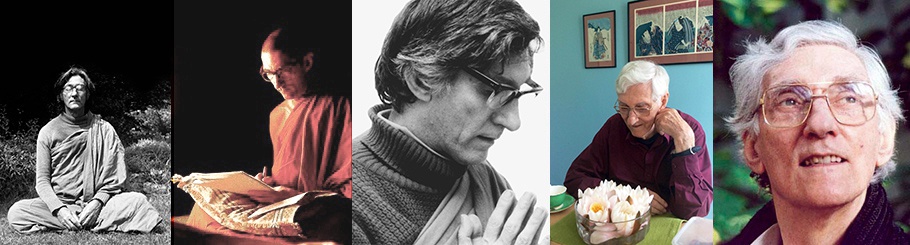
When I was looking for a suitable "Buddhist Poem" to post for today's World Poetry Day Google reminded me of the sad death last October of Sangharakshita, the founder of the FWBO now known as Triratna. A Triratna member, Munisha, posted this poem, "In deep gratitude to my teacher who has given me so much, my favourite of his poems".
INVOCATION
Field-freshening rain,
White night-rain lingering on in drizzles till the dawn,
Pools of bright silver making, birthing streams
In dry clay river-beds, pour down, O rain,
All day, all night, pour down pour down, O rain,
Pour down…
World-welfaring Compassion,
Void-born Compassion diamond-hard and petal-tender,
Peace to wild heartwaves bringing, birthing love
On the low couch of self, pour down, Compassion,
All day, all night, pour down pour down, Compassion,
Pour down –
Pour down like rain on this compassionless
Lost world…
Pour down, pour down, pour down…
From Sangharakshita’s Complete Poems
INVOCATION
Field-freshening rain,
White night-rain lingering on in drizzles till the dawn,
Pools of bright silver making, birthing streams
In dry clay river-beds, pour down, O rain,
All day, all night, pour down pour down, O rain,
Pour down…
World-welfaring Compassion,
Void-born Compassion diamond-hard and petal-tender,
Peace to wild heartwaves bringing, birthing love
On the low couch of self, pour down, Compassion,
All day, all night, pour down pour down, Compassion,
Pour down –
Pour down like rain on this compassionless
Lost world…
Pour down, pour down, pour down…
From Sangharakshita’s Complete Poems
Friday, 23 March 2018
World Poetry Day
I missed putting up something for World Poetry Day on Wednesday so to make up for that I'm reposting this powerful slam performance by award-winning poet George Yamazawa.
In it he recounts his earliest memories of teasing classmates by calling them “gay,” and the reaction he got from his Buddhist father. In rhythmic verse, Yamazawa talks about the power of words as insults and poetry, and the love that Buddhism inspires.
In it he recounts his earliest memories of teasing classmates by calling them “gay,” and the reaction he got from his Buddhist father. In rhythmic verse, Yamazawa talks about the power of words as insults and poetry, and the love that Buddhism inspires.
Tuesday, 21 March 2017
A Buddhist Poem for World Poetry Day
Here's a poem by Kenji Miyazawa – "Strong In The Rain" (Ame ni mo Makezu) for World Poetry Day.
World Poetry Day is today, the 21 March, and was declared by UNESCO (the United Nations Educational, Scientific and Cultural Organisation) in 1999. The purpose of the day is to promote the reading, writing, publishing and teaching of poetry throughout the world and, as the UNESCO session declaring the day says, to "give fresh recognition and impetus to national, regional and international poetry movements".
Strong in the rain
Strong in the wind
Strong against the summer heat and snow
He is healthy and robust
Unselfish
He never loses his temper
Nor the quiet smile on his lips
He eats four go of unpolished rice
Miso and a few vegetables a day
He does not consider himself
In whatever occurs…his understanding
Comes from observation and experience
And he never loses sight of things
He lives in a little thatched-roof hut
In a field in the shadows of a pine tree grove
If there is a sick child in the east
He goes there to nurse the child
If there’s a tired mother in the west
He goes to her and carries her sheaves
If someone is near death in the south
He goes and says, “Don’t be afraid”
If there’s strife and lawsuits in the north
He demands that the people put an end to their pettiness
He weeps at the time of drought
He plods about at a loss during the cold summer
Everyone calls him “Blockhead”
No one sings his praises
Or takes him to heart…
That is the sort of person
I want to be.
Tuesday, 31 January 2017
A Poem That I Like
When I visited the Newport Soto Zen Group the other week Val, one of the group's members, offered a reading from an English rendering of the Satapañcasatka otherwise known as Matrceta's Hymn to the Buddha. The translation is by Ven. S. Dhammika......

In Praise of Benefits Conferred
Just to hear you brings joy;
just to look upon you calms the heart;
your speech refreshes and your teaching frees.
People rejoice at your birth,
they celebrate as you grow,
they benefit from your presence
and sorrow in your absence.
To praise you removes faults,
to recollect you brings joy,
to follow you gives understanding,
to know you purifies the heart.
To approach you brings good fortune,
to serve you gives wisdom,
to worship you dispels fear,
to wait upon you bestows prosperity .
You are a great lake of goodness,
with waters purified by virtue,
surface calmed by meditation
and depths stilled by wisdom.
Your form is a jewel to see,
your speech is a jewel to hear,
your teachings are a jewel to reflect upon.
Truly, you are a mine bearing the jewels of goodness.
You are an island for those swept along by the flood,
a shelter for the stricken,
a refuge for those in fear of becoming,
a resort for those who aspire to liberation.
To, all living beings
you are a useful vessel because of your virtue,
a fertile field because of your perfect fruit,
a true friend because of the benefits you confer.
You are admired for your altruism,
charming for your tenderness,
beloved for your gentleness
and honoured for your many virtues.
You are cherished because of your flawlessness,
delightful because of the goodness of your form and
speech,
opulent because you promote the good of all,
and blessed because you are the abode of virtues.
Thursday, 6 October 2016
National Poetry Day
Back in March we posted some Buddhist poems for World Poetry Day. Well, today is National Poetry Day so here are two poems by one of my favourite British Buddhist poets, Wendy Stern.................
Every day
Every day,
Every day it seems
A raindrop rests in the crook of a fragile willow branch
Outside my window.
Not all day,
But at a precise and special moment
As if by some strange and prearranged agreement.
It is a glow infused with light,
Effortlessly yet magnificently reflecting the early spring sunlight.
Does it cling,
Clutching ferociously with all its might,
Trembling, terrified
Of that which is to come,
That which is yet to face it
As the gentle breeze quivers the surrounding leaves,
Rouses and awakens the freshly formed blossom,
Lightly brushes against your cheek should you notice it?
Or does it rest,
Nestling in its willow branch home
Undisturbed, idle,
Complacent and unbothered even -
Just is?
Will we ever know?
Every day,
Every day it seems
A raindrop rests in the crook of a fragile willow branch
Outside my window.
Trapped on the inside
Life came to me today,
Through my window,
All feathers and passion,
With more colour, intensity, swiftness and determination
Than perhaps I've ever known before.
It perched, finally,
 Trapped on the inside for once,
And it looked at me.
I spoke to it, calming it,
And then I set it free.
Life came to me today,
Trapped on the inside for once.
(Wendy is a Buddhist and poet living in Bristol, in the west of England. For many years she has been completely bedridden, and her poetry therefore comes from this unusual perspective.)
Every day
Every day,
Every day it seems
A raindrop rests in the crook of a fragile willow branch
Outside my window.
Not all day,
But at a precise and special moment
As if by some strange and prearranged agreement.
It is a glow infused with light,
Effortlessly yet magnificently reflecting the early spring sunlight.
Does it cling,
Clutching ferociously with all its might,
Trembling, terrified
Of that which is to come,
That which is yet to face it
As the gentle breeze quivers the surrounding leaves,
Rouses and awakens the freshly formed blossom,
Lightly brushes against your cheek should you notice it?
Or does it rest,
Nestling in its willow branch home
Undisturbed, idle,
Complacent and unbothered even -
Just is?
Will we ever know?
Every day,
Every day it seems
A raindrop rests in the crook of a fragile willow branch
Outside my window.
Trapped on the inside
Life came to me today,
Through my window,
All feathers and passion,
With more colour, intensity, swiftness and determination
Than perhaps I've ever known before.
It perched, finally,
Trapped on the inside for once,And it looked at me.
I spoke to it, calming it,
And then I set it free.
Life came to me today,
Trapped on the inside for once.
(Wendy is a Buddhist and poet living in Bristol, in the west of England. For many years she has been completely bedridden, and her poetry therefore comes from this unusual perspective.)
Monday, 21 March 2016
Some Buddhist Poems for World Poetry Day
Today is World Poetry Day.
One of the main objectives of the Day is to support linguistic diversity through poetic expression and to offer endangered languages the opportunity to be heard within their communities.
The observance of World Poetry Day is also meant to encourage a return to the oral tradition of poetry recitals, to promote the teaching of poetry, to restore a dialogue between poetry and the other arts such as theatre, dance, music and painting, and to support small publishers and create an attractive image of poetry in the media, so that the art of poetry will no longer be considered an outdated form of art, but one which enables society as a whole to regain and assert its identity.

One of the main objectives of the Day is to support linguistic diversity through poetic expression and to offer endangered languages the opportunity to be heard within their communities.
The observance of World Poetry Day is also meant to encourage a return to the oral tradition of poetry recitals, to promote the teaching of poetry, to restore a dialogue between poetry and the other arts such as theatre, dance, music and painting, and to support small publishers and create an attractive image of poetry in the media, so that the art of poetry will no longer be considered an outdated form of art, but one which enables society as a whole to regain and assert its identity.
TODAY
This day is a special day, it is yours.
Yesterday slipped away, it cannot be filled anymore with meaning.
About tomorrow nothing is known.
But this day, today, is yours, make use of it.
Today you can make someone happy.
Today you can help another.
This day is a special day, it is yours.
Vijaya Samarawickama
Shrine Room
Shrine Room
I have no shrine room
There are no flowers
There is no smell of incense burning in the room
There are no candles flickering gently
No meditation stool
No other bodies positioned round me
There is just me
What do I have?
I have a bed beneath me
I have my breath coming in, flowing out
And some, at least, awareness
I have pain in my body
And the cool detachment of moments of mindfulness
May that be enough
May I be well, may I be happy
May I be free from suffering
May I be at peace
Wendy Stern
(Wendy is a Buddhist and poet living in Bristol, in the west of England. For many years she has been completely bedridden, and her poetry therefore comes from this unusual perspective.)
Butsumon - The Gate of the Buddha
Before the mountain and by grace
of nature
I was allowed to realise "Oh!
I am only a child!"
Tendered by spruce and birds
I saw without my usual defences
and endless thinking I know
anything or everything
coming between me
and creation.
Myochi Roko Sherry Chayat
Thursday, 28 January 2016
A Poem that I Like
"Hearing the Gibbons Call in Pa Gorge" by Wen Chao translated by Paul Hansen
 As I lean
On my oar, gazing
At the cloud-line, purity
Emerges, deep and lonely,
From the Gorge.
When the mind
Doesn't have anything
On it, there's no sorrow
Inherent in repeated calls. They bear
The dew where every peak is distant,
Dangle in space where a slice
Of Moon shines
Bright.
Whoever
Hears it like this
Can finish a poem
By dawn.
As I leanOn my oar, gazing
At the cloud-line, purity
Emerges, deep and lonely,
From the Gorge.
When the mind
Doesn't have anything
On it, there's no sorrow
Inherent in repeated calls. They bear
The dew where every peak is distant,
Dangle in space where a slice
Of Moon shines
Bright.
Whoever
Hears it like this
Can finish a poem
By dawn.
Subscribe to:
Posts (Atom)