In a news release, the Buddhist Society of Western Australia (BSWA) announced that Ajahn Brahm (or Ajahn Brahmavamso) has resigned from his post as the Spiritual Director of the organization.
The announcement, signed by Drew Bellamy, Immediate Past President* of BSWA, reads:
I wish to inform you that at tonight’s Society Annual General Meeting, Ajahn Brahmavamso resigned, without notice, from his post as Spiritual Director of the Buddhist Society of Western Australia.
The 2015-2018 Committee has for some time been examining and trying to implement more support (paid or unpaid) and a more efficient organizational structure at the Society in order to reduce the workload of Ajahn Brahm and the Volunteer Committee. Again at this year’s AGM, due to certain members forming a blocking party with proxy votes, we were unable to get changes through to support this aim.
At the end of the AGM, Ajahn Brahm considering his workload and lack of support by members on this issue informed the meeting he felt he had no choice but to resign from the Society.
Ajahn Brahm clarified his resignation in a personal letter published on the BSWA website:
The committee had agreed on a proposal to amend the Constitution of the BSWA to allow the committee to appoint a subcommittee consisting of members of BSWA. At present, the Constitution of the BSWA only allows a subcommittee to be made up of serving committee members. In Ajahn Brahm’s opinion, this increases the workload of existing committee members by excluding non-committee members from helping on a subcommittee. It also increases my own workload, and stops us to tapping the expertise of our current members.
Despite me showing strong support for this amendment and advising the members at the AGM how this will reduce my workload, this proposal was blocked by a small group using proxies which, though legal, was unethical in my opinion. Proxies were, apparently, solicited without giving a balanced explanation of the background to this proposal.
As such, I have decided to step down as the Spiritual Director of BSWA. In practice, this means Venerable Hasapanna will be the Spiritual Director and I will be the Assistant Spiritual Director.
When the Buddha was not heard at Kosambi, He went to the Parileyya Forest for three months. I doubt that the lay members of the BSWA will wait that long to settle this matter.
The sutta that Ajahn Brahm is referencing is the Kosambiya Sutta (MN48) which you can hear him explain below.
Showing posts with label Brahm. Show all posts
Showing posts with label Brahm. Show all posts
Tuesday, 27 March 2018


Tuesday, 30 May 2017
Ajahn Brahm's UK Dhamma Talks Tour
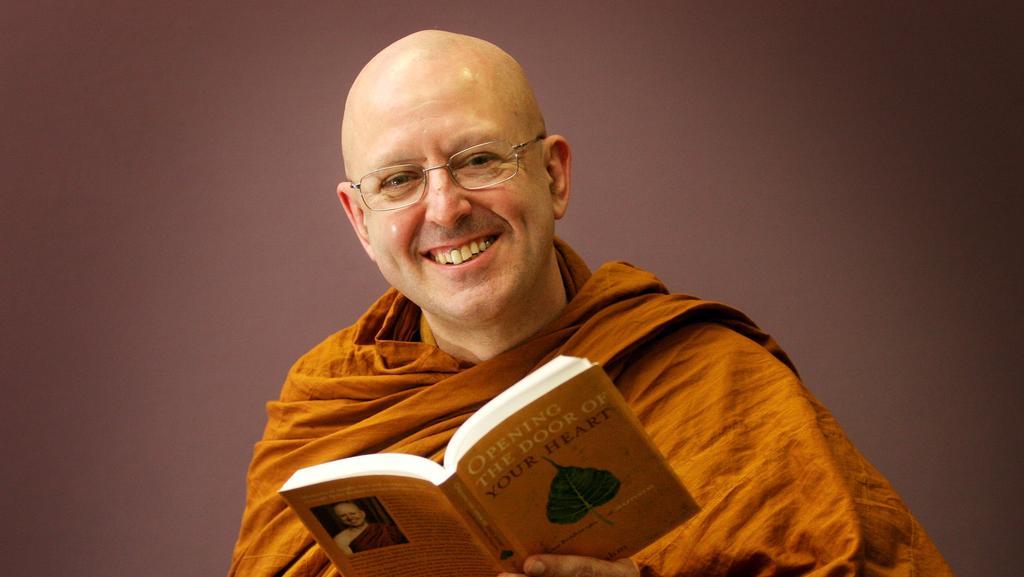 I've just had news of Ajahn Brahm's upcoming "Real Dhamma" UK Tour, starting in October this year. Details are as follows:-
TUE, 10 OCTOBER 7:00 PM -
9:00 PM
Dhamma Talk: “Cultivating Ethics in a Cybernetic Age"
Venue TBA, London, UK.
WED, 11 OCTOBER 3:00 PM - 5:00 PM
Dhamma talk: "A Path With a Laugh"
Cross Street Chapel, Manchester, UK.
WED, 11 OCTOBER 7:00 PM - 9:00PM
Dhamma Talk: “Courage and Authenticity at Work"
Friends Meeting House, Manchester, UK.
THUR, 12 OCTOBER 7:00 PM - 9:00 PM
Dhamma talk: "At Peace With Uncertainty"
Kagyu Samye Dzong, London, UK.
Starting: FRI, 13 OCTOBER 7:00 PM
Non-Residential Weekend Retreat: “Unconditional Mindfulness”
Mary Ward House, London, UK.
The tour is in support of the Anukampa Bhikkhuni Project which aims to promote the teachings and practices of Early Buddhism, through establishing a Bhikkhuni presence in the UK. Their long term aspiration is to develop a monastery for women who wish to train towards full ordination.

Here is an abstract from their latest newsletter........................
ENCOURAGING BEGINNINGS
Since the inspired conception of Anukampa Bhikkhuni Project in Perth, November 2015, joyful steps - often taken in leaps and bounds - are paving the way to make Britain's first bhikkhuni monastery a reality!
Bhikkhuni Canda and and her team are currently organising Ajahn Brahm's second teaching trip to England in consecutive years - a benefit event to build on the significant funds already raised and to further awareness of Anukampa's mission. The tour is entitled "Real Dhamma," because spreading the Dhamma as taught by the Buddha and preserved by the four-fold assembly of bhikkhunis, bhikkhus, laywomen and laymen, lies at the heart of our aspiration and manifests in the compassionate endeavour to increase training opportunities for female monastics.
One of the most uplifting benefits of the project so far has been to witness a dynamic new spiritual community taking shape! People of all nationalifies and from all walks of life have participated, helping us find firm footing. Thanks to them, here are some of our main accomplishments to date:
• February 2016: website (www.anukampaproject.org) gets up and running
• April 2016: ABP becomes a legal entity
• June 2016: ABP's highly active facebook page is born
• October 2016: Ajahn Brahm's unprecedented sell-out UK tour raises around £50,000
• November 2016: Anukampa receives a large, anonymous donation from an overseas supporter, which brings us up to around half the required funds for a modest property.
Fundraising enterprises such as book-selling in Thailand and sponsored head-shaving in Perth (any more takers?!) are ongoing and particularly welcome, as are the increasing number of teaching invitations being extended to Bhikkhuni Canda, by existing Buddhist groups. We are also establishing an "Anukampa Friend's" Dhamma group in London and recently held the second meeting.
On April 12th 2017, Anukampa reached a major milestone, becoming registered as both a religious and an educational charity, which attests to the dedication and commitment of our trustees and key volunteers.
Our immediate next steps focus on building up our team. We recently welcomed a new volunteer book-keeper to assist in our treasury department and are now looking for a webmaster. The services of a lawyer would undoubtedly be very helpful going forward too. We will continue to organise benefit events and also retreats with various monastic teachers. After Ajahn Brahm's 2017 teaching tour, will be looking for more people to help manage the online tour registration system and general administration, working closely with our outreach team.
In the coming year or two, we will experiment with having a temporary base in England for Bhikkhuni Canda and one or two lay guests who will look after her monastic needs. This will enable us to suss out the level of interest in a chosen area, as well as provide a much-needed space from where regular Dhamma talks and discussion groups can be held. When our core team (and accounts!) are mature enough, we will look for suitable properties for the monastery, in a beautiful natural setting. This should be secluded yet not isolated; private yet accessible by public transport. At present, intuition guides us south of and up to an hour and a half from London....but if the right place comes up elsewhere we are open!
(I wonder what they think of the Isle of Wight?)
Friday, 12 August 2016
The First Buddhist Nunnery in the UK & Ajahn Brahm!
At the end of October and early November Ajahn Brahm is giving a series of Dhamma talks here in the U.K.
The teaching tour is entitled "Buddhism in the 21st Century" and is, appropriately, to support the setting up of the UK’s first ever monastery for fully ordained Buddhist nuns known as Bhikkhunis.
The aspiration behind the Anukampa Bhikkhuni Project, as it is called (anukampa means “empathic compassion”) is to help people grow in the Dhamma and to nurture spiritual qualities such as contentment, compassion, wisdom, and peace. The project aims to build a community of like-minded people who wish to practice the teachings of the Buddha, establish a bhikkhuni presence in Britain by responding to teaching invitations and offers of support, and, primarily, to found and develop a harmonious training monastery for bhikkhunis dedicated to the goal of awakening.
The project’s coordinator is British born nun Venerable Canda.
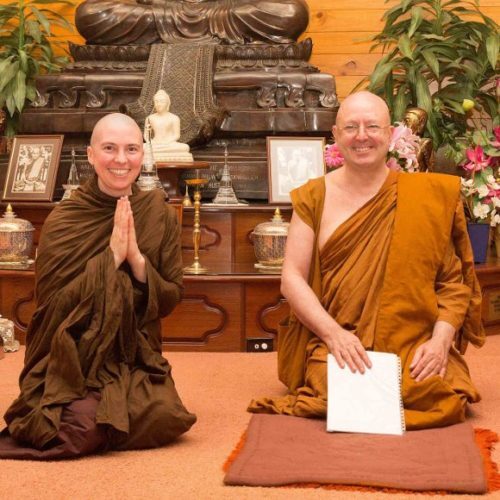
The scheduled tour by Ajahn Brahm, who is also spiritual adviser to the Anukampa Bhikkhuni Project, is the first major fundraising project towards accomplishing these aims, offering a rare opportunity to receive the teachings of Ajahn Brahm in his homeland and to help establish a bhikkhuni presence in the UK.
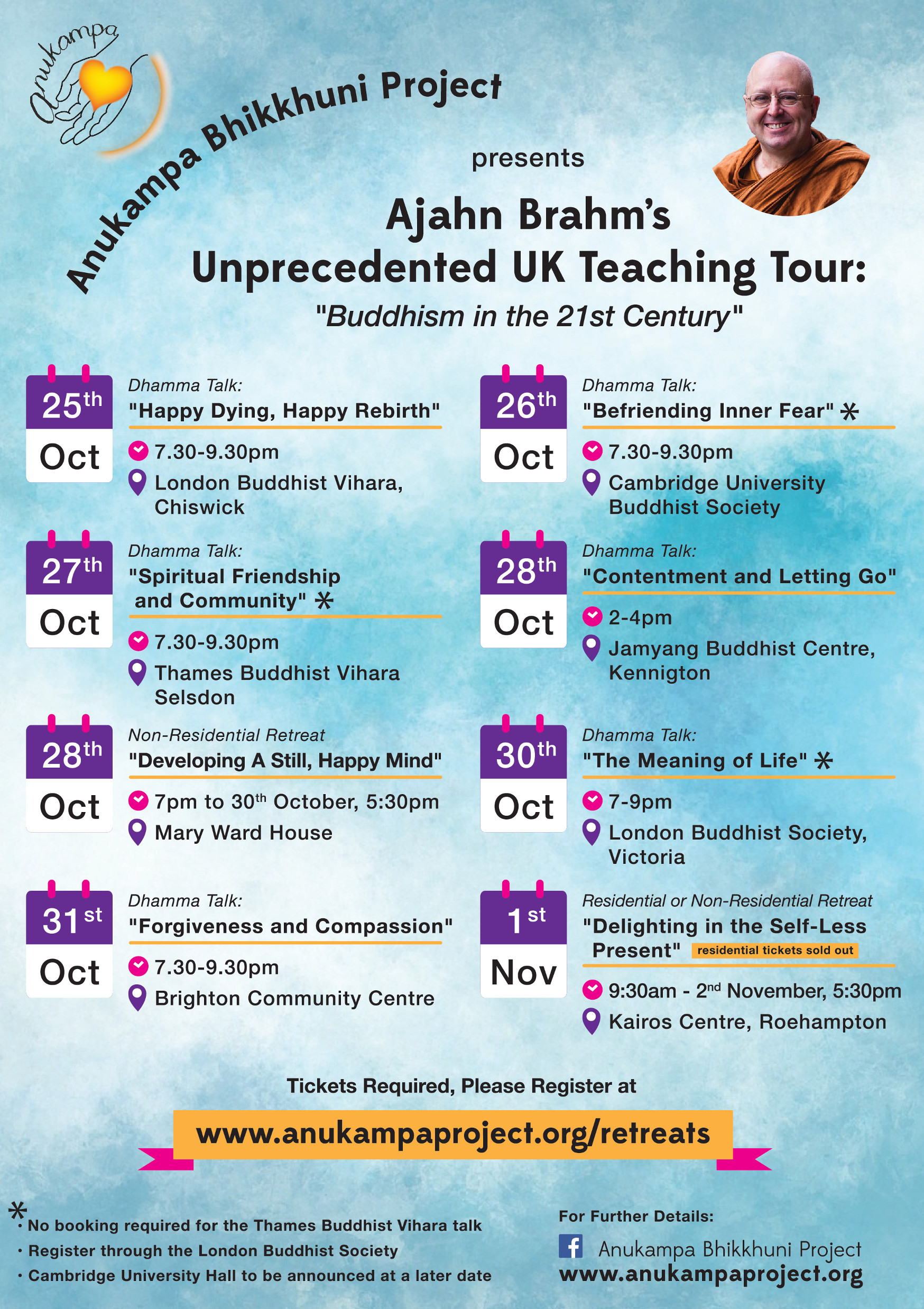
The teaching tour is entitled "Buddhism in the 21st Century" and is, appropriately, to support the setting up of the UK’s first ever monastery for fully ordained Buddhist nuns known as Bhikkhunis.
The aspiration behind the Anukampa Bhikkhuni Project, as it is called (anukampa means “empathic compassion”) is to help people grow in the Dhamma and to nurture spiritual qualities such as contentment, compassion, wisdom, and peace. The project aims to build a community of like-minded people who wish to practice the teachings of the Buddha, establish a bhikkhuni presence in Britain by responding to teaching invitations and offers of support, and, primarily, to found and develop a harmonious training monastery for bhikkhunis dedicated to the goal of awakening.
The project’s coordinator is British born nun Venerable Canda.
Sunday, 13 September 2015
NEW MOON - Storehouse of Goodness
Here and hereafter
those who live their lives well, abide in happiness.
They are filled with a natural appreciation of virtue,
and dwell in delight.

Dhammapada 18
Transformation takes energy. The energy that most of us have in abundance - greed, anger and delusion - is wild and dangerous; uncontained it leads to intolerable suffering. To ‘live life well’ means to build up a storehouse of goodness so that when these wild energies threaten to leak out, we are not overwhelmed. By cultivating such forces of goodness as restraint and wise reflection, we begin to transform this wild energy into something more suitably human: generosity, kindness and understanding. The Buddha describes how this path of practice leads to an abiding filled with delight. Our work is finding the willingness to begin again, however many times we fail.
those who live their lives well, abide in happiness.
They are filled with a natural appreciation of virtue,
and dwell in delight.
Dhammapada 18
Transformation takes energy. The energy that most of us have in abundance - greed, anger and delusion - is wild and dangerous; uncontained it leads to intolerable suffering. To ‘live life well’ means to build up a storehouse of goodness so that when these wild energies threaten to leak out, we are not overwhelmed. By cultivating such forces of goodness as restraint and wise reflection, we begin to transform this wild energy into something more suitably human: generosity, kindness and understanding. The Buddha describes how this path of practice leads to an abiding filled with delight. Our work is finding the willingness to begin again, however many times we fail.
Tuesday, 23 June 2015
International Conference on Buddhist Women Starts Today
 The 14th Sakyadhita International Conference on Buddhist Women starts today in Yogyakarta, Indonesia, running until June 30. Its theme will be “Compassion and Social Justice.”
The organization was founded in 1987 in Bodhgaya, India. Sakyadhita is an alliance of women and men founded at the conclusion of the first International Conference on Buddhist Women, held in Bodh Gaya, where the 14th Dalai Lama was the keynote speaker. The term Sakyadhita means "daughters of the Buddha" and was first used at the conference. The initiative for creating the organization came from Ayya Khema, Karma Lekshe Tsomo, Dr. Chatsumarn Kabilsingh (now Dhammananda Bhikkhuni) and Carola Roloff (now Bhikṣuni Jampa Tsedroen). Currently, Sakyadhita has almost 2000 members in 45 countries around the world. National branches of Sakyadhita have been established in Canada, France, Germany, Korea, Nepal, Taiwan, the United Kingdom, and the United States. New branches are currently being formed in Indonesia, Malaysia, Mongolia, Russia, Spain, and Vietnam.
The conferences are held every two years. This year there will be Scheduled dharma talks by
Ajahn Brahm on “Buddhism with Compassion, Buddhism with Justice” on June the 24
Jetsunma Tenzin Palmo on “The Six Paramitas” on June the 26
and Venerable Thubten Chodron on “Open Heart, Clear Mind" on June the 28.
Thursday, 7 August 2014
Ajahn Brahm on Gay Rights
Here's a short video from Ajahn Brahm in which he responds to a question asked by an audience member about the Buddhist position on LGBTs.
Tuesday, 1 July 2014
Petition in Support of Ajahn Brahm's Banned Speech on Gender Equality
Further to our post "Ajahn Brahm Speech Banned", I have now heard that there is a petition stating that,
"We, the undersigned, are astounded and deeply disappointed by the banning of Ajahn Brahm's paper on gender equality at the 2014 United Nations Day of Vesak (UNDV) conference in Vietnam.
The paper was clearly aligned with the UN’s Millennium Development Goal 3 (Promote Gender Equality and Empower Women), which the UNDV is committed to uphold through its connection with the UN. Moreover, Ajahn Brahm's paper had already been approved for presentation when it was suddenly banned the day before its scheduled presentation.
We value free and open dialogue. We therefore ask that the UNDV, in accordance with Millennium Development Goal 3, promotes dialogue about the participation of women in contemporary Theravada Buddhism by inviting Ajahn Brahm to publicly present his gender equality paper at the next UNDV conference in 2015."

"We, the undersigned, are astounded and deeply disappointed by the banning of Ajahn Brahm's paper on gender equality at the 2014 United Nations Day of Vesak (UNDV) conference in Vietnam.
The paper was clearly aligned with the UN’s Millennium Development Goal 3 (Promote Gender Equality and Empower Women), which the UNDV is committed to uphold through its connection with the UN. Moreover, Ajahn Brahm's paper had already been approved for presentation when it was suddenly banned the day before its scheduled presentation.
We value free and open dialogue. We therefore ask that the UNDV, in accordance with Millennium Development Goal 3, promotes dialogue about the participation of women in contemporary Theravada Buddhism by inviting Ajahn Brahm to publicly present his gender equality paper at the next UNDV conference in 2015."
Please consider signing this important petition.
Friday, 30 May 2014
Ajahn Brahm Speech Banned
Ajahn Brahm, was invited to deliver a speech on Gender Equality at the UN Day of Vesak Convention in Vietnam in May 2014. His speech was banned by the conference organising committee the day before it was due to be given at the Convention. Although Gender Equality is one of the declared UN millennium goals and although Ajahn Brahm’s paper on Gender Equality had been officially accepted for the convention, he was told at the last moment while he was in Vietnam that he would not be allowed to present his paper.
This is Ajahn's response from the following Friday's talk at Dhammaloka (it's audio).............
And here's his banned speech in full.............. !!
Theravada Buddhism and MDG 3:
Gender Equality and the Empowerment of Women in Theravada Buddhism
By Ajahn Brahm
Introduction
On December1 1955, in Montgomery Alabama, an African-American woman refused to obey a bus driver’s order to give up her seat on the bus to a white passenger. That simple act of defiance for the cause of social justice became one of the most important symbols of the modern Civil Rights Movements in the USA. That woman was Rosa Parks. The United States Congress called her “the first lady of civil rights” and “the mother of the freedom movement”. December 1 is commemorated in the US states of California and Ohio as “Rosa Parks Day”. Rosa Parks became a Buddhist before she passed away in 2005 aged 92. One can speculate that this female icon against discrimination chose Buddhism because it is well suited to advancing social justice issues.
In this paper, I will discuss how Buddhism may advance the particular social justice issue of Millennium Development Goal No. 3: Gender Equality and the Empowerment of Women. I will focus on the need for Theravada Buddhism’s current male leadership to clearly demonstrate its own commitment to MDG 3 through acceptance of the bhikkhuni ordination. Only then can it use its considerable influence to make our world more fair, one where people are judged on their character and not on their gender.
This is Ajahn's response from the following Friday's talk at Dhammaloka (it's audio).............
And here's his banned speech in full.............. !!
Theravada Buddhism and MDG 3:
Gender Equality and the Empowerment of Women in Theravada Buddhism
By Ajahn Brahm
Introduction
On December1 1955, in Montgomery Alabama, an African-American woman refused to obey a bus driver’s order to give up her seat on the bus to a white passenger. That simple act of defiance for the cause of social justice became one of the most important symbols of the modern Civil Rights Movements in the USA. That woman was Rosa Parks. The United States Congress called her “the first lady of civil rights” and “the mother of the freedom movement”. December 1 is commemorated in the US states of California and Ohio as “Rosa Parks Day”. Rosa Parks became a Buddhist before she passed away in 2005 aged 92. One can speculate that this female icon against discrimination chose Buddhism because it is well suited to advancing social justice issues.
In this paper, I will discuss how Buddhism may advance the particular social justice issue of Millennium Development Goal No. 3: Gender Equality and the Empowerment of Women. I will focus on the need for Theravada Buddhism’s current male leadership to clearly demonstrate its own commitment to MDG 3 through acceptance of the bhikkhuni ordination. Only then can it use its considerable influence to make our world more fair, one where people are judged on their character and not on their gender.
Wednesday, 2 January 2013
Through the Stained Glass Ceiling, or Not?
Firstly, a happy and secure 2013 to everyone.
Talking of the new year, some things are moving towards change whilst others are struggling to stay the same (the latter an impossibility, according to the Buddha).
So, what's changing. As regular readers of this site will know we have been supportive of the moves towards gender equality within the Buddhist monastic community, particularly as regards the Theravada tradition, but that's not to ignore the wider diminishing of the role, value and status of women across the board when it comes to religion.
Here in the UK the General Synod of the Church of England rejected a revision of canon law which—coming after years of deliberations, defections, redraftings, and often ugly debates—would finally have allowed the appointment of women bishops. Curiously, while this act of potential cultural suicide was taking place in Britain the Anglican Church of Australia had just appointed its fourth female bishop (you might recall that it was also in Australia that Ajahn Brahm facilitated first full bhikkhuni ordination of women in the Forest sangha of Thailand’s most famous meditation master, Ajahn Chah, back in October, 2009).
 Elsewhere; Amid outrage across the Jewish diaspora over a flurry of recent arrests of women seeking to pray at the Western Wall with ritual garments in defiance of Israeli law, Prime Minister Benjamin Netanyahu has asked Natan Sharansky, the chairman of the Jewish Agency, to study the issue and suggest ways to make the site more accommodating to all Jews.
A call for Mormon women to wear trousers to church, begun this month by a small group of women, has stretched across the globe, but not before creating a backlash and even generating death threats.
“Wear Pants (yes, I know it sounds kinky but Americans insist on calling trousers pants) to Church,” an event on Sunday, was meant to draw attention to the role of women in the Church of Jesus Christ of Latter-day Saints, using attire as a symbolic first salvo in a larger struggle over gender inequalities.

Though the Mormon Church has no official policy against women wearing trousers to church, many say they feel peer pressure to wear a dress, particularly in the Western United States, organisers said. So on Sunday, thousands of Mormon women arrived at church in trousers in places like Cambridge, England; Heidelberg, Germany; Austin, Tex.; the Marshall Islands; and Kotzebue, Alaska. A number of the women posted their photos on Facebook and other Web sites. Others said they could not participate because they were fearful of ridicule or reprimand.
I've nothing topical to add to the sad litany of denigrations against women re: the third of the Abrahamic faiths but dogma and culture, as always, seem to have far more influence than anything actually taught by any of these religions' founders.
Talking of the new year, some things are moving towards change whilst others are struggling to stay the same (the latter an impossibility, according to the Buddha).
So, what's changing. As regular readers of this site will know we have been supportive of the moves towards gender equality within the Buddhist monastic community, particularly as regards the Theravada tradition, but that's not to ignore the wider diminishing of the role, value and status of women across the board when it comes to religion.
Here in the UK the General Synod of the Church of England rejected a revision of canon law which—coming after years of deliberations, defections, redraftings, and often ugly debates—would finally have allowed the appointment of women bishops. Curiously, while this act of potential cultural suicide was taking place in Britain the Anglican Church of Australia had just appointed its fourth female bishop (you might recall that it was also in Australia that Ajahn Brahm facilitated first full bhikkhuni ordination of women in the Forest sangha of Thailand’s most famous meditation master, Ajahn Chah, back in October, 2009).
A call for Mormon women to wear trousers to church, begun this month by a small group of women, has stretched across the globe, but not before creating a backlash and even generating death threats.
“Wear Pants (yes, I know it sounds kinky but Americans insist on calling trousers pants) to Church,” an event on Sunday, was meant to draw attention to the role of women in the Church of Jesus Christ of Latter-day Saints, using attire as a symbolic first salvo in a larger struggle over gender inequalities.
I've nothing topical to add to the sad litany of denigrations against women re: the third of the Abrahamic faiths but dogma and culture, as always, seem to have far more influence than anything actually taught by any of these religions' founders.
Tuesday, 31 August 2010
Ajahn Brahm talk on Bhikkhuni Ordination
Don't know how I missed this one, but here is Ajahn Brahm's Opening Talk to the Bhikkhuni Seminar at Santi Forest Monastery back in 2008.
Saturday, 7 August 2010
Ajahn Brahm asks Fellow Monks to "Explain Themselves" on the Question of Bhikkhuni Ordination
Further to a previous posting "The Inequality of Women in Buddhism", I came across an item on Ajahn Sujato's blog where he features a comment by Ajahn Brahm. The comment is in response to a post by Ajahn Sujato on the article in BuddhaDharma, "The Time has Come". This article is the subject of our above mentioned post!
 “What would it look like to relocate the ‘problem’ of bhikkhuni ordination and gender equity within Buddhism to where it really belongs? … with those who fear women’s full participation”
Having read the comments in this thread with interest, as I am inextricably involved, I think they have drifted away from the main thrust of the Buddhadharma magazine article as expressed in the quote above. That is, for too long Ajahn Sujato, myself and the participating Bhikkhunis, have been asked to justify our actions in facilitating the Perth Bhikkhuni ordinations.
Now it is the time for those Western monks, and Thai monks who either live in the West or regularly travel there, to either show their support for Bhikkhuni ordination in the West,or justify their opposition to it.
Ajahn Sumedho is leaving Amaravati at the end of this year, so is the Thai monk Ven Pannyasaro who, I was told, drafted the notorious Five Points. Ajahn Amaro, currently at Abhayagiri Monastery in California, is to take over leadership of the Amaravati group. It seems appropriate that he makes his position on Bhikkhuni ordination clear, in plain English not in Amaravati-speak, to the supporters of his future monastery. Other influential monks such as Ajahn Vajiro of Amaravati, Ajahn Nyanadhammo in Thailand, Ajahn Pasanno of Abhayagiri, the Thai monk Ajahn Preecha in Italy, Ajahn Tiradhammo in New Zealand, the Thai monk Ajahn Anan who visits the West regularly, they should also be pressed by their lay supporters to publicly explain their position, not as a group but as individuals. If they have nothing to be ashamed of, they should have no fear in articulating their position in public clearly and independently. I ask this because I understand that straightforward honesty, not deafening silence, is necessary for moving forward on this painful issue.
Unfortunately, I do not have the power to compel these good monks to explain whatever position they hold on Bhikkhuni ordination, or to question them on why they refused my genuine offer of forgiveness and reconciliation. But you, the lay people who feed these monks and provide the funds that support their other needs, do have that power. Maybe it is the time to exercise that power.
It is now the time, as a result of The Buddhadharma magazine’s article, for them to personally explain themselves to the Buddhist world.
With Mega Metta, Ajahn Brahm.
Having read the comments in this thread with interest, as I am inextricably involved, I think they have drifted away from the main thrust of the Buddhadharma magazine article as expressed in the quote above. That is, for too long Ajahn Sujato, myself and the participating Bhikkhunis, have been asked to justify our actions in facilitating the Perth Bhikkhuni ordinations.
Now it is the time for those Western monks, and Thai monks who either live in the West or regularly travel there, to either show their support for Bhikkhuni ordination in the West,or justify their opposition to it.
Ajahn Sumedho is leaving Amaravati at the end of this year, so is the Thai monk Ven Pannyasaro who, I was told, drafted the notorious Five Points. Ajahn Amaro, currently at Abhayagiri Monastery in California, is to take over leadership of the Amaravati group. It seems appropriate that he makes his position on Bhikkhuni ordination clear, in plain English not in Amaravati-speak, to the supporters of his future monastery. Other influential monks such as Ajahn Vajiro of Amaravati, Ajahn Nyanadhammo in Thailand, Ajahn Pasanno of Abhayagiri, the Thai monk Ajahn Preecha in Italy, Ajahn Tiradhammo in New Zealand, the Thai monk Ajahn Anan who visits the West regularly, they should also be pressed by their lay supporters to publicly explain their position, not as a group but as individuals. If they have nothing to be ashamed of, they should have no fear in articulating their position in public clearly and independently. I ask this because I understand that straightforward honesty, not deafening silence, is necessary for moving forward on this painful issue.
Unfortunately, I do not have the power to compel these good monks to explain whatever position they hold on Bhikkhuni ordination, or to question them on why they refused my genuine offer of forgiveness and reconciliation. But you, the lay people who feed these monks and provide the funds that support their other needs, do have that power. Maybe it is the time to exercise that power.
It is now the time, as a result of The Buddhadharma magazine’s article, for them to personally explain themselves to the Buddhist world.
With Mega Metta, Ajahn Brahm.
Tuesday, 20 July 2010
A Visit to Chithurst & a Letter from Perth


Saturday, 8 May 2010
BuddhaDharma & Women's Ordination


The first full bhikkhuni ordination of women in the Forest sangha of Thailand’s most famous meditation master, Ajahn Chah, had taken place on October 22, 2009, in Perth in Western Australia................. Like a cork popped from a tight bottle, this initiative has added momentum to the painstaking work toward gender equality in this Buddhist community. However, in the process it has inadvertently challenged the core of Thai monastic authority, which refuses to accept the validity of Theravada bhikkhuni ordination............
The Seventeenth Gyalwang Karmapa stunned an international audience in Bodhgaya last winter by making an unprecedented declaration of commitment to ordaining women as bhikshunis in the Tibetan Buddhist tradition. Asked when there would be bhikshuni ordination in the Tibetan tradition,he leaned forward and said, in English, “I will do it.”...........
Bringing back full ordination is a crucial step for women’s full participation within Buddhism as it is practiced today. However, it is only one step toward achieving gender equality within Buddhism. With due inquiry, there can remain no doubt that the impulse to resist women’s full participation in the Buddhist tradition comes not from the teachings of the Buddha, but from ignorance.........
See the FULL PREVIEW HERE

Thursday, 21 January 2010
On Gratitude - On Message
Tuesday, 12 January 2010
Wat Pah Pong Attack on Ajahn Brahm & Bodhinyana Monastery
The latest post on Ajahn Sujato's blog describes the latest move by Wat Pah Pong to undermine Ajahn Brahm. It makes for sad reading but does put the record straight on many of the side issues of, for example, the "ownership" of Bodhinyana monastery.

The post is "Letter to Perth Thai Community from the BSWA".
Saturday, 2 January 2010
Wat Pah Pong's response to article on “Monks Target Western Clergy”
Wat Nong Pah Pong has issued a press statement, to the Thai media, to "clear-up any mis-understandings" of it's position on "disobedient Western monks."
 Although this matter has been cleared up within the Thai press, it seems that the article in English has stirred up and agitated Western readers. This has been caused by some misrepresentations of the events of the press conference and the editorial language used in the article. Wat Nong Pah Pong feels that it is best to clear up these misunderstandings.
The article says that the Thai Sangha “want the properties of Thai temples in the West to come under the ownership of the Thai Sangha to ensure complete control.” In reality, Wat Nong Pah Pong stated in the press conference that it had no power in which to retake ownership of Bodhinyana Monastery, even if the land on which it was built on was initially offered to Ajahn Chah (Bodhinyana Thera) and Wat Nong Pah Pong. Wat Nong Pah Pong requested the Office of National Buddhism to reevaluate the way that monasteries in the West are governed so that confusion and division such as with the present situation would be avoided in the future.
The most misleading section is where it is written that “If action is not taken, the council fears that more women could be ordained in the West,” and quotes Phra Kru Opaswuthikorn saying that "Sooner or later, we'll see female monks everywhere."
Although this is a sensational statement in the eyes of a Western reader, a more accurate translation would be, “If we (Wat Nong Pah Pong) had not taken any action, it would open the doors in the future for women to ordain as bhikkhunis within the Wat Nong Pah Pong western sangha, running into the same problem we have at the moment (breaking Thai law)”. The issue is not that Wat Nong Pah Pong is against women ordaining, but rather due to Wat Nong Pah Pong’s status as a member of the Thai Sangha and its obligation to follow Thai Sangha Laws.
Further, this article’s portrayal of facts is to be questioned. It cites that “two women” were ordained, instead of the four women which were actually ordained.
In conclusion, we would like readers of this article to be wary of the editorial sensationalism and misrepresentations that have been given to this press release. It was originally intended to reply to the questions the Thai media had on Wat Nong Pah Pong’s stance in relation to the present situation with Ajahn Brahmavamso and Bodhinyana Monastery’s status, not a gender equality and power-seizing issue that it has been made into.
But while we're at it, lets have a look at some of the statements made during the meeting to expel Ajahn Brahm, one Thera stated, "If I go and do this, and you go and do that, and everybody does what they want, then what will happen? This plot [of yours] was a ten year plan; a plan to destroy the Buddhist religion. I have been to many spots (plots?) and I can tell one from another. And I can tell what you are doing fits right into the plot. You have been roused through many different methods to destroy Buddhism."
Read More..............
 Although this matter has been cleared up within the Thai press, it seems that the article in English has stirred up and agitated Western readers. This has been caused by some misrepresentations of the events of the press conference and the editorial language used in the article. Wat Nong Pah Pong feels that it is best to clear up these misunderstandings.
The article says that the Thai Sangha “want the properties of Thai temples in the West to come under the ownership of the Thai Sangha to ensure complete control.” In reality, Wat Nong Pah Pong stated in the press conference that it had no power in which to retake ownership of Bodhinyana Monastery, even if the land on which it was built on was initially offered to Ajahn Chah (Bodhinyana Thera) and Wat Nong Pah Pong. Wat Nong Pah Pong requested the Office of National Buddhism to reevaluate the way that monasteries in the West are governed so that confusion and division such as with the present situation would be avoided in the future.
The most misleading section is where it is written that “If action is not taken, the council fears that more women could be ordained in the West,” and quotes Phra Kru Opaswuthikorn saying that "Sooner or later, we'll see female monks everywhere."
Although this is a sensational statement in the eyes of a Western reader, a more accurate translation would be, “If we (Wat Nong Pah Pong) had not taken any action, it would open the doors in the future for women to ordain as bhikkhunis within the Wat Nong Pah Pong western sangha, running into the same problem we have at the moment (breaking Thai law)”. The issue is not that Wat Nong Pah Pong is against women ordaining, but rather due to Wat Nong Pah Pong’s status as a member of the Thai Sangha and its obligation to follow Thai Sangha Laws.
Further, this article’s portrayal of facts is to be questioned. It cites that “two women” were ordained, instead of the four women which were actually ordained.
In conclusion, we would like readers of this article to be wary of the editorial sensationalism and misrepresentations that have been given to this press release. It was originally intended to reply to the questions the Thai media had on Wat Nong Pah Pong’s stance in relation to the present situation with Ajahn Brahmavamso and Bodhinyana Monastery’s status, not a gender equality and power-seizing issue that it has been made into.
But while we're at it, lets have a look at some of the statements made during the meeting to expel Ajahn Brahm, one Thera stated, "If I go and do this, and you go and do that, and everybody does what they want, then what will happen? This plot [of yours] was a ten year plan; a plan to destroy the Buddhist religion. I have been to many spots (plots?) and I can tell one from another. And I can tell what you are doing fits right into the plot. You have been roused through many different methods to destroy Buddhism."
Read More..............
Wednesday, 30 December 2009
Wat Pah Pong moves to Punish Western Monks!
 The latest move by Wat Pah Pong sees a move away from just a "parting of the ways" between themselves and Ajahn Brahm over the issue of female ordination. Now they are accusing Ajahn Brahm of temple mismanagement with a view to "reclaiming" Bodhinyana, "in order to return the land and temple to the Thai Buddhists and to ensure that the temple management is in line with Dhamma Vinaya." As the land also houses Dhammasara Nuns Monastery, this would obviously mean bringing them "back into line!"
Bodhinyana was founded on the 1st of December 1983 near the small town of Serpentine, located 55 kilometres south of Perth, the capital of Western Australia. Donations to support and grow the monastery have come from all directions, much of it Australian and Singaporean in origin, so any claims from Thailand are now extremely tenuous.
These moves come in a statement from Phra Kru Opaswuthikorn who presided at a press conference on Monday where he urged the Office of National Buddhism and the Council of Elders to issue rules and regulations to empower the Thai Sangha to punish monks overseas who violate the Sangha's mandates.
Read more here.....
"Sooner or later, we'll see female monks everywhere!" said Phra Kru Opaswuthikorn. He added that the introduction of the Siladhara order, or 10-precept nuns, which was set up by the most senior Western monk, Ajahn Sumedho, as an alternative to female monks in Thailand was also unthinkable.
Tuesday, 22 December 2009
Bhikkhuni Ordination - the Propaganda War Hots Up

For other "takes" on the issue I would recommend Ajahn Sujato's Blog and, on Facebook, the Women and the Forest Sangha Group. Also Ajahn Punnadhammo's Bhikkhu's Blog for a balanced view.
Monday, 14 December 2009
WAM statement on Bhikkhuni Ordination
Here is the statement from the latest gathering of Western elders of the Ajahn Chah Sangha (referred to informally as WAM) which took place from the 7-9th December 2009 at Wat Pah Nanachat, in Ubon, Northeast Thailand. The gathering was attended by some twenty-eight elders, including Ven. Ajahn Sumedho, abbot of Amaravati Buddhist Monastery in England, the senior Western disciple of Ajahn Chah. Luang Por Liem, the abbot of Wat Pah Pong, (Ajahn Chah's monastery) gave the opening address.

The gathering this year was dominated by discussion of the "unfortunate" events surrounding the delisting of Bodhinyana Monastery in Perth, Western Australia from the Ajahn Chah Sangha, and the estrangement of an old friend and erstwhile member of the group, Ajahn Brahmavamso (for ordaining women).
The events of the last two months have caused an unprecedented storm in our communities, both monastic and lay, and feelings of division have run high throughout the wider Buddhist world. Evidence of this was clear in a petition and various letters presented to the gathering. Several elders noted how many familiar names appeared in the documents. Sympathy with the feelings expressed in them was mixed with a regret that they were often based on an interpretation of events that differed markedly from our own. There was a sense of frustration that we had not as yet been able to adequately transmit our understanding of the various issues raised, accompanied by an acknowledgment that it was hard to see how it could have been any other way. Our commitment to the principle of consultation and consensus meant that we had no choice but to delay crafting a coherent response until we could come together as a group and discuss the matter face to face.
It might be worthwhile at this point to give a brief overview of the nature of our Sangha. The first thing that must be said is that the Ajahn Chah Sangha is far from being the monolithic Vatican-like entity that some have portrayed it as.

The gathering this year was dominated by discussion of the "unfortunate" events surrounding the delisting of Bodhinyana Monastery in Perth, Western Australia from the Ajahn Chah Sangha, and the estrangement of an old friend and erstwhile member of the group, Ajahn Brahmavamso (for ordaining women).
The events of the last two months have caused an unprecedented storm in our communities, both monastic and lay, and feelings of division have run high throughout the wider Buddhist world. Evidence of this was clear in a petition and various letters presented to the gathering. Several elders noted how many familiar names appeared in the documents. Sympathy with the feelings expressed in them was mixed with a regret that they were often based on an interpretation of events that differed markedly from our own. There was a sense of frustration that we had not as yet been able to adequately transmit our understanding of the various issues raised, accompanied by an acknowledgment that it was hard to see how it could have been any other way. Our commitment to the principle of consultation and consensus meant that we had no choice but to delay crafting a coherent response until we could come together as a group and discuss the matter face to face.
It might be worthwhile at this point to give a brief overview of the nature of our Sangha. The first thing that must be said is that the Ajahn Chah Sangha is far from being the monolithic Vatican-like entity that some have portrayed it as.
Sunday, 6 December 2009
Chithurst Visit and the Bhikkhuni Issue
Today, Sunday, the West Wight Sangha and the Newport Soto Zen group had planned another visit to Chithurst monastery. Unfortunately we had to cancel as we couldn't get enough people together to share out the ferry cost for the mini bus and make it individually affordable. That said there was some concern as to what the "atmosphere" at the monastery would be like given the on-going "Bhikkhuni Ordination" controversy.
Yesterday the subject was raised. I have joined the Facebook group "Women and the Forest Sangha" and Patrick Butler posted to it.......

"THAT" issue was finally broached at Chithurst Puja tonight. Ajahn Upekka, on a visit from her life out of the monastery was allowed to give the Dhamma talk by Aj Karuniko (sorry if I spell wrongly).

Never mind the subject matter, it was THE most moving talk I've ever heard from that chair. And the subject matter made it all the more powerful. Simply, after heartfelt thanks to the Sangha for her 24 years of learning and practice,the plea "please don't waste your time dividing people into men/women, us/them. Seek TRUE Dhamma, not adherence to superficial form. Strive for compassionate loving kindness for ourselves and all others.
Sadly some monks could not bring themselves to chant "Sadhu" . But there was electricity among the small and (coincidentally) mainly male lay audience.
Thank you to wonderful Aj Karuniko, for allowing this speech at a difficult time for the whole Sangha.
Yesterday the subject was raised. I have joined the Facebook group "Women and the Forest Sangha" and Patrick Butler posted to it.......


Sadly some monks could not bring themselves to chant "Sadhu" . But there was electricity among the small and (coincidentally) mainly male lay audience.
Thank you to wonderful Aj Karuniko, for allowing this speech at a difficult time for the whole Sangha.
Subscribe to:
Posts (Atom)