Showing posts with label UN. Show all posts

Tuesday, 11 December 2018

70th Anniversary of UN Declaration of Human Rights

The Universal Declaration of Human Rights reaches its 70th anniversary today, a chance to highlight the many important breakthroughs brought about by the landmark UN document, and a reminder to the world that the human rights of millions are still being violated on a daily basis.

Thanks to the Declaration, and States’ commitments to its principles, the dignity of millions has been uplifted, untold human suffering prevented and the foundations for a more just World have been laid.


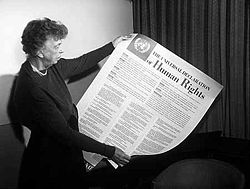
(Eleanor Roosevelt and UNs Universal Declaration of Human Rights (1949))

Michelle Bachelet, the UN High Commissioner for Human Rights, said in a statement released on Wednesday that the document has gone from being an “aspirational treatise” to a set of standards that has “permeated virtually every area of international law.”
  • All people are born free and equal, because they have reason and conscience.
  • Everyone has a right to life, liberty, and security of their person. 
  • Everyone should be protected from any kind of discrimination. 
  • Everyone has a right to have a nationality and change one's nationality. Everyone has a right to an education. 
  • Everyone has a right to get a job. 
  • Everyone has a right to vote and take part in the government of one's own country. 
  • Everyone has a right to take part in cultural life—to choose a way of life. 
  • No person may be tortured, or treated in a cruel or unkind way. 
  • Everyone has the right to seek and gain asylum from persecution. 
  • Everyone has a right to have ideas or opinions, to decide what is right and what is wrong, and to choose a religion. 
  • Everyone has a right to speak or write freely and the right to join a peaceful group to express one's opinion. 
  • Everyone has a right to security if suffering unemployment, disease, disability, old age or loss of a partner. 
  • Everyone has duties to the community where one's personality can be developed freely. 
  • No one can abuse the rights to destroy the freedom or rights in this Declaration.

Tuesday, 21 March 2017

A Buddhist Poem for World Poetry Day

Here's a poem by Kenji Miyazawa – "Strong In The Rain" (Ame ni mo Makezu) for World Poetry Day.


Strong in the rain
Strong in the wind
Strong against the summer heat and snow
He is healthy and robust
Unselfish
He never loses his temper
Nor the quiet smile on his lips
He eats four go of unpolished rice Miso and a few vegetables a day
He does not consider himself
In whatever occurs…his understanding
Comes from observation and experience
And he never loses sight of things
He lives in a little thatched-roof hut
In a field in the shadows of a pine tree grove
If there is a sick child in the east
He goes there to nurse the child
If there’s a tired mother in the west
He goes to her and carries her sheaves
If someone is near death in the south
He goes and says, “Don’t be afraid”
If there’s strife and lawsuits in the north
He demands that the people put an end to their pettiness
He weeps at the time of drought
He plods about at a loss during the cold summer
Everyone calls him “Blockhead”
No one sings his praises
Or takes him to heart…
That is the sort of person I want to be.


World Poetry Day is today, the 21 March, and was declared by UNESCO (the United Nations Educational, Scientific and Cultural Organisation) in 1999. The purpose of the day is to promote the reading, writing, publishing and teaching of poetry throughout the world and, as the UNESCO session declaring the day says, to "give fresh recognition and impetus to national, regional and international poetry movements".

Wednesday, 21 September 2016

International Day of Peace

Today is the United Nations International Day of Peace.


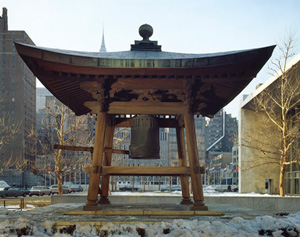
The day is marked by the striking of the Japanese Peace Bell. Traditionally, the Bell is rung twice a year. It is tolled on the first day of Spring at the time of the vernal equinox, in celebration of the annual Earth Day ceremony initiated by Earth Day Founder, John McConnell. 

It is also tolled on every opening day of the UN General Assembly's yearly session in September, coinciding with the International Day of Peace established by the General Assembly in 1981. This occasion is observed by the Secretary-General.


The bell tower was modelled after the Hanamido (a small temple decorated with flowers) that symbolises the place where Buddha was born.

Monday, 16 May 2016

Wesak in the West Wight

This month, the night of the 21st and morning of the 22nd mark the first full moon of May. This has been designated by the United Nations as the international Day of Wesak to acknowledge the contribution that Buddhism, one of the oldest religions in the world, has made for over two and a half millennia and continues to make to the spirituality of humanity.

Wesak is the Buddhist festival that commemorates the Buddha's birth, awakening and final passing and is celebrated by millions of Buddhists around the world on the day of the first full Moon of May.

This year we will be celebrating Wesak here in the West Wight from 12:00 midday to 2:30ish on Sunday the 22nd (usual format of bringing vegetarian food to share). All Buddhists and friends and family are welcome.

Monday, 21 September 2015

It's World Peace Day, Honest

Now I seem to have almost missed this but today is World Peace Day. What with all the ceasefires being declared and peace treaties being signed, the universal dancing in the streets and all those swords being beaten into ploughshares it's amazing but I really didn't notice the significance of the date.


Each year the International Day of Peace is observed around the world on 21 September. The United Nations General Assembly has declared this as a day devoted to strengthening the ideals of peace, both within and among all nations and peoples. The theme of this year’s commemoration is “Partnerships for Peace – Dignity for All” which aims to highlight the importance of all segments of society to work together to strive for peace.

So it is opportune that the Dalai Lama has given his blessing to a new course of evening classes, available across the UK, promising to make participants happier… and the world a better place.

The eight-week course, designed by the Action for Happiness organisation, claims to be scientifically proven to increase life satisfaction, mental well being, compassion and social trust.

Entitled Exploring What Matters, the classes will be free - although organisers do ask for a donation to cover costs. Hundreds of people have already volunteered to host the course in locations across the UK.

Launching the course today, on World Peace Day, the Dalai Lama said he was delighted to see the "work being done to create a happier and more caring society".

"I wholeheartedly support the Exploring What Matters course and hope that many thousands of people will benefit from it and be inspired to take their own action to help create a happier world," he said. During the course, local groups explore a series of questions including "What really matters in life?", "What really makes us happy?" and "How can we create a happier world?".

Better get a move on as the world ends day after tomorrow.................................

Wednesday, 14 May 2014

Wishing Everyone a Happy Wesak

Today millions of Buddhists celebrate Vesak or Wesak Day, an officially recognised United Nations (UN) holiday that celebrates the birth of siddhartha Gautama, the founder of Buddhism.

People in Theravada countries also celebrate the triple anniversary of Lord Buddha - his birth, his attaining of Enlightenment and his passing away into Nirvana all of which are said to have occurred on the first full moon of May. Also known as the Buddhist Festival of Light, colourful bamboo framed lanterns adorn the interior of every home and incredible luminous displays decorate the streets of most towns.


Vesak is a commemorative occasion which calls for restraint and immersion in the true philosophy of Buddhism. And in this drawing away from mundane life and immersing oneself in the Dhamma or Teaching, is happiness that no material possession or sense-motivated activity can bring. One has to experience it through meditation to realise the depth and intensity of the joy that is there for the taking by the truly dedicated Buddhist.

As the sun sets, devotees partake in processions and return to the temples in the evening to hear monks read stories from sacred texts.

Monday, 31 March 2014

Japan Told to Stop Whaling

Breaking news!!!!!

The United Nation's top court has ordered Japan to stop its annual whale hunt in the Antarctic.


"Japan shall revoke any existant authorisation, permit or licence granted in relation to Jarpa II [research programme] and refrain from granting any further permits in pursuance to the programme," the International Court of Justice's Judge Peter Tomka said.

Japan had argued that the suit brought by Australia, in May 2010, was an attempt to impose its cultural norms on Japan.

But Canberra said since 1988 Japan has slaughtered more than 10,000 whales under the programme, allegedly putting the Asian nation in breach of international conventions and its obligation to preserve marine mammals and their environment.

In its application before the world court, Australia accused Japan of failing to "observe in good faith the zero catch limit in relation to the killing of whales".

Meanwhile, here in the UK, The Tory Government was considering amending the Hunting Act, which would have made it almost impossible to enforce, signalling a return to hunting with dogs "by the back door".


However, thanks to a public outcry at the news, the Government has announced it will not now attempt to do this. Mr. Cameron in Prime Minister's Questions on Wednesday 26 March said that the Government has dropped plans to amend the Hunting Act on the issue of the number of dogs that can be used in "exempt hunting".

A growing number of Conservative MPs had warned David Cameron that he risked losing the Commons vote if he pushed ahead with what they believed was an attempt to weaken the ban on hunting to woo rural voters away from Ukip.

Thursday, 8 August 2013

Ayya Khema and the Coincidence

At our Sangha meeting this Tuesday evening members were trawling through our library and the subject of books by Ayya Khema came up.

In the World of strange coincidences (they're only strange if we notice them), I was checking the traffic to this site this morning and noticed that a visitor from Japan had Googled "ayya khema united nations address" and had got a hit to a post on this site from 2008. It was entitled "Talks by Ayya Khema" and detailed a website selling audio tapes of her talks. I corrected the post with the news that all of Ayya Khema's recorded talks have now been digitalised and can be downloaded for free from Dharma Seed.

As to her books, we are fortunate to have the following titles in our collection:-

Being Nobody, Going Nowhere, Meditations on the Buddhist Path,
When the Iron Eagle Flies, Buddhism for the West,
Who is myself?, A guide to Buddhist meditation,
Come and See for Yourself, The Buddhist Path to Happiness,
Be an Island, The Buddhist practice of Inner Peace,
Visible here and now,
I Give You My Life, her autobiography

Ayya Khema was born in Berlin in 1923 to Jewish parents. In 1938, she escaped from Germany with two hundred other children and was taken to Glasgow, Scotland. Her parents went to China and, two years later Ayya Khema joined then in Shanghai. With the outbreak of the war, however, the family was put into a Japanese prisoner-of-war camp and it was here her father died. She later married, had a son and a daughter, and now has four grand-children.

Four years after the American liberation of the camp, Ayya Khema was able to emigrate to the United States. Between 1960 and 1964 she travelled with her husband and son throughout Asia, including the Himalayan countries, and it was at this time she learned meditation. Ten years later she began to teach meditation throughout Europe and Australia. Her experiences led her to become a Buddhist nun in Sri Lanka in 1979, when she was given the name of 'Khema' (Ayya means Venerable) meaning safety and security.

She helped to establish Wat Buddha-Dhamma, a forest monastery in the Theravada tradition, near Sydney, Australia, in 1978. In Colombo she set up the International Buddhist Women's Centre as a training centre for Sri Lankan nuns, and the Parappuduwa Nun's Island at Dodanduwa. (now unfortunately closed). She was the spiritual director of Buddha-Haus in Germany, established in 1989 under her auspices. In June 1997 "Metta Vihara", the first Buddhist forest monastery in Germany, was inaugurated by her, and the first ordinations in the German language took place there.

In 1987 she co-ordinated the first international conference of Buddhist nuns in the history of Buddhism, which resulted in the setting-up of Sakyadhita, a worldwide Buddhist women's organisation. H.H. the Dalai Lama was the keynote speaker at the conference. In May 1987, as an invited lecturer, she was the first ever Buddhist nun to address the United Nations in New York on the topic of Buddhism and World Peace. 

She died in November 1997.............................

Friday, 21 September 2012

International Day of Peace

Today is the U.N. International Day of Peace. Each year the International Day of Peace is observed around the world on 21 September. The General Assembly has declared this as a day devoted to strengthening the ideals of peace, both within and among all nations and peoples.


This year, world leaders, together with civil society, local authorities and the private sector, will be meeting in Rio de Janeiro, Brazil for the United Nations Conference on Sustainable Development to renew political commitment to long term sustainable development.

It is in the context of the Rio+20 Conference that “Sustainable Peace for a Sustainable Future” is the theme chosen for this year's observance of the International day of Peace.

There can be no sustainable future without a sustainable peace. Sustainable peace must be built on sustainable development.

Wednesday, 11 July 2012

World Population Day

With today being World Population Day it's good news to hear that the U.K. government is to pledge to donate more than £1 billion to help family planning services in the developing world.


In a bid to help 24 million girls and women in the world's poorest countries, British aid will be doubled for eight years, International Development Secretary Andrew Mitchell announced.

Reproductive health problems remain the leading cause of ill health and death for women of childbearing age worldwide. Some 222 million women who would like to avoid or delay pregnancy lack access to effective family planning. Nearly 800 women die every day in the process of giving life. About 1.8 billion young people are entering their reproductive years, often without the knowledge, skills and services they need to protect themselves.

As the world population reached 7 billion people this year (up from 2.5 billion in 1950), it has had profound implications for development. A world of 7 billion is a challenge with implications on sustainability, urbanization, access to health services and youth empowerment.

Monday, 19 March 2012

The Buddha in Kenya

Now this is a bit different......
 
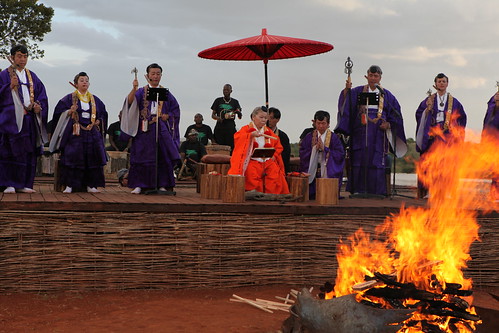
Two tall Samburu warriors light the fire for the World Peace ceremony in Kenya in front of a reclining Buddha statue.


The 10th anniversary of the UN Global Peace Initiative of Women (GPIW) was celebrated in Laikipia, Kenya earlier this month.

The Global Peace Initiative has a three-fold focus: Deepening inter-religious dialogue; leadership training for youth and raising environmental concerns. It also aims to raise awareness of global issues such as climate change, environmental degradation, poverty and conflict.


Following the lighting of the fire a Fire and Water ceremony was performed by Her Holiness Shinso Ito head of the Shinnyo-en school of Japanese Buddhism. The ceremony created by Shinso Ito is based on an ancient fire ritual (Homa) performed in various forms in Hindu, Tibetan and Japanese Buddhist and Jain traditions.

Wednesday, 29 February 2012

Civilisation faces ‘perfect storm of ecological and social problems’

Celebrated scientists and development thinkers warn that civilisation is faced with a perfect storm of ecological and social problems driven by overpopulation, overconsumption and environmentally malign technologies.

In the face of an “absolutely unprecedented emergency”, say the 18 past winners of the Blue Planet prize – the unofficial Nobel for the environment – society has “no choice but to take dramatic action to avert a collapse of civilisation. Either we will change our ways and build an entirely new kind of global society, or they will be changed for us”.

The stark assessment of the current global outlook by the group, who include Sir Bob Watson, the government’s chief scientific adviser on environmental issues, US climate scientist James Hansen, Prof José Goldemberg, Brazil’s secretary of environment during the Rio Earth summit in 1992, and Stanford University Prof Paul Ehrlich, is published today on the 40th anniversary of the foundation of the UN Environment Programme (UNEP). The paper, which was commissioned by UNEP, will feed into the Rio +20 earth summit conference in June.

 “The current system is broken,” said Watson. “It is driving humanity to a future that is 3-5C warmer than our species has ever known, and is eliminating the ecology that we depend on for our health, wealth and senses of self.”

"Many of the earth´s habitats, animals, plants, insects and even micro-organisms that we know to be rare may not be known at all by future generations. We have the capability and the responsibility to act; we must do so before it is too late." The Dalai Lama

The paper urges governments to:

• Tackle overconsumption in the rich world, and address population pressure by empowering women, improving education and making contraception accessible to all.

• Conserve and value biodiversity and ecosystem services, and create markets for them that can form the basis of green economies.

• Replace GDP as a measure of wealth with metrics for natural, built, human and social capital – and how they intersect.

• Eliminate subsidies in sectors such as energy, transport and agriculture that create environmental and social costs, which currently go unpaid.

• Transform decision-making processes to empower marginalised groups, and integrate economic, social and environmental policies instead of having them compete.

• Invest in knowledge through research and training.

Saturday, 1 October 2011

7,000,000,000 of Us!

Sometime this month, a baby will be born who will take the global population above seven billion for the first time, and in all probability that birth will take place in China or India, the two countries with more than a billion inhabitants.

The United Nations has fixed October 31 as the date of the fateful birth, but events have so often proved demographers wrong in the past that the expectation is that it will be sooner rather than later.


The rate of population growth has soared over the course of recorded history: when the Buddha was born,
there are thought to have been less than 300 million people on earth. The billion-mark was reached only after 1800, but as a measure of just how fast global population is growing, the sixth billionth living person—Bosnian Adnan Nevic—is only 11!

Current predictions are that by 2050 or so, the world population will reach nine billion, essentially adding two Chinas to the number of people alive today.

Those billions will be seeking food, water and other resources on a planet where, scientists say, humans are already shaping climate and the web of life.

CIA director Michael Hayden recently identified one of the biggest threats facing the U.S., something that occurs over 215 million times a day — sex.

“Population is the essential multiplier for any number of human ills," Hayden said recently. He said overpopulation in the poorest parts of the world is causing global political instability and extremism, climate change, and the food and fuel crises.

Soon India Will Take The Lead From China in population growth.

From The Hindu:

It’s also clear that the proportions will shift between the continents, driven by high birth rates in Asia and Africa. Soon India, with 1.2 billion currently, will take the lead from China, with 1.3 billion, as the world’s most populous nation..

Nigeria, Africa’s most populous country today with 162 million, will see its population increase to almost 750 million by the middle of the century.

Another example: highly industrialised Germany and developing Ethiopia each have a little more than 80 million people. In another 40 years, there will probably be 174 million Ethiopians, while Germany’s population will decline to 72 million.
And the industrialised world is ageing rapidly.

This also means that relations of political power will change.

Can We Support A Population Of Seven Billion?

Can the planet Earth really support seven billion people? With some 1.5 billion people already living on less than $1.25 a day, nearly one billion people hungry and the natural world already heavily damaged, are we humans destroying ourselves?

With increasing pressure on land, food and energy sources, many believe that there will be wars between neighbouring countries over water and land.

Wednesday, 21 September 2011

International Peace Day

Today is International Peace Day.

The International Day of Peace ("Peace Day") provides an opportunity for individuals, organizations and nations to create practical acts of peace on a shared date. It was established by a United Nations resolution in 1981 to coincide with the opening of the General Assembly. The first Peace Day was celebrated in September 1982.

In 2002 the General Assembly officially declared September 21 as the permanent date for the International Day of Peace.

By creating the International Day of Peace, the UN devoted itself to worldwide peace and encouraged all of mankind to work in cooperation for this goal. During the discussion of the U.N. Resolution that established the International Day of Peace, it was suggested that:

"Peace Day should be devoted to commemorating and strengthening the ideals of peace both within and among all nations and peoples…This day will serve as a reminder to all peoples that our organization, with all its limitations, is a living instrument in the service of peace and should serve all of us here within the organization as a constantly pealing bell reminding us that our permanent commitment, above all interests or differences of any kind, is to peace."

Since its inception, Peace Day has marked our personal and planetary progress toward peace. It has grown to include millions of people in all parts of the world, and each year events are organized to commemorate and celebrate this day. Events range in scale from private gatherings to public concerts and forums where hundreds of thousands of people participate.

Anyone, anywhere can celebrate Peace Day. It can be as simple as lighting a candle at noon, or just sitting in silent meditation. Or it can involve getting your co-workers, organization, community or government engaged in a large event. The impact if millions of people in all parts of the world, coming together for one day of peace, is immense.

International Day of Peace is also a Day of Ceasefire – personal or political. Take this opportunity to make peace in your own relationships as well as impact the larger conflicts of our time. Imagine what a whole Day of Ceasefire would mean to humankind.

Tuesday, 17 May 2011

Wesak, the 2,600th Anniversary of the Buddha's Awakening!

Today, on the full moon of May two thousand six hundred years ago, Siddhartha Gautama awoke to the reality of existence and became the Buddha, the fully awakened one. This is celebrated by the festival of Wesak which in many schools of Buddhism also marks the Buddha's birth and death all traditionally having occurred on the first full moon of May.


A single day lived
with conscious intention and wisdom
is of greater value than a hundred years lived devoid of discipline and manifest wisdom.

Dhammapada verse 111

The best gift we can offer the Buddha on his birthday is to live this day wisely. We all know the consequences of living according with
preferences: we feel divided, not whole. When conditions conspire to be agreeable we lose ourselves in the happiness we have gained; when conditions become disagreeable we despair over what we have lost.
Wisdom ‘sees’ both gain and loss - wisdom sustains the awareness which makes us free.

With Metta,

Bhikkhu Munindo

(this is the Buddha's enlightenment as portrayed in the film "Little Buddha")


West Wight Sangha will be celebrating Wesak with fellow Buddhists from the Island wide Sangha this coming Sunday, the 22nd, from mid-day.

Wednesday, 11 May 2011

Ten Buddhist Monks Allowed into North Korea

Last Wednesday, the 4th, ten Buddhist monks arrived in North Korea with government approval to bring essential drugs for the population.

The venerable monks from the Jogye Order spent a day in North Korea, entering the border region near Mount Kumgang. The ten monks visited Singye, one of the oldest Buddhist temples in all of Korea, located in the north, at the foot of the mountain. Inside the temple, they did not see any pictures of Kim Jong-il, or his father, Kim Il-sung, an exceptional circumstance since every place of worship in North Korea is usually used to venerate the two dictators. The Jogye Order had planned to hold a joint service at Singye Temple with its North Korean counterpart, but it had to cancel the plan after the North Korean government disapproved.

The monks gave a village chief more than 100,000 anthelmintic tablets to kill parasitic worms. Many North Koreans suffer from these because of poor nutrition and a lack of facilities for good hygiene.

According to the Food and Agriculture Organisation and the World Health Organisation, North Koreans have the worst diet and healthcare in the world.

“What struck me the most was the temple visit. We did not see any of the regime’s symbols but saw those of our faith,” one of the monks said. “Although there were no worshippers, it is clear that someone is keeping the place clean and in order. This filled by heart with hope because it means that there are still some Buddhists in North Korea, even if they are hiding.”

(The picture is of the the Woljong Temple, I couldn't find a decent one of Singye)

Friday, 22 April 2011

Happy Earth Day

Today is Earth Day! This year, Earth Day's theme is themed after A Billion Acts of Green: a people-powered campaign to generate a billion acts of environmental service and advocacy before Rio +20.

The largest living system on earth…is earth. That is a simplified version of the Gaia hypothesis, first posited by scientists James Lovelock and Lynn Margulis in the 1970s. The idea is that both organic beings and inorganic matter have evolved to operate together as a single, living system that self-regulates, with the goal of allowing life to persist and thrive.

The Gaia hypothesis has gained credence with scientists in the intervening decades, and it has been "upgraded" from "hypothesis" to "theory", i.e., other scientists have conducted research and experiments to verify or extend its tenets. Whether Theory or Hypothesis, it's a beautiful idea with some hard edged consequences. Lovelock's theory challenges the world view, propagated by some faiths, that the Earth was put here for humans' use. Lovelock writes, "The concept of Gaia, a living planet, is for me the essential basis of a coherent and practical environmentalism; it counters the persistent belief that the Earth is a property, an estate, there to be exploited for the benefit of humankind. This false belief that we own the Earth, or are its stewards, allows us to pay lip service to environmental policies and programs but then continue with business as usual."

Buddhist Perspectives on Gaia; Gaian Perspectives on Buddhism

Since the early days of Gaia Theory, its connection with Buddhist thought has been widely remarked,

Monday, 4 April 2011

Sense after the Book Burning

Following on from the Qu'ran burning story this piece from Reuters shows the intelligent alternative to the bigotry of pastor Jones' Dove World Outreach Centre church.

Islamic countries have set aside their 12-year campaign to have religions protected from “defamation”,
allowing the U.N. Human Rights Council in Genea to approve a plan to promote religious tolerance on Thursday, March the 24th. Western countries and their Latin American allies, strong opponents of the defamation concept, joined Muslim and African states in backing without vote the new approach that switches focus from protecting beliefs to protecting believers.

Since 1998, the 57-nation Organisation of the Islamic Conference (OIC) had won majority approval in the council and at the United Nations General Assembly for a series of resolutions on “combating defamation of religion”. Critics said the concept ran against international law and free speech, and left the way open for tough “blasphemy” laws like those in Pakistan which have been invoked this year by the killers of two moderate politicians in Pakistan. They argued that it also allowed states where one religion predominates to keep religious minorities under tight control or even leave them open to forced conversion or oppression.

But Pakistan, which speaks for the OIC in the rights council, had argued that such protection against defamation was essential to defend Islam, and other religions, against criticism that caused offence to ordinary believers. Islamic countries pointed to the publication of cartoons depicting the prophet Mohammed in Denmark in 2005, which sparked anti-Western violence in the Middle East and Asia, as examples of defamatory treatment of their faith that they wanted stopped. However, support for the fiercely-contested resolutions — which the OIC had been seeking to have transformed into official U.N. human rights standards — has declined in recent years.

The new three-page resolution, which emerged after discussions between U.S. and Pakistani diplomats in recent weeks, recognises that there is “intolerance, discrimination and violence” aimed at believers in all regions of the world. Omitting any reference to “defamation”, it condemns any advocacy of religious hatred that amounts to incitement to hostility or violence against believers and calls on governments to act to prevent it.

The U.S.-based Human Rights First campaign group said the new resolution was “a huge achievement because…it focuses on the protection of individuals rather than religions” and put the divisive debates on defamation behind. However, diplomats from Islamic countries have warned the council that they could return to campaigning for an international law against religious defamation if Western countries are not seen as acting to protect believers.

Wednesday, 9 March 2011

Women's Day Celebrations - but no Bishops! (or Bhikkhunis)

Yesterday was the centenary of International Women's Day. Each year around the world, International Women's Day (IWD) is celebrated on March 8. Hundreds of events occur not just on this day but throughout March to mark the economic, political and social achievements of women.

Organisations, governments and women's groups worldwide choose different themes each year that reflect global and local gender issues. This year the global theme was "Equal access to education, training and science and technology: Pathway to decent work for women." Last year it was "Equal rights, equal opportunities: Progress for all."

Today 600 Anglicans are officially leaving the Church of England in protest at the decision to ordain women as bishops.

So it's not just Buddhists adhering to medieval traditional Asian cultural norms who deny women's equality.

The "justification" offered by the those leaving the Church of England is that they are convinced the Bible teaches that male headship is what God wills, both in individual families, and in the family of the Church. They point to passages such as 1 Corinthians 11:13 - "The head of every man is Christ, and the head of the woman is man, and the head of Christ is God."

"For us in Reform we see the Bible teaching so clearly the leadership of men - in a loving way," says the Rev Paul Dawson, the group's media officer.

"We have to say OK, we can live with working alongside women leading local churches though we think it's not ideal. But once you have women in a very public leadership role within the Church then we have to say 'That's gone beyond the line.'"

UN support for the rights of women began with the Organization's founding Charter.  Among the purposes of the UN declared in Article 1 of its Charter is “To achieve international co-operation … in promoting and encouraging respect for human rights and for fundamental freedoms for all without distinction as to race, sex, language, or religion.”

Sunday, 28 November 2010

Wikileaks, Truth & Right Speech

It is error alone which needs the support of government. Truth can stand by itself. ~Thomas Jefferson

So Wikileaks have done it again and are putting America's dirty laundry out for all to see. Wikileaks bases it's raison d'etre on Article 19 of the Universal Declaration of Human Rights which states, "Everyone has the right to freedom of opinion and expression; this right includes freedom to hold opinions without interference and to seek, receive and impart information and ideas through any media and regardless of frontiers".

But, in Buddhist terms, are these revelations "Right Speech"? Right, or skillful speech is the third of the eight path factors in the Noble Eightfold Path, it is speech that does not harm another being. "And what is right speech? Abstaining from lying, from divisive speech, from abusive speech, and from idle chatter: This is called right speech."

The key point here is that of divisive speech and does the "fault" lie with those who "spoke" it and/or with those who repeat it? From a Buddhist perspective, intention is all important. Is there an intention to harm in either the original comments or in the reporting of them?

"One should speak only that word by which one would not torment oneself nor harm others. That word is indeed well spoken.

"One should speak only pleasant words, words which are acceptable (to others). What one speaks without bringing evils to others is pleasant."

"Truth is indeed the undying word; this is an ancient verity. Upon truth, the good say, the goal and the teaching are founded."

Vangisa