Sunday, 18 November 2007

New Video Talks

If you look to the right, near the middle of the "green" column, you will see a strip of video stills which when clicked on will display the video in the top of the "posting" column. NOTE: YOU NOW NEED TO GO TO OUR VIDEO PAGE FOR ANY VIDEO AND FILM-STRIPS.

We're starting to change these for new speakers on a regular basis and to continue the Isle of Wight theme the first new speaker is Ajahn Jayasaro who was born on the Island!
Venerable Ajahn Jayasaro - The Biography


Ajahn Jayasaro was born on the Isle of Wight in 1958. He joined Ajahn Sumedho’s community for the Rains Retreat as an anagarika in 1978. In November of that year he left for Wat Pa Pong in Northeast Thailand where he ordained as a novice in the following year, and as a bhikkhu in 1980 with Venerable Ajahn Cha as his preceptor. From 1997 until 2002 Ajahn Jayasaro was the Abbot of Wat Pa Nanachat. He is now living alone in a hermitage at the foot of Kow Yai mountains.

Thursday, 15 November 2007

Another Isle of Wight

I recently came across this article about Wat Pasantidhamma Buddhist temple in Isle of Wight County Virginia USA. I knew we had a namesake for the Island in the states but never thought of it's having it's own Buddhist community........ neat!


A different path

BY JOY BUCHANAN, Daily Press, January 18, 2005

Carollton, VA.(USA) -- The wet gravel crunched underfoot as worshippers walked from their cars through the parking lot of the Buddhist temple Sunday night.Milky white smoke from logs burning in metal drums hung low in the damp, cold air, carrying the scent of pine through the courtyard.
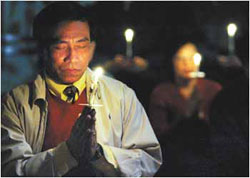
<< Charus Boonrung, a member of the Wat Pasantidhamma Buddhist temple in Isle of Wight County, meditates Sunday night during a candlelight vigil for tsunami victims and survivors.


At Wat Pasantidhamma, the people had gathered for a candlelight vigil to offer compassion to the victims and survivors of the tsunamis that have killed more than 160,000 people in Asia and Africa. Members of the congregation organized a simultaneous vigil with four temples in New York, Washington, Pennsylvania and New Mexico.
"The people who died have died. We cannot bring them back," Phramaha Saman Methawee, one of the temple's five monks, said in an interview before the vigil. "How we respond to death is to look at our lives. Are we living the right way? Are we doing the right things?"
The candlelight vigil, an American tradition, at a Buddhist temple is a symbol of Buddhism's pliability - it is an ancient philosophy that shuns materialism and encourages meditation, chanting and reflection, but its principles adapt to life in a modern, technological world.
Just before 5 p.m. Sunday, more than 70 people filed past the temple office and into the worship area. Some people sat in dark wooden chairs. Others folded their legs and sat on the thick, red carpet. Some bowed to the four, giant, golden Buddha statues sitting in the lotus position on platforms before them. Tony McDaniel, a 34-year-old Thailand native who briefly served as a monk at the temple, spoke through a microphone, explaining the order of the service. Behind him, the five monks sat on a platform with their legs folded, dressed in traditional saffron robes.
The most senior monk, Phramaha Udom Papunggaro, led the first chant. The rhythm of the Thai words buzzed from the monk's chest to his throat and hummed through the speakers.
Afterward, McDaniel instructed the people to close their eyes and meditate. Intermittently, an older man would stand to pound the black gong hanging in the corner. The deep, hollow sound reverberated through the temple. Latecomers scrambled to find a seat some held conversations in the hallway. A few people in the temple coughed or shifted loudly in their seats.
"You hear sound, but let it pass like the wind," McDaniel said. "Keep your thoughts concentrated on the idea of compassion."
While a few of the visitors had difficulty meditating for 15 minutes, the monks sat silently, undistracted. It is a skill they practice daily.
The temple and the monks' home sit on an unpaved portion of Chapman's Lane in Carrollton. The temple is surrounded by trees, bare in the winter, some felled by Hurricane Isabel. Standing in the courtyard, you can hear the tinkling wind chimes on the temple roof and rumbling trucks downshifting on Brewers Neck Boulevard, but you can't see anything beyond the trees.
The monks rise before 5 a.m. and start their days with an hour of group meditation followed by an hour of chanting. They lead a chanting service for the public in Pali, the sacred language of Theravada Buddhism. They eat once before noon and only what visitors offer them. They are not allowed to ask for food or anything else.
The monks spend most of the afternoon working. Daily, they brush the sandy ground leading to the three meditation refuges outside the temple - Buddha Land, Dhamma Land and Sangha Land, which represent the man, the teaching and the community. Last week, on a warm Thursday afternoon, they used shovels to lay a gravel path from the parking lot to their new home beside the temple. They also maintain a Web site, answer e-mail and phone calls and prepare a monthly newsletter sent to about 1,200 recipients.
Inside the monks' new house, visitors walk past the kitchen, complete with a microwave and water cooler and bottles of Starbucks Frappuccino brought by visitors. The library is in an open space with a soft, cream-colored carpet. There, the monks and visitors can sit at a black, wooden table and read some of the Thai books on the Buddha or browse through the copy of "JavaScript for Dummies."
If you want to learn more about Buddhism, the monks have cassettes and CDs available as well - in English and Thai. While Saman Methawee led a tour of the temple, a cell-phone rang and vibrated deep in the folds of his robe. He continued to speak as though he didn't notice it at all.
"Buddhism is not a religion. It is a way of life. You can apply it to your life," he explained about the incongruity of a monk and a cell phone. "Use technology, don't be a slave to technology. We use it to make our minds happy - to live without fear or worry."
Like focusing on breathing rather than sipping air into a chest tight with frustration about an unresponsive printer or a frozen computer screen.
"Hell and heaven are in our minds," Saman Methawee said. "When you think bad things, bad things happen to you. If you think good things, good things happen. The best way to take care of the future is to care for the here and now."

Click HERE for their website.
 
I particularly like the way that the location is described as being "in rural Isle of Wight" ... just like us!

Sunday, 28 October 2007

New Blog Features


Newly entered at the top of the right-hand column you will see our latest addition, a collection of Meditation Timers. Clicking the link takes you to the hosting site where you will see all of the files listed in a "media player".... select and play OR, if you look below the media player, you can download the "Whole Item" or the individual "Audio Files" to your own PC, pick the "VBR" version for a faster download. (Note: when playing reduce the volume to a gentle level for best effect)

Our other new additions (at the top of the blue, right hand column) are two subscription options so that you can keep up to date with new postings to the blog. Firstly we have an email notifier whereby you receive an email from FeedBurner whenever there is an update. We also have an RSS feed for those with an aggregator reader, which also has a link at the end of the address box.

Wednesday, 24 October 2007

Further to Group Discussion on Awareness of the Breath

Herein are a collection of talks by Thanissaro Bhikkhu that Sangha members might like to peruse following our general look at meditation techniques.


Powered by ScribeFire.

Friday, 12 October 2007

New Blog Feature

Over at the top of the right-hand column of this blog you will see our latest feature "View available MP3 Talks" this links directly to an online version of our Dharma Talks Catalogue.

We have a huge number of Dharma talks in MP3 format from such teachers as the Dalai Lama, Jack Kornfield, Myoshin Kelley, Joseph Goldstein, Stephen Batchelor, Ayya Khema, Steve Armstrong..... And literally hundreds of others. We have Zen, Vipasanna, Tibetan and Theravadan speakers and others not so easily pigeon holed, like Alan Watts.

Please note that the catalogue is due for updating in the new Year and we already have a large amount of talks which are not yet listed!

Anyone from one of the other Buddhist groups on the Island is welcome to copies of selected talks, if you're interested contact me or leave contact details in the comments at the bottom of this posting (they are moderated, so will not show to the general public!). Other visitors to the blog who might be interested should also leave their details and we'll see what we can do.

Tuesday, 9 October 2007

Burma Petitions

Hello

I wanted to offer a few personal reflections on events in Myanmar/Burma: more particularly to say something about the responses that are being encouraged. For the sake of brevity, and underlining that these are personal views, I’ll just make two points: one of the petitions had a sentence saying something like, ‘We pledge to hold you to account’ – well, I think that’s coercive. Fostering a retributive state of mind is to call on the power mode of being, the opposite of what the Buddha as the way to freedom from suffering. Of course, one might consider that, intentionally exercising power in horrible ways against unarmed people, the authorities are in fact setting up causes for their own suffering. To take any comfort from this view of others having suffering coming is not skilful! To say that I pledge to get my own back is still to threaten the use of power. However, the Amnesty International letter doesn’t fall into the trap of joining in trading with the regime’s power-based currency. You can find it at http://web.amnesty.org/pages/mmr-270907-action-eng

My other point also leads towards the Amnesty International website (as a starting-point). Am I the only one to be a bit uneasy with all this rallying to a Buddhist-linked cause? What about Darfur, China, Uganda? I would like to find that my practice leads me to stand with humans suffering horribly, whether they’re Buddhist or not. It just seems a bit tribal that Buddhists support Buddhists and don’t go on to highlight the range of horrible extremes of suffering around the globe about which we can pretty simply express our opinions. This has been a prompt to me to be more active in Amnesty letter-writing and not to flinch from the more disturbing aspects of the cruelty that Amnesty addresses. Hands-up, though: I could do more to get around to actually writing those letters, so am in no position to feel comfortable here.

What do others think?

Click on "Comments" below

palaka

Friday, 5 October 2007

To the Himalayas


Last year (2006) Val from the Newport Soto Zen group and her husband Alex undertook a hike into the foothills of the himalayas. What follows is Val's account of their visit with some amazing photos.


Kangchenjunga and the Singalila Ridge Trek, October 2006
Community Action Treks Ltd.


Community Action Treks was founded by Doug Scot, who reached the summit of Everest in 1975 with Dougal Haston. Money raised from these trekking holidays is used to provide schools, health centres, employment and clean water supplies for villages in Nepal.

We spent 24 days with a group of experienced travellers and mountaineers and were looked after very well by Raja of “Adventure Mania” (based in Kolkata) assisted by two teams of porters from Nepal and Sikkim. Accommodation ranged from the best hotels to wooden huts and camping. We initially flew to Kolkata and then from there to Bagdogra in northern West Bengal, from there driving to Darjeeling. After walking on jeep tracks on the Singalila Ridge which runs along the border with Nepal. We then drove to Sikkim (now part of India) where we walked up to 4 900m at Goecha La pass 5Km from Kangchenjunga, the world's third highest mountain.

Most of the people Alex and I met were Indian Hindus, Nepalese porters and Buddhists from Tibet.

Highlights of the tour.

We saw Kangchenjunga for the first time at dawn in Darjeeling. The peaks appear above cloud level and seem to belong to the sky instead of rising from the earth.

We visited many Buddhist monasteries, both of the Gelukpa (yellow hat school) and Nyingmapa schools (the oldest of the four major Tibetan schools). They were well maintained each with approximately 50 monks and a school for the young novices. Prayer wheels set in the outer walls with the interior walls being painted with bright colours from floor to ceiling. At the front a large Buddha statue would be flanked by statues of important Bodhisattvas. Eventually we discovered that we could go upstairs in the monasteries where plainer rooms and libraries could be seen. We could often hear the monks chanting in a separate room off of a courtyard. Only once did I get to talk to one of the monks, who had very good English.

Whilst staying in a small hilltop village I was very lucky to sit with a small group of monks who were chanting and performing rituals for a sick, elderly lady. Although I couldn't talk to them it was a great joy to sit with them chanting and observe the preparations for ancient ceremonies, using rice to create pictures on paper laid on the floor. Tiny models of people and yaks were then placed on top of the rice picture.

Another joy was to see the long strips of colourful prayer flags in the mountains and small towns. We saw a ceremony in which new prayer flags were placed at Tenzing Norgay's grave.


The mountain roads were very dangerous and like the vehicles , were continually being repaired. They are often closed during the monsoon season when it is particularly dangerous for the children walking to school.

The poverty and density of the crowds were a culture shock in Kolkata, it's very difficult to travel in the city without a guide.

Valerie & Alex