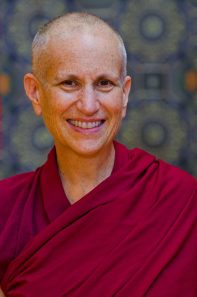
In Plum Village a devoted team of monastic attendants are continuing to support him and care for him 24 hours a day, under the guidance of visiting doctors and nurses. He is receiving on-site physical therapy and speech therapy, and it is hoped that being back in his "spiritual home" will provide favourable conditions to treat his hemiparesis and allow him to make progress in swallowing and recovering his speech.
Tuesday, 7 April 2015
Good News! Thich Nhat Hanh returns to Plum Village to Recuperate
The medical team at the University Hospital in Bordeaux have given their approval for Thich Nhat Hanh to leave the rehabilitation clinic and return to his Hermitage at Plum Village. Thay was hospitalised for four and half months after he experienced a severe brain hemorrhage last November.
In Plum Village a devoted team of monastic attendants are continuing to support him and care for him 24 hours a day, under the guidance of visiting doctors and nurses. He is receiving on-site physical therapy and speech therapy, and it is hoped that being back in his "spiritual home" will provide favourable conditions to treat his hemiparesis and allow him to make progress in swallowing and recovering his speech.
Friday, 3 April 2015
FULL MOON - Dilemmas
Dilemmas
Silence does not denote profundity
if you are ignorant and untrained.
Like one holding scales,
a sage weighs things up,
wholesome and unwholesome,
and comes to know both the inner and outer worlds.
Therefore the sage is called wise.
Dhammapada v. 268 – 269
How can we know whether we should act or not act? When faced with a dilemma, the challenge is how to stay tuned to what our heart says, at the same time as being fully open to life’s complexity. Reverting to quietude could be a form of avoidance, but it might also be exactly what is called for. Our outer world is fraught with injustice and inequality; naturally we want to help. Engaged action could be our response, or it might be silent contemplation. It is essential that our decision to act or not act arises out mindful consideration, not out of aversion, and as always, in accord with our precepts.
Silence does not denote profundity
if you are ignorant and untrained.
Like one holding scales,
a sage weighs things up,
wholesome and unwholesome,
and comes to know both the inner and outer worlds.
Therefore the sage is called wise.
Dhammapada v. 268 – 269
How can we know whether we should act or not act? When faced with a dilemma, the challenge is how to stay tuned to what our heart says, at the same time as being fully open to life’s complexity. Reverting to quietude could be a form of avoidance, but it might also be exactly what is called for. Our outer world is fraught with injustice and inequality; naturally we want to help. Engaged action could be our response, or it might be silent contemplation. It is essential that our decision to act or not act arises out mindful consideration, not out of aversion, and as always, in accord with our precepts.
Thursday, 2 April 2015
Should Buddhists Vote?
With the General Election now “only” five weeks away I felt that it was an opportune moment to forward an emailed article that I received from a Sangha member a while back. It is entitled “Should Buddhists Vote?” and is by Thubten Chodron.The article was written from an American perspective in relation to the 2012 U.S. Presidential Election. I have taken the liberty of changing “Democrat” to “Labour” and “Republican” to “Conservative” and substituting a well known British personality for an unheard of American one to make the piece compatible with the U.K. situation (for the original article click HERE).
I’ll also take this opportunity to restate our editorial policy re: politics. "It is Not the purpose of this site to campaign on political issues, however as a Buddhist site we will continue to promote peace and the welfare of all beings by any appropriate non-violent means".
When the Buddha established the Sangha, the monastic community, each person ordained ten years or more was considered sufficiently informed about monastic lifestyle and precepts and was thus accorded a voice when the assembly met to decide important matters. Extending this by analogy to present circumstances, Buddhists who are informed citizens should vote. By sharing our knowledge, voting is one way to contribute to the welfare of society.
A common misunderstanding exists that the Buddha wanted his followers to leave society. This is incorrect. Where can we ever live where we are entirely disconnected from other living beings? In a monastery, in a Dharma centre, in a family, we are always in relationship to those immediately around us as well as to the broader society and to all sentient beings. Even in a remote hermitage, we still live in relationship with each and every living being. Our challenge is to make this relationship a healthy one, physically, verbally, and mentally. With a pure motivation, voting and being politically active can be ways of sharing our vision, and values with others, in an attempt to stop harm and create happiness in society.
The challenges of being an informed voter and a wise citizen are many. For example, how do we keep abreast of current issues without being swept away by the media blitz? How can we learn enough to make wise choices without becoming involved in trivial affairs or allowing attachment and anger arise towards candidates and their views? This involves discipline on our part. We need to have a wise relationship with the media, knowing how much we can handle, discerning media excesses, and halting our infatuation, distraction, and addiction to TV, radio, newspapers, and the Internet. We only develop this balance by examining our own minds, and by trial and error in our daily lives.
Another challenge is forming wise views without clinging to them as part of our ego identity. “I am a Labour supporter,” “I support affirmative action.” We can all too easily solidify these labels into identities that we then feel compelled to defend. How can we have views and yet make sure our minds are tolerant of others who hold opposing ones? Sometimes it seems to me that some Western Buddhists expect all other Western Buddhists to have similar political views. A woman in our centre had to remind us during a discussion on compassion and politics, that she was a Buddhist and a Conservative.
We must also be mindful not to make the opposition party and its candidates into solid figures that we then disapprove of, ridicule, fear, and even hate. One person once said to me, “I have compassion for almost everyone, but don’t know how to have compassion for Conservatives.” If, in the name of caring about the welfare of all sentient beings, we condemn those who hold different views, we have adopted their mental state: we help our friends (those who agree with our opinions) and are hostile to our enemies (those who have different views). Much meditation is necessary to separate people from their views, knowing that although someone’s views may seem harmful, those people still have the Buddha potential. Repeatedly re-forming our attitudes is required to develop equanimity towards all.
How do we use Buddhist values to inform our political decisions? Or do we first decide what we believe and then select a quotation from the Buddha to validate our opinion? For example, one person could say, “The Buddha believed that people should make their own decisions and be responsible for them. Therefore, as a Buddhist, I am pro-choice.” Another person could say, “The Buddha said killing is a destructive action. Therefore, as a Buddhist, I oppose abortion.” In other hot social and political issues, similar things occur.
Yet another challenge lies in choosing compassionate methods to accomplish our political and social goals. For example, do we boycott Chinese goods and oppose China having Most Favoured Nation status because we want freedom for Tibet? Many people do, yet His Holiness the Dalai Lama opposes such action because it will harm the average Chinese who is not responsible for the government policy on Tibet. As a supporter of freedom for Tibet, do we ban together with Russell Brand who advocates a “free Tibet” and opposes China, but also tells us not to vote?
By now, we have found ourselves deep in questions. Each of us must spend quiet time in reflection, looking at our own mind and coming to our own conclusions. While the cushion leads us to compassionate action in the world, these actions lead us back to the cushion. They are interdependent.
Thursday, 26 March 2015
Now Here's Something You may Not have Expected!
In Russia, Buddhism ranks with Orthodox Christianity, Islam and Judaism as one of the "traditional religions" whose leaders, in return for a broadly loyal stance, enjoy privileged access to the Kremlin.
Sunday, 22 March 2015
The End of Inquiring Mind
Here at the West Wight Sangha we have an extensive library of books, DVDs, audio dharma talks and magazines. While a former member gifted us a large collection of "The Middle Way", the Buddhist Society's quarterly journal, our other magazines and journals regularly arrive by post from the United States and their arrival is always eagerly anticipated.
It is therefore with great sadness that we await the delivery of the final ever edition of the semi-annual journal "Inquiring Mind". Barbara Gates, co-editor and co-founder (with Wes Nisker) of the publication writes:
"This journal, published with low overhead, on newsprint, and financed by donation by those who could afford it, is, after 31 years of service, completing its final issue in April 2015. Readers of Inquiring Mind include followers of many different Buddhist traditions, and others interested in the philosophy and ideas of Buddhism."
Inquiring Mind has always been made freely available for distribution to libraries and many prisons in America in fact, prisoners have been Inquiring Mind’s most quickly growing population of readers, and to this end, the magazine intends to donate its 17,000 back issues to prisoners.
About the final issue, Gates says, “In preparing our final Mind, Spring 2015, “Blowin’ in the Wind,” we’ve read over our many years of issues, from our first lean edition in 1984. We came across a letter in 1993 from Joseph Goldstein which ended, “Freedom and compassion are the reference points for all of practice. The Dharma has one taste, the taste of freedom.” This is the underlying message we at the Mind have hoped to convey. It feels appropriate that with that aspiration, we would be donating our back issues to prisoners.”
It is therefore with great sadness that we await the delivery of the final ever edition of the semi-annual journal "Inquiring Mind". Barbara Gates, co-editor and co-founder (with Wes Nisker) of the publication writes:"This journal, published with low overhead, on newsprint, and financed by donation by those who could afford it, is, after 31 years of service, completing its final issue in April 2015. Readers of Inquiring Mind include followers of many different Buddhist traditions, and others interested in the philosophy and ideas of Buddhism."
Inquiring Mind has always been made freely available for distribution to libraries and many prisons in America in fact, prisoners have been Inquiring Mind’s most quickly growing population of readers, and to this end, the magazine intends to donate its 17,000 back issues to prisoners.
About the final issue, Gates says, “In preparing our final Mind, Spring 2015, “Blowin’ in the Wind,” we’ve read over our many years of issues, from our first lean edition in 1984. We came across a letter in 1993 from Joseph Goldstein which ended, “Freedom and compassion are the reference points for all of practice. The Dharma has one taste, the taste of freedom.” This is the underlying message we at the Mind have hoped to convey. It feels appropriate that with that aspiration, we would be donating our back issues to prisoners.”
Thursday, 19 March 2015
NEW MOON - Simplify
Reciting a single verse of truthwhich calms the mind
is better than reciting
a hundred meaningless verses.
Dhammapada v. 102
I can still vividly recall on one particular occasion when, being tortured by doubt, I sought the support of my teacher, Ajahn Chah. His initial response was one of empathy: “I've been there,” he said quietly. Then he followed on with: “If something is inherently uncertain, and we struggle to make it certain, we are going to suffer.” So obvious! Often it is within simplicity that we find solutions to our problems, not with increased complexity. The Buddha is not suggesting we make simplicity a fixed position; when we encounter complexity we must meet it as it is. This verse brings awareness to any compulsive tendencies that we might have to overly-complicate.
Ajahn Munindo
Tuesday, 10 March 2015
Isle of Wight on NCIS
Some of you may have watched the episode of NCIS on Channel 5 last Friday. It was Episode 3 from Season 11 and was entitled "Under the Radar", it featured the team relying on Twitter to track a low flying aircraft.
The planes course was plotted on the big screen in MTAC, the Multiple Threat Alert Centre, and the aircraft can clearly be seen crossing the map over the "Isle of Wight"!
Yes, I know that this is Isle of Wight County in Virginia USA but long time followers of this site may remember that way back in 2007 we covered a story about Wat Pasantidhamma Buddhist temple in Isle of Wight County.
The fact that the American one is sandwiched between Sussex and Suffolk and isn't actually an island is a little disorientating but hey, its nice to know we have company and that both "isles" have Buddhist communities.
The planes course was plotted on the big screen in MTAC, the Multiple Threat Alert Centre, and the aircraft can clearly be seen crossing the map over the "Isle of Wight"!
Yes, I know that this is Isle of Wight County in Virginia USA but long time followers of this site may remember that way back in 2007 we covered a story about Wat Pasantidhamma Buddhist temple in Isle of Wight County.
The fact that the American one is sandwiched between Sussex and Suffolk and isn't actually an island is a little disorientating but hey, its nice to know we have company and that both "isles" have Buddhist communities.
Wednesday, 4 March 2015
FULL MOON – Transforming
There are those who discover
they can completely abandon confused reactions
and become patient as the earth;
unmoved by anger,
unshaken as a pillar,
unperturbed as a clear and quiet pool.
Dhammapada v. 95
When I catch a cold it can feel like it’s going to last forever. Those who suffer sleeplessness might feel like the night will never end. Falling in love and we’re convinced it will always be this way. There is nothing wrong with the way experience appears. It is simply how information received via the physical senses is perceived. Fortunately we also have the mind sense. When this faculty is rightly trained it tells us that we can choose to outshine sense impressions with patient endurance. We are allowed, and potentially we are able, to exercise the choice to bear with the way things appear to be and in so doing transform perception. When patient endurance is a kind, careful meeting of experience, without adding or taking anything away, we are no longer merely defined by conditioning.
they can completely abandon confused reactions
and become patient as the earth;
unmoved by anger,
unshaken as a pillar,
unperturbed as a clear and quiet pool.
Dhammapada v. 95
When I catch a cold it can feel like it’s going to last forever. Those who suffer sleeplessness might feel like the night will never end. Falling in love and we’re convinced it will always be this way. There is nothing wrong with the way experience appears. It is simply how information received via the physical senses is perceived. Fortunately we also have the mind sense. When this faculty is rightly trained it tells us that we can choose to outshine sense impressions with patient endurance. We are allowed, and potentially we are able, to exercise the choice to bear with the way things appear to be and in so doing transform perception. When patient endurance is a kind, careful meeting of experience, without adding or taking anything away, we are no longer merely defined by conditioning.
Subscribe to:
Posts (Atom)