The West Wight is the Western side of the Isle of Wight, situated off the Southern coast of England. There is a thriving Buddhist community on the Island made up of a number of different groups. The West Wight group, or Sangha, is non-denominational and meets weekly to meditate and discuss the Dharma, the Buddha's teachings.
I receive a daily email from Delanceyplace.com which is a brief excerpt or quote that they view as interesting or noteworthy, offered with commentary to provide context. There is no theme, except that most excerpts will come from a non-fiction work, mainly works of history, are occasionally controversial, and hopefully have a more universal relevance than simply the subject of the book from which they came.
Today's selection is from A Daughter of the Samurai by Etsu Inagaki Sugimoto. For centuries under Buddhism, vegetarianism was widely practised in Japan. That continued until the 1850s, when the expedition of Commodore Matthew Perry forced the opening of Japanese society and the Japanese began to tentatively adopt Western eating habits and other practises, (I particularly like the grandmother's final comment):
"I was about eight years old when I had my first taste of meat. For twelve centuries, following the introduction of the Buddhist religion, which forbids the killing of animals, the Japanese people were vegetarians. In late years, however, both belief and custom have changed considerably, and now, though meat is not universally eaten, it can be found in all restaurants and hotels. But when I was a child it was looked upon with horror and loathing. "How well I remember one day when I came home from school and found the entire household wrapped in gloom. I felt a sense of depression as soon as I stepped into the 'shoe-off' entrance, and heard my mother, in low, solemn tones, giving directions to a maid. A group of servants at the end of the hall seemed excited, but they also were talking in hushed voices. Of course, since I had not yet greeted the family, I did not ask any questions, but I had an uneasy feeling that something was wrong, and it was very hard for me to walk calmly and unhurriedly down the long hall to my grandmother's room. " 'Honourable Grandmother, I have returned,' I murmured, as I sank to the floor with my usual salutation. She returned my bow with a gentle smile, but she was graver than usual. She and a maid were sitting before the black-and-gold cabinet of the family shrine. They had a large lacquer tray with rolls of white paper on it and the maid was pasting paper over the gilded doors of the shrine. "Like almost every Japanese home, ours had two shrines. In time of sickness or death, the plain wooden Shinto shrine, which honours the Sun goddess, the Emperor, and the nation, was sealed with white paper to guard it from pollution. But the gilded Buddhist shrine was kept wide open at such a time; for Buddhist gods give comfort to the sorrowing and guide the dead on their heavenward journey. I had never known the gold shrine to be sealed; and besides, this was the very hour for it to be lighted in readiness for the evening meal. That was always the pleasantest part of the day; for after the first helping of our food had been placed on a tiny lacquer table before the shrine, we all seated ourselves at our separate tables, and ate, talked and laughed, feeling that the loving hearts of the ancestors were also with us. But the shrine was closed. What could it mean? "I remember that my voice trembled a little as I asked, 'Honourable Grandmother, is --is anybody going to die?' "I can see now how she looked -- half amused and half shocked. " 'Little Etsu-ko,' she said, 'you talk too freely, like a boy. A girl should never speak with abrupt unceremony.' " 'Pardon me, Honourable Grandmother,' I persisted anxiously; 'but is not the shrine being sealed with the pure paper of protection?' " 'Yes,' she answered with a little sigh, and said nothing more. "I did not speak again but sat watching her bent shoulders as she leaned over, unrolling the paper for the maid. My heart was greatly troubled. "Presently she straightened up and turned toward me. 'Your honourable father has ordered his household to eat flesh,' she said very slowly. 'The wise physician who follows the path of the Western barbarians has told him that the flesh of animals will bring strength to his weak body, and also will make the children robust and clever like the people of the Western sea. The ox flesh is to be brought into the house in another hour and our duty is to protect the holy shrine from pollution. "That evening we ate a solemn dinner with meat in our soup; but no friendly spirits were with us, for both shrines were sealed. Grandmother did not join us. She always occupied the seat of honour, and the vacant place looked strange and lonely. That night I asked her why she had not come. " 'I would rather not grow as strong as a Westerner -- nor as clever,' she answered sadly. 'It is more becoming for me to follow the path of our ancestors.' "My sister and I confided to each other that we liked the taste of meat. But neither of us mentioned this to anyone else; for we both loved Grandmother, and we knew our disloyalty would sadden her heart."
Here's a poem by Kenji Miyazawa – "Strong In The Rain" (Ame ni mo Makezu) for World Poetry Day.
Strong in the rain
Strong in the wind
Strong against the summer heat and snow
He is healthy and robust
Unselfish
He never loses his temper
Nor the quiet smile on his lips
He eats four go of unpolished rice
Miso and a few vegetables a day
He does not consider himself
In whatever occurs…his understanding
Comes from observation and experience
And he never loses sight of things
He lives in a little thatched-roof hut
In a field in the shadows of a pine tree grove
If there is a sick child in the east
He goes there to nurse the child
If there’s a tired mother in the west
He goes to her and carries her sheaves
If someone is near death in the south
He goes and says, “Don’t be afraid”
If there’s strife and lawsuits in the north
He demands that the people put an end to their pettiness
He weeps at the time of drought
He plods about at a loss during the cold summer
Everyone calls him “Blockhead”
No one sings his praises
Or takes him to heart…
That is the sort of person
I want to be.
World Poetry Day is today, the 21 March, and was declared by UNESCO (the United Nations Educational, Scientific and Cultural Organisation) in 1999. The purpose of the day is to promote the reading, writing, publishing and teaching of poetry throughout the world and, as the UNESCO session declaring the day says, to "give fresh recognition and impetus to national, regional and international poetry movements".
Spotted this shared photo a friend posted from "Totland and Freshwater Today". The scene is Freshwater Bay in the West Wight and is very Zen....................
Creating delicately balanced piles of rocks is a wide spread Buddhist practice. Its origins are unclear but it has been a long term tradition within Korean Buddhism and Japanese Zen.
Some scholars have speculated that the piles are lay peoples emulations of stupas but others point out that stacking the stones is incidental, and it is the coordination, balance and concentration needed to control the mind and body that is the intended outcome.
Today is the United Nations International Day of Peace.
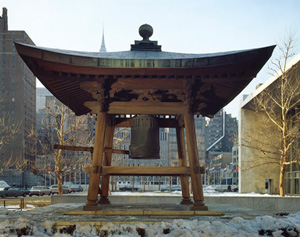
The day is marked by the striking of the Japanese Peace Bell. Traditionally, the Bell is rung twice a year. It is tolled on the first day of Spring at the time of the vernal equinox, in celebration of the annual Earth Day ceremony initiated by Earth Day Founder, John McConnell.
It is also tolled on every opening day of the UN General Assembly's yearly session in September, coinciding with the International Day of Peace established by the General Assembly in 1981. This occasion is observed by the Secretary-General.
The bell tower was modelled after the Hanamido (a small temple decorated with flowers) that symbolises the place where Buddha was born.
THE five-storey pagoda of the Temple of the Flourishing Law in the Nara prefecture of Japan is one of the world’s oldest wooden buildings. It has withstood wind, rain, fire and earthquakes for 1,400 years. Analysis of the rings in the central pillar supporting the 32-metre structure suggests the wood that it is made from was felled in 594, and construction is thought to have taken place soon after.
In an age of steel and concrete, the pagoda is a reminder of wood’s long history as a construction material. New techniques mean that wood can now be used for much taller buildings. A handful are already going up in cities around the world. The 14-storey Treet block of flats in Bergen, Norway, is currently the tallest. But Brock Commons, an 18-storey wooden dormitory at the University of British Columbia in Canada, is due to be completed in 2017.
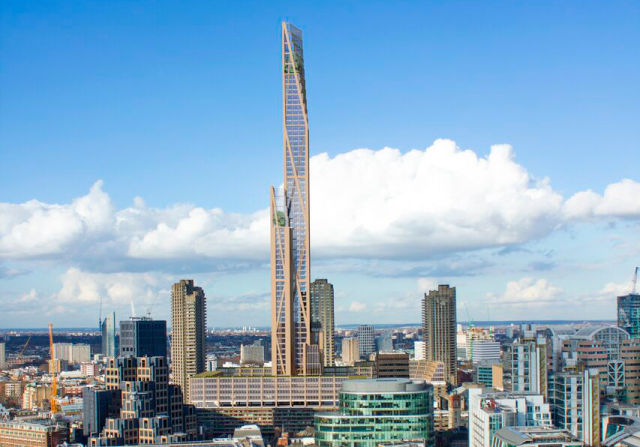
And this is a proposed 1,000ft structure off the edge of the Barbican, in the City of London. If it goes ahead it will be London's second tallest building after The Shard - and the tallest wooden structure in the world.
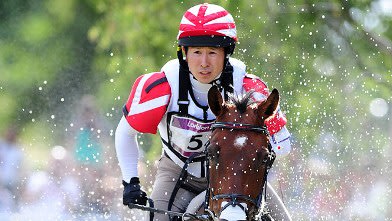
You may remember that back in 2012 we reported that a Japanese Buddhist monk was competing in the Equestrian Individual Eventing at the London Olympics. Kenki Sato was from the Myoshoji temple in the mountains near Nagano, where his father, Shodo, is the 25th master of the 460-year-old temple and adjacent horse-riding club.
He says his religious discipline helps him when he's riding: "Before the competition starts I concentrate. I'm behaving more like a monk." Kenki followed his younger brother Eiken, who also trained as a priest and rode at the Beijing Games.
Now another Japanese Zen monk, Kazuki Yazawa, is entering the Rio Olympic games. Kazuki is a Buddhist priest at the ancient Zenkoji Daikanjin Temple in Nagano prefecture. He is a slalom canoer who has competed since the mid-2000s. At the 2008 Summer Olympics in Beijing, he was eliminated in the qualifying round of the K-1 event finishing in 18th place. Four years later at the London games he was able to qualify for the final of the K-1 event where he finished in 9th place.
He became a monk in 2013 but in Zen that does not preclude one from secular activities and interests, (even including marriage and having a family).
One of our Sangha members is a keen marathon runner and when I first saw the following article I thought to just send them a link or a print off; but then I thought to share it with a wider audience.
Somewhere in the mountains around Kyoto live the marathon monks. Legend has it that the monks of Mount Hiei run 1,000 marathons in 1,000 days in their quest to reach enlightenment. Those who succeed become revered, as human Buddhas or living saints. It is rare that a monk embarks on the 1,000-day challenge, or kaihogyo, and even rarer that one completes it. In the last 130 years, only 46 men have managed it. I have come to Japan, hoping to meet one of them and to find out what they can teach a recreational runner about the path to spiritual wellbeing.
I can’t, however, just walk up the mountain and knock at his door. Visits are by invitation only. So at a private temple in northern Kyoto I, with my translator friend Max, meet a woman who knows one of the monks. She tells me that they run in straw sandals. She once met one on the last day of his challenge and expected to see his feet all swollen and sore. “But they were smooth and clean,” she says. “As though he had been floating over the ground.”
At the end of their quest, the monks enter a darkened room where they spend nine days without food, water or sleep. The idea is to bring the body as close as possible to death. Once they complete the challenge, they are given the title of Daigyoman Ajari, or Saintly Master of the Highest Practice. In imperial Japan, such monks were granted a special place at court, and were the only people allowed to wear shoes in the presence of the emperor. Today, those who complete the challenge become celebrities, television cameras transmitting the final stages of their journey live to the nation.
A priest at the temple tells me that the idea behind the constant movement is to exhaust the mind, the body, everything, until nothing is left. “When you are nothing, then something, pop, comes up to fill the space.”
He mimes a bubble popping.
This something, he tells me, is the vast consciousness that lies below the surface of our lives. A sense of oneness with the universe. I ask the woman about stories I’ve heard, too: that if they can’t complete the challenge, if they have to quit, they must kill themselves. She doesn’t know. This used to happen, yes, but now it is not clear. A lot of secrecy surrounds the marathon monks.
Months later, our invitation is finally granted. We collect the woman from the temple, along with a young man in a baggy jumper she introduces as her friend, then drive out of Kyoto. We’ve barely left the suburbs when we come to a stop outside some traditional buildings. This is where the running monk we’re going to meet lives. I had imagined more of a pilgrimage, hiking up some steep mountain path to a temple high in the clouds.
We get out of the car beside a garage filled with pots of paint and planks of wood. A beefy man in a tracksuit opens the door. This is the monk. We follow him across a small courtyard. “First he will do the ceremony,” the man in the jumper explains. He shows me how I can get my own prayer included in the ritual. Along one wall is a list of all the prayers you can make, from success in exams, or a job promotion, to simply your dreams coming true. It doesn’t seem particularly Buddhist, asking for the fulfilment of all these worldly desires, but I’m no expert. I opt for the prayer of good health for my family.
The man in the tracksuit returns, now wearing the white robes of a priest. He climbs up and settles himself cross-legged on the table, and starts chanting. It’s a continuous, rhythmic chant that sounds like a didgeridoo. It’s all in Japanese, of course, so to me it’s just deep, guttural sounds, until I hear my own name as he lays a stick on an ever-growing pile. Then suddenly it’s over. He stands up and says something matter-of-factly in Japanese, as though he has just come into the room to find us sitting there.
“So, what do you want to know?” he asks, settling down beside us.
I may be misreading him, but something about his demeanour suggests he is already impatient, as though he’s expecting me to ask him something stupid. I need to fire a deep, perceptive question at him, to win him over with my understanding of running and the path to spiritual enlightenment.
“I’m interested in why people run,” I begin. In answer, he starts explaining the whole process of the 1,000-day training. It’s not just about running, he says. Along the way, each day you need to stop at over 250 shrines and temples. The running is really just a way to get from one to the other. And it is not even running. Much of the time you are walking.
“But why?” I ask. “Why this 1,000-day challenge?”
He ponders for a moment.
“All humans are asking the question: ‘Why are we alive?’ he says. “The constant movement for 1,000 days gives you lots of time to think about this, to reflect on your life. It is a type of meditation through movement. That is why you shouldn’t go too fast. It is a time to meditate on life, on how you should live.”
“And when you did it,” I say, “did you find an answer to the question, why are we alive?” I may be pushing it here, but I’m waiting to hear about the sense of oneness with the universe he experienced. I want to know what reaching enlightenment actually feels like.
“There is not this one point of understanding where everything else stops and you’ve made it,” he says calmly. “Learning continues. Once you graduate from university, you don’t stop learning. The 1,000-day challenge is not an end point, the challenge is to continue, enjoying life and learning new things.”
These monks are purportedly some of the wisest, most spiritual men on earth, with insight gained through incredible feats of endurance. And yet here is a real-life Daigyoman Ajari telling me that running for 1,000 days was basically some good thinking time, and that really, afterwards, life went on as before.
“It’s like Lady Di,” he says. Lady Di? “Even though she was at the very top of English society, she found meaning in helping victims of landmines.”
Now he has really thrown me.
“What do people think?” he asks, leaning forward, watching me carefully. “Was it really an accident? I saw a television programme about it, and it seemed to suggest some dark forces were in action, that she didn’t die in a simple accident. What do you think?”
I shake my head: “I don’t know.” In some ways it’s a relief to know that even the highest Zen Buddhists are sitting up in their temples in Mount Hiei watching television and gossiping about the death of Lady Diana. There is an idea, fostered by religion, that monks and priests are somehow different to us, free from the shackles of human desire. The reality is clearly different.
This can lead you in one of two directions. On one hand, you can despair. If the world’s spiritual guardians are sitting watching trashy TV, then surely we’re all doomed, a hopeless species trapped in a futile rush towards destruction. Or you can take solace from their everydayness. If the monks are like us, then it figures that we are like the monks. If they can gain a deeper understanding of life, yet still indulge their foibles, then perhaps we too can attain wisdom and fulfilment.
I ask him what he thinks. Are there similarities between what he found, and the experience of athletes and recreational runners? He says he saw a television programme about people training for the marathon and he was encouraged because he saw they often had slumps in their training.
“This was the same,” he says. “Sometimes I had slumps too, so it was good to see it wasn’t just me.”
Now he is finding solace in the trials of novice marathon runners. The 1,000-day challenge is such an extreme thing to do, and yet here is this man who has done it, and still suffers the same doubts, has the same questions as anyone else.
“Look,” he says, as though he is reading my thoughts. “Everyone needs to find something that suits them, that works with their body, with what they are doing in this life. I chose to undertake this challenge. But it is just one of many different paths to the same place.”
Sport is often seen in Japan as a way towards self-fulfilment, and the names of many of Japan’s most traditional sports, such as judo and kendo, end with the suffix -do, which actually means “the path” or “the way”. Running, too, can be a way to self-fulfilment. It has a purity, a power, a way of clearing the mind that few other activities possess. Sometimes it may seem unlikely, as we creak and struggle along, our legs heavy and tired, but then come those moments when we break through and our bodies begin to feel light, strong, at one with the earth.
But enlightenment, the monk says, isn’t a point where everything stops and you’ve made it, forever surrounded by a halo of bliss. It is something alive, something that pushes you on every day, whether you are a Daigyoman Ajari on Mount Hiei or a data-management assistant in an office in Hounslow. Something deep inside us wants to know that place, to find it again, to return to it. And for some of us, it means lacing up our shoes and heading out for another run.
Some of you may have heard Melvyn Bragg's Radio 4 program, "In Our Time" this morning in which the subject discussed was Zen Buddhism. If you did you will have learnt precious little about Zen or indeed Buddhism!
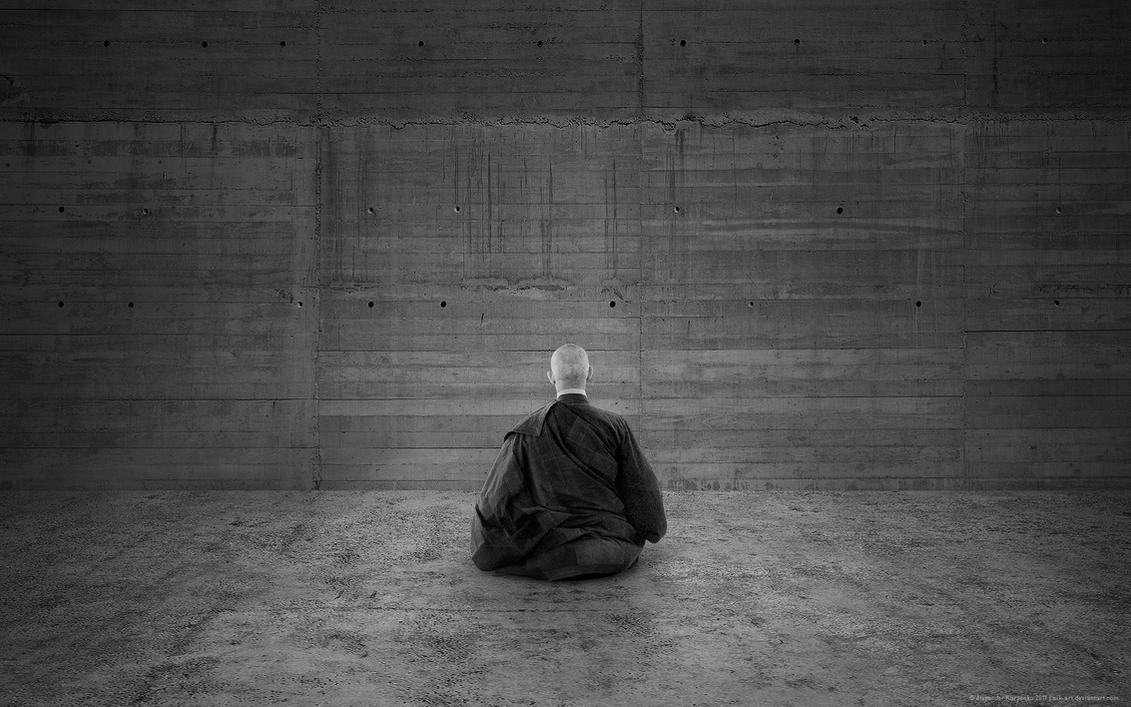
The whole program was a bit of a mishmash not helped by the fact that Bragg was obviously suffering from a ferocious cold. The guests, Tim Barrett, Emeritus Professor in the Department of the Study of Religions at SOAS, University of London, Lucia Dolce, Numata Reader in Japanese Buddhism at SOAS, University of London and Eric Greene, Lecturer in East Asian Religions at the University of Bristol failed to get over some key points. The most central one being the nature of Zen meditation, Zazen. Constantly reiterating that it meant "just" sitting was singularly uninformative so I'm quoting from the "Rules for Meditation" from the Soto Zen tradition...........
"You should meditate in a quiet room, eat and drink moderately, cut all ties, give up everything, think of neither good
nor evil, consider neither right nor wrong. Control mind function, will, consciousness, memory, perception and understanding; you must not strive thus to become Buddha. Cling to neither sitting nor lying down. When meditating, do not wear tight clothing. Rest the left hand in the palm of the right hand with the thumbs touching lightly; sit upright, leaning neither to left nor right, backwards nor forwards. The ears must be in line with the shoulders and the nose in line with the navel; the tongue must be held lightly against the back of the top teeth with the lips and teeth closed. Keep the eyes open, breathe in quickly, settle the body comfortably and breathe out sharply. Sway the body left and right then sit steadily, neither trying to think nor trying not to think; just sitting, with no deliberate thought, is the important aspect of serene reflection meditation."
As you can see there is a little more to it than "just sitting" but as always I'll let you listen and decide for yourselves.................
I have also placed this on the Miscellaneous page of our Audio section where you can download it.
In America and Canada April is National Poetry Month. As part of the event the New York
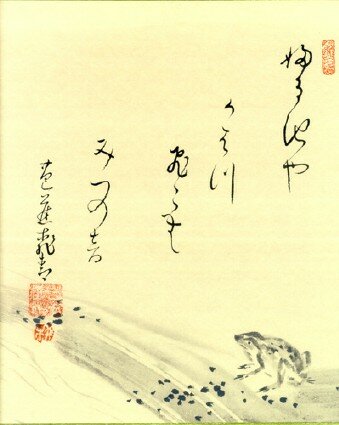
Times asked it's readers to write haiku about the city. The writers were asked to use the traditional 17 syllable form. The essence of haiku is "cutting" (kiru). This is often represented by the juxtaposition of two images or ideas and a kireji ("cutting word") between them, a kind of verbal punctuation mark which signals the moment of separation and colors the manner in which the juxtaposed elements are related.
Here are some of the one's that I like......
Strange how fast night comes:
Silence, as I pass through you,
wide awake at dark.
Beware the puddle
of indeterminate depth
that swallows boots whole (strikes a cord after the floods here in the UK)
Homeless gentleman
White cane seeks safe street crossing
Teenage boy takes arm
Behind him a trail
of bread crumbs, popcorn and seeds.
He makes birds happy
Mistrust grips the heart.
Though we travel in large packs,
we are still alone.
Coffee by myself
The wind whispers names of friends
Yet alone I sit
Park at Winter dawn
We danced through each orange gate
Unconcealing Spring
Our eyes avoid but
If we looked we would see that
We might just be friends.
Since 2000 Great Britain has celebrated a National Poetry Month each October. This follows on from the BBC polling the nation for our favourite poem back in 1995.
Kipling's "If" won by a mile polling twice as many votes as the runner up The Lady of Shalott by erstwhile West Wight resident, Alfred, Lord Tennyson. In subsequent votes the Beeb changed the rules to stop us voting for Kipling again. If remains the Nation's and my favourite poem, so here it is........
IF you can keep your head when all about you
Are losing theirs and blaming it on you,
If you can trust yourself when all men doubt you,
But make allowance for their doubting too;
If you can wait and not be tired by waiting,
Or being lied about, don't deal in lies,
Or being hated, don't give way to hating,
And yet don't look too good, nor talk too wise:
If you can dream - and not make dreams your master;
If you can think - and not make thoughts your aim;
If you can meet with Triumph and Disaster
And treat those two impostors just the same;
If you can bear to hear the truth you've spoken
Twisted by knaves to make a trap for fools,
Or watch the things you gave your life to, broken,
And stoop and build 'em up with worn-out tools:
If you can make one heap of all your winnings
And risk it on one turn of pitch-and-toss,
And lose, and start again at your beginnings
And never breathe a word about your loss;
If you can force your heart and nerve and sinew
To serve your turn long after they are gone,
And so hold on when there is nothing in you
Except the Will which says to them: 'Hold on!'
If you can talk with crowds and keep your virtue,
' Or walk with Kings - nor lose the common touch,
if neither foes nor loving friends can hurt you,
If all men count with you, but none too much;
If you can fill the unforgiving minute
With sixty seconds' worth of distance run,
Yours is the Earth and everything that's in it,
And - which is more - you'll be a Man, my son!
Hana-Matsuri refers to the memorial service performed at temples
throughout Japan to celebrate the birth of Buddha on April 8th. It is
formally called Kanbutsue. On this day, small buildings decorated with
flowers are made at temples and a tanjobustu (baby Buddha figurine) is
placed inside. This figurine is sprinkled by worshippers using a ladle
with ama-cha, which is a beverage made by soaking tealeaves in hot water
Some people take this ama-cha home and drink it as holy water.
The United Nation's top court has ordered Japan to stop its annual whale hunt in the Antarctic.
"Japan shall revoke any existant authorisation, permit or licence granted in relation to Jarpa II [research programme] and refrain from granting any further permits in pursuance to the programme," the International Court of Justice's Judge Peter Tomka said.
Japan had argued that the suit brought by Australia, in May 2010, was an attempt to impose its cultural norms on Japan.
But Canberra said since 1988 Japan has slaughtered more than 10,000
whales under the programme, allegedly putting the Asian nation in breach
of international conventions and its obligation to preserve marine
mammals and their environment.
In its application before the world court, Australia accused Japan of
failing to "observe in good faith the zero catch limit in relation to
the killing of whales".
Meanwhile, here in the UK, The Tory Government was considering amending the Hunting Act, which would have made it almost impossible to enforce, signalling a return to hunting with dogs "by the back door".
However, thanks to a public outcry at the news, the Government has announced it will not now attempt to do this.
Mr. Cameron in Prime Minister's Questions on Wednesday 26 March said that the Government has dropped plans to amend the Hunting Act on the issue of the number of dogs that can be used in "exempt hunting".
A growing number of Conservative MPs had warned David Cameron that he risked losing the Commons vote if he pushed ahead with what they believed was an attempt to weaken the ban on hunting to woo rural voters away from Ukip.
At our Sangha meeting this Tuesday evening members were trawling through our library and the subject of books by Ayya Khema came up.
In the World of strange coincidences (they're only strange if we notice them), I was checking the traffic to this site this morning and noticed that a visitor from Japan had Googled "ayya khema united nations address" and had got a hit to a post on this site from 2008. It was entitled "Talks by Ayya Khema"
and detailed a website selling audio tapes of her talks. I corrected
the post with the news that all of Ayya Khema's recorded talks have now
been digitalised and can be downloaded for free from Dharma Seed.
As to her books, we are fortunate to have the following titles in our collection:-
Being Nobody, Going Nowhere, Meditations on the Buddhist Path,
When the Iron Eagle Flies, Buddhism for the West,
Who is myself?, A guide to Buddhist meditation,
Come and See for Yourself, The Buddhist Path to Happiness,
Be an Island, The Buddhist practice of Inner Peace,
Visible here and now,
I Give You My Life, her autobiography
Ayya Khema was born in Berlin in 1923 to Jewish parents. In 1938, she escaped from Germany with two hundred other children and was taken to Glasgow, Scotland. Her parents went to China and, two years later Ayya Khema joined then in Shanghai. With the outbreak of the war, however, the family was put into a Japanese prisoner-of-war camp and it was here her father died. She later married, had a son and a daughter, and now has four grand-children. Four years after the American liberation of the camp, Ayya Khema was able to emigrate to the United States. Between 1960 and 1964 she travelled with her husband and son throughout Asia, including the Himalayan countries, and it was at this time she learned meditation. Ten years later she began to teach meditation throughout Europe and Australia. Her experiences led her to become a Buddhist nun in Sri Lanka in 1979, when she was given the name of 'Khema' (Ayya means Venerable) meaning safety and security. She helped to establish Wat Buddha-Dhamma, a forest monastery in the Theravada tradition, near Sydney, Australia, in 1978. In Colombo she set up the International Buddhist Women's Centre as a training centre for Sri Lankan nuns, and the Parappuduwa Nun's Island at Dodanduwa. (now unfortunately closed). She was the spiritual director of Buddha-Haus in Germany, established in 1989 under her auspices. In June 1997 "Metta Vihara", the first Buddhist forest monastery in Germany, was inaugurated by her, and the first ordinations in the German language took place there. In 1987 she co-ordinated the first international conference of Buddhist nuns in the history of Buddhism, which resulted in the setting-up of Sakyadhita, a worldwide Buddhist women's organisation. H.H. the Dalai Lama was the keynote speaker at the conference. In May 1987, as an invited lecturer, she was the first ever Buddhist nun to address the United Nations in New York on the topic of Buddhism and World Peace.
She died in November 1997.............................
Hana-Matsuri refers to the memorial service performed at temples throughout Japan to celebrate the birth of Buddha on April 8th. It is formally called Kanbutsue.
On this day, small buildings decorated with flowers are made at temples and a tanjobustu (baby Buddha figurine) is placed inside.
This figurine is sprinkled by worshippers using a ladle with ama-cha, which is a beverage made by soaking tea leaves in hot water. Some people take this ama-cha home and drink it as holy water.
At its Executive and Advisory Board meeting this month, the International Network of Engaged Buddhists ratified a statement condemning ongoing violence between Buddhists and Muslims in Burma’s Rakhine state, and calling for the Burmese government and religious leaders to work toward a resolution.
“We hope that it expresses the concerns of Buddhists around the world who are witness to the communal conflict and violence in Myanmar’s western Rakhine state,” said Hozan Alan Senauke. “Clearly this conflict must be resolved by the Burmese peoples themselves, but this statement affirms that INEB and Buddhists everywhere care about the well-being of Burma’s emerging democracy and of all its peoples. We send our encouragement and faith in the Buddha’s great way.”
Conflict in Myanmar’s Rakhine State: A Statement from the International Network of Engaged Buddhists
Since June 2012, violence between communities of Rohingyas and Rakhines in Rakhine State has resulted in hundreds of dead and wounded, thousands of homes and shops razed, and more than 75,000 displaced and impoverished.
The roots of this conflict are hard to untangle. They go back at least decades to the period of British colonial occupation. But current hostility also speaks to a scarcity of land and economic resources that manifests as communal hostility. Undoubtedly there has been violence and provocation on both sides. We commit ourselves to open-minded investigation of the past and present sources of this violence.
Although some Rohingyas have lived in Myanmar for generations, if not for several hundred years, the former military regime’s 1982 law excluded them from among the nation’s many recognized ethnicities, denying the Rohingyas citizenship and basic rights. As they are driven from their homes, neighboring Bangladesh prohibits the entry of them as refugees, and also denies citizenship to Rohingyas presently living within its own borders. It is not surprising that the United Nations views the Rohingyas as “one of the world’s most persecuted minorities.”
We feel for the families of all sides of this conflict, and have compassion for the people of Myanmar who are suffering and trying their best to resolve this issue.
We call for the government of Myanmar, and the leaders of the Buddhist Sangha and other religious leaders, to play an active and nonviolent role in resolving the conflict in Rakhine state. Central to this is to grant humanitarian assistance and work towards tolerance and respect for all of Myanmar’s diverse inhabitants. We also call on Buddhist monks across Myanmar to set aside fear and the delusive religious discrimination; to honor the Buddha’s role and example by being peacemakers for all people. May all beings — Buddhist, Muslim, Eastern, Western — and all peoples of Myanmar recall the Buddha’s vital message:
Hatred is never appeased by hatred in this world; by non-hatred only is
hatred appeased. This is an unending truth. — Dhammapada, 5
Adopted and ratified at the annual INEB Executive and Advisory Board Meeting, November 8-9, 2012 at the Kodo Kyodan Buddhist Fellowship in Yokohama, Japan.
Following on from our previous post, those of us on the other side of the pond may have been unaware that elections to the Senate and House of Representatives, collectively the Congress, were also taking place (these occur every two years).
In Hawaii, Democrat Mazie Hirono beat former Governor Linda Lingle in the race for the Senate, making Hirono the first Buddhist to serve in the house.
Hirono, who was born in Japan, practices the Jodo Shinshu tradition of Buddhism.
"Ultimately, politics comes down to 'how does it impact me?' or 'how am I included?' It will mean so much for the upcoming generations of Buddhists."
We've reported several times in the past on China's bully-boy tactics against other sovereign nations (and Leeds!) who dare to invite his Holiness the Dalai Lama to their countries. The latest victim of this intimidation is Japan. However, I don't suppose that it might also be an excuse to lean on Japan in relation to the "disputed" Senkaku Islands?
China strongly opposes all forms of support from any country or any individual for the Dalai Lama's separatist activities, a Foreign Ministry spokesman said at a regular press briefing on Monday.
"The Dalai Lama is merely a political exile who has long been engaged in activities to split China under the disguise of religion," Hong Lei said in response to a question regarding the Dalai Lama's 10-day trip to Japan, which started on Sunday.
The Dalai Lama's international activities aim at colluding with international anti-China separatist forces to undermine relations between China and other countries so as to split the nation, according to the spokesman.
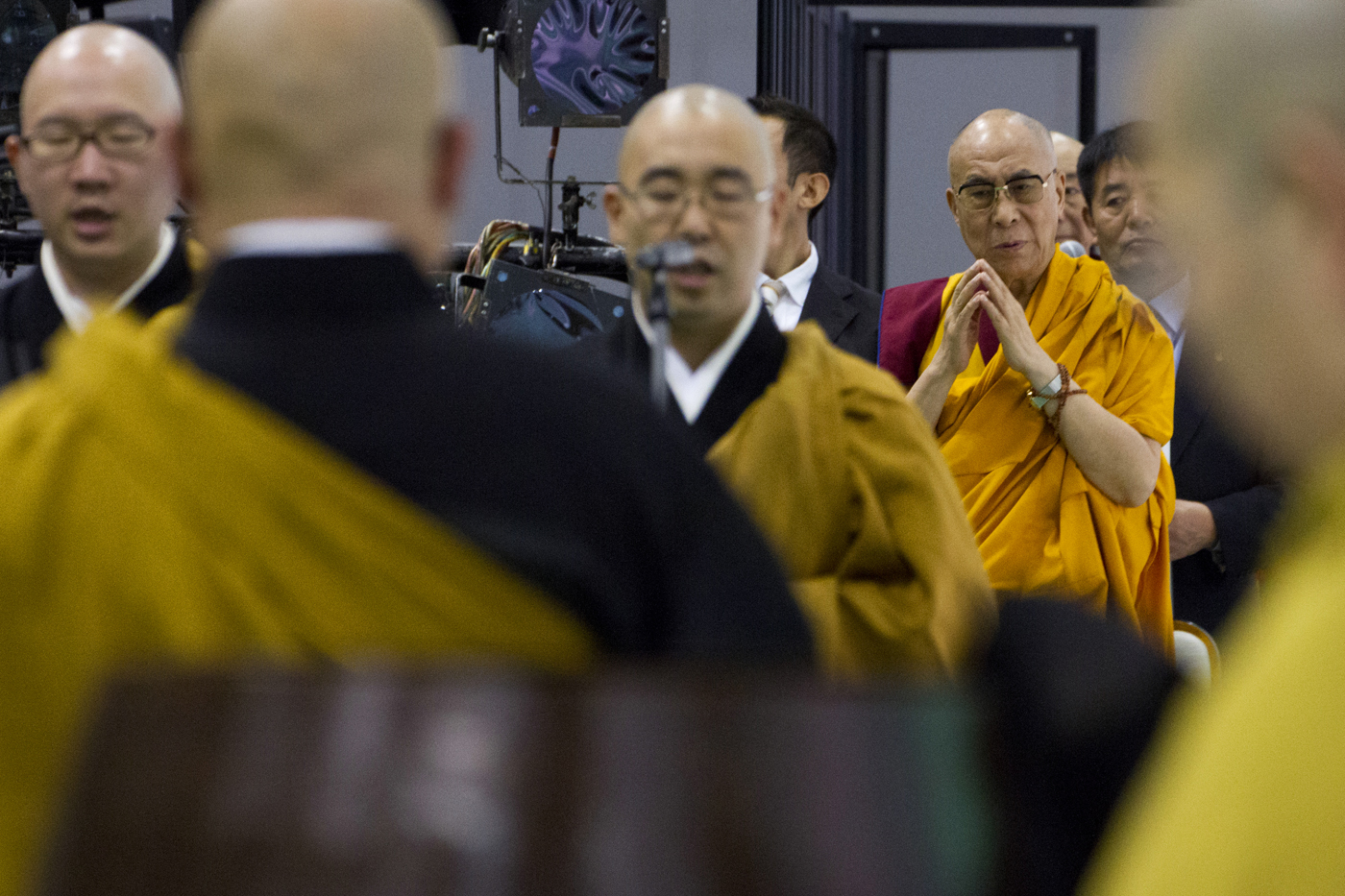
This from the "infamous splitist" himself................. “China needs Japan, Japan needs China,” said His Holiness as he faced a group of 20 or so reporters, both Japanese and international, in a conference room in a hotel in Yokohama. “East needs West, and West needs East.
Every country on this planet needs others. So a small disagreement or divergence of interests should not affect basic relations. That’s short-sighted, narrow-minded. We should think more broadly.”
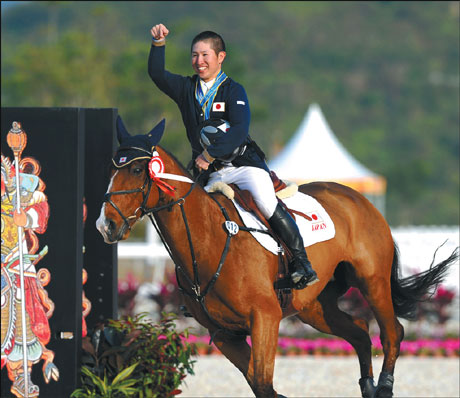
One of the Olympic events today is the Equestrian Individual Eventing, look out for Kenki Sato who is competing for Japan. Kenki is a Buddhist monk from the Myoshoji temple in the mountains near Nagano, where his father, Shodo, is the 25th master of the 460-year-old temple and adjacent horse-riding club.
Kenki is following his younger brother Eiken, who also trained as a priest and
rode at the Beijing Games. His sister, Tae, 24, is a five-time national
show-jumping champion.
Here Kenki is pictured making a lap of honour with his horse Toy Boy and the two gold medals he won in individual and team jumping at the 16th Asian Games in 2010.
The Zen master Wumen Huikai once wrote, 'A hundred flowers blossom in spring, the moon shines in autumn, there is a fresh breeze in summer, and there is snow in winter. If your mind isn’t occupied with trivial matters, every time is a good time.'
Coincidently, the latest addition to our video library here at the West Wight Sangha is "Spring, Summer, Fall, Winter... and Spring" by the South Korean director Kim Ki-duk. about a Buddhist monastery that floats on a lake in a pristine forest. The story is about the life of a Buddhist monk as he passes through the seasons of his life, from childhood to old age.
Today is the Japanese Flower Festival or Hanamatsuri, a celebration of the Buddha's birthday. The date of the Buddha’s birth varies from one tradition or school of Buddhism to another. According to the Japanese, Buddha was born on the eighth day of the fourth month of the traditional Chinese calendar, and although this date will vary on the international calendar, the Japanese have translated the date to the 8th of April. The nature of the festival varies greatly from region to region, and often appears to have the characteristics of older spring festivals: driving out devils or praying for the coming harvest.
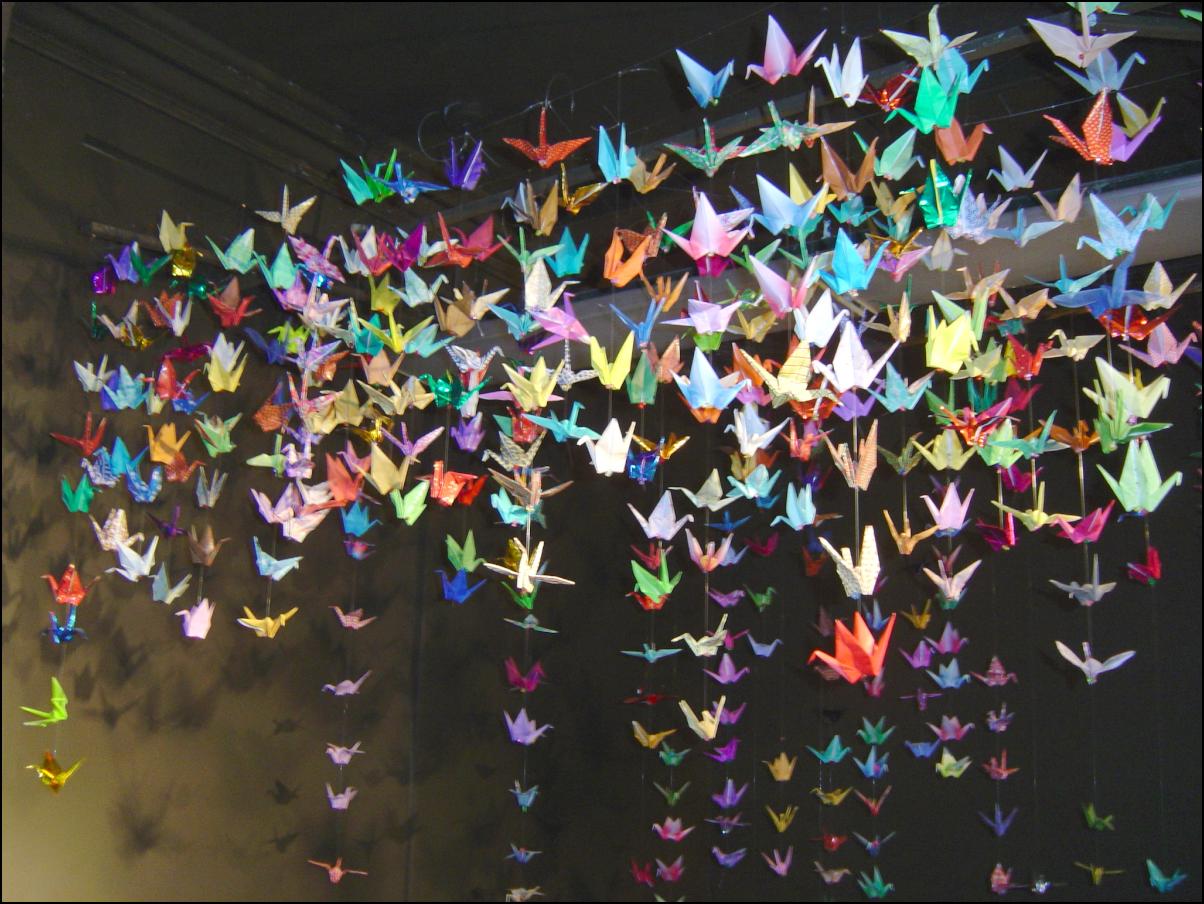
You may remember our story about Sadako Sasaki and the Paper Peace Crane from August last year, about the young Japanese girl who died of radiation poisoning from the Hiroshima bomb. She vowed to fold a thousand origami Buddhist peace cranes before she died.
Now I see from one of the Island's leading websites, the Ventnor blog, that Linda Barnes is going to fold a million peace cranes, not hopefully all on her own!
As Linda says, "The lovely thing about origami is you can share this peaceful art with others, and by sharing it you pass on that knowledge and also help a charity. So I hope many people will join in, I will continue making them for however long it takes, or until my fingers stiffen up!
I’m appealing for donations of 1 pence per crane to help the good work of various chosen charities.
Your name will go on the crane and on a sponsor sheet, and feedback on how the projects progressing – and where the money’s going. If you wish to know more please contact me via VB."