Showing posts with label China. Show all posts

Wednesday, 10 April 2019

Dalai Lama Ill

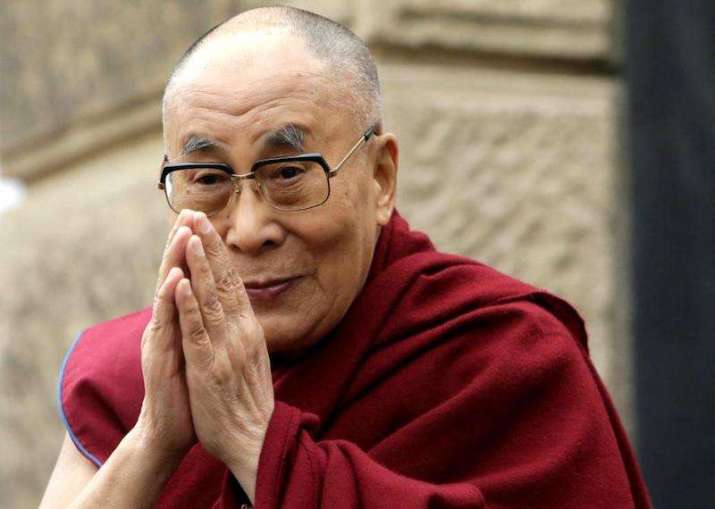
Talking about Tibet it was announced that the Dalai Lama was admitted to hospital in New Delhi yesterday with a chest infection. Given his holinesses age, 83, this is a serious condition but he is described as being stable.

Many of the up to 100,000 Tibetans living in India are worried that their fight for a genuinely autonomous homeland would end with the Dalai Lama.

He told Reuters last month that it was possible that once he dies his incarnation could be found in India and warned that any other successor named by China would not be respected.

China brands the Nobel peace laureate as a dangerous "splittist" and says the ruling Chinese Communist Party has the right to select the Dalai Lama’s successor, as a legacy inherited from China’s emperors.

Monday, 8 April 2019

Tibetan Play in the West End


Abhishek Majumdar's play Pah-La is now showing at the Royal Court Theatre, London.

Last year, he faced censure when Pah-La, his drama about Tibetans caught up in the Lhasa riots of 2008, was put on ice by the Royal Court, with charges that the Beijing authorities had weighed in and the theatre’s writing programme in China could have been jeopardised if the play went ahead.

The theatre issued an apology to the Tibetan community, he explains, sitting in the venue’s cafe, and it is now about to stage Pah-La. “The leadership at the Royal Court was extraordinary in accepting problems that were larger than them and then doing something about it.”

The play will still, probably, ruffle some feathers. Set among a monastic circle of Tibetans, the drama shows their forced assimilation and interrogation at the hands of the Chinese army, but it also dramatises the controversial practice of self-immolation among Tibetan protestors (a woman sets herself alight in his play) and the faultlines between non-violent Buddhist ideals and the all-too-human descent into retaliatory violence that the 2008 riots encapsulated.

That led him to explore the themes at the heart of Pah-La. “In the last century, there were so many major examples of non-violent revolutions, from Gandhi’s to Martin Luther King’s to Nelson Mandela’s. But if these are models to go by, what happened to them? They vanished after the 1970s.”
Tibet, he says, is the last remaining model for such non-violence. “The Tibetans are at the forefront of a conscience that the world needs to have. When the last Tibetan turns violent, we should pack up.”

Pah-La is at the Royal Court, London, until 27 April.

Tuesday, 5 February 2019

Happy 4717, Happy Losar - 2146

Well, it's Chinese New year, the year of the pig and it's 4717. Although the People’s Republic of China uses the Gregorian calendar for civil purposes, a special Chinese calendar is used for determining festivals and the traditional New Year.

The beginnings of the Chinese calendar can be traced back to the 14th century B.C.E. Legend has it that the Emperor Huangdi invented the calendar in 2637 B.C.E.

A quick bit of maths shows that the Chinese calendar has drifted from the Gregorian calendar and this is because the Chinese calendar is a combined solar/lunar calendar in that it strives to have its years coincide with the tropical year and its months coincide with the synodic months. An ordinary year has 12 months, a leap year has 13 months and an ordinary year has 353, 354, or 355 days, a leap year has 383, 384, or 385 days.


In Tibet where the calendar is related to the Chinese calendar, it's the year of the Female Earth Pig or 2146.

Friday, 6 July 2018

Happy Birthday your Holiness

Today is the Dalai Lama's 83rd birthday.


Authorities in northwest China’s Qinghai province have clamped down on social media and deployed large numbers of armed police to Tibetan villages and towns in an effort to discourage celebrations of the July 6 birthday of the exiled spiritual leader.

Tightened restrictions include warnings recently issued to the managers of social media chat groups, urging them to restrict any sharing of “secret, internal” information by Tibetans and to keep an eye out for attempts to organise celebrations of the birthday of the Dalai Lama.

Friday, 29 December 2017

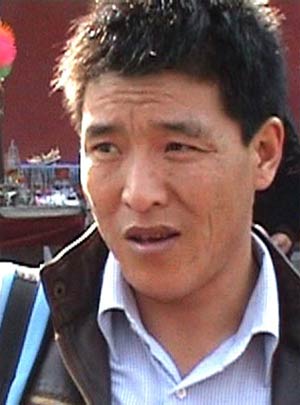
Dhondup Wangchen Escapes From China

Tibetan film-maker Dhondup Wangchen was jailed in China for six years in late 2009 in the western province of Qinghai after he made a documentary in which ordinary Tibetans praised the Dalai Lama and complained about how their culture had been trampled upon.

The film, “Leaving Fear Behind”, features a series of interviews with Tibetans who talk about how they still love their exiled spiritual leader and thought the 2008 Beijing Olympics would do little to improve their lives. The film was shown in secret to a small group of foreign reporters in Beijing during the Olympics.

In a statement issued in Beijing late on Wednesday evening, the group "Filming for Tibet" said Dhondup Wangchen had arrived in the United States that day.

“After many years, this is the first time I'm enjoying the feeling of safety and freedom,” he said.

“I would like to thank everyone who made it possible for me to hold my wife and children in my arms again. However, I also feel the pain of having left behind my country, Tibet.”

Dhondup Wangchen had been released from prison in June 2014 in the Qinghai provincial capital of Xining but remained under tight surveillance with his movements and communications monitored.

Qinghai, which borders the Tibet Autonomous Region, is home to a large ethnic Tibetan population and is considered by many Tibetans as part of greater Tibet. It is also the birthplace of exiled Tibetan spiritual leader, the Dalai Lama.

Watch the film here............

Friday, 30 June 2017

Buddhist Group Changing China (or visa versa?)

This article by Ian Johnson is from the New York Times..............................


For most of her life, Shen Ying was disappointed by the world she saw around her. She watched China’s economic rise in this small city in the Yangtze River Valley, and she found a foothold in the new middle class, running a convenience store in a strip mall. Yet prosperity felt hollow.

She worried about losing her shop if she didn’t wine and dine and pay off the right officials. Recurring scandals about unsafe food or tainted infant formula made by once-reputable companies upset her. She recalled the values her father had tried to instill in her — honesty, thrift, righteousness — but she said there seemed no way to live by them in China today.

“You just feel disappointed at some of the dishonest conduct in society,” she said.

Then, five years ago, a Buddhist organisation from Taiwan called Fo Guang Shan, or Buddha’s Light Mountain, began building a temple in the outskirts of her city, Yixing. She began attending its meetings and studying its texts — and it changed her life.

She and her husband, a successful businessman, started living more simply. They gave up luxury goods and made donations to support poor children. And before the temple opened last year, she left her convenience store to manage a tea shop near the temple, pledging the proceeds to charity.

Across China, millions of people like Ms. Shen have begun participating in faith-based organisations like Fo Guang Shan. They aim to fill what they see as a moral vacuum left by attacks on traditional values over the past century, especially under Mao, and the nation’s embrace of a cutthroat form of capitalism.

Many want to change their country — to make it more compassionate, more civil and more just. But unlike political dissidents or other activists suppressed by the Communist Party, they hope to change Chinese society through personal piety and by working with the government instead of against it. And for the most part, the authorities have left them alone.


Fo Guang Shan is perhaps the most successful of these groups. Since coming to China more than a decade ago, it has set up cultural centres and libraries in major Chinese cities and printed and distributed millions of volumes of its books through state-controlled publishers. While the government has tightened controls on most other foreign religious organisations, Fo Guang Shan has flourished, spreading a powerful message that individual acts of charity can reshape China.

It has done so, however, by making compromises. The Chinese government is wary of spiritual activity it does not control — the Falun Gong an example — and prohibits mixing religion and politics. That has led Fo Guang Shan to play down its message of social change and even its religious content, focusing instead on promoting knowledge of traditional culture and values.

The approach has won it high-level support; President Xi Jinping is one of its backers. But its relationship with the party raises a key question: Can it still change China?

Avoiding Politics

Fo Guang Shan is led by one of modern China’s most famous religious figures, the Venerable Master Hsing Yun. I met him late last year at the temple in Yixing, in a bright room filled with his calligraphy and photos of senior Chinese leaders who have received him in Beijing. He wore tannish golden robes, and his shaved head was set off by thick eyebrows and sharp, impish lips.

At age 89, he is nearly blind, and a nun often had to repeat my questions so he could hear them. But his mind was quick, and he nimbly parried questions that the Chinese authorities might consider objectionable. When I asked him what he hoped to accomplish by spreading Buddhism — proselytising is illegal in China — his eyebrows arched in mock amusement.

“I don’t want to promote Buddhism!” he said. “I only promote Chinese culture to cleanse humanity.”

As for the Communist Party, he was unequivocal: “We Buddhists uphold whoever is in charge. Buddhists don’t get involved in politics.”

That has not been true for most of Master Hsing Yun’s life. Born outside the eastern city of Yangzhou in 1927, he was 10 when he joined a monastery that he and his mother passed by while searching for his father, who disappeared during the Japanese invasion of China.

There, he was influenced by the ideas of Humanistic Buddhism, a movement that aimed to save China through spiritual renewal. It argued that religion should be focused on this world, instead of the afterworld. It also encouraged clergy to take up the concerns of the living, and urged adherents to help change society through fairness and compassion.

After fleeing the Communist Revolution, Master Hsing Yun took that message to Taiwan and founded Fo Guang Shan in the southern port of Kaohsiung in 1967. He sought to make Buddhism more accessible to ordinary people by updating its fusty image and embracing mass-market tactics. In sports stadiums, he held lectures that owed more to Billy Graham than the sound of one hand clapping. He built a theme park with multimedia shows and slot machines that displayed dioramas of Buddhist saints.

The approach had a profound impact in Taiwan, which then resembled mainland China today: an industrialising society that worried it had cast off traditional values in its rush to modernise. Fo Guang Shan became part of a popular embrace of religious life. Many scholars say it also helped lay the foundation for the self-governing island’s evolution into a vibrant democracy by fostering a political culture committed to equality, civility and social progress.

Fo Guang Shan expanded rapidly, spending more than $1 billion on universities, community colleges, kindergartens, a publishing arm, a daily newspaper and a television station. It now counts more than 1,000 monks and nuns, and more than one million followers in 50 countries, including the United States.


Government Support

But the group declines to offer an estimate of its following in China, where the government initially viewed it with suspicion. In 1989, an official fleeing the Tiananmen massacre took refuge in its temple in Los Angeles. China retaliated by barring Master Hsing Yun from the mainland.

More than a decade later, though, Beijing began looking at Master Hsing Yun differently. Like many in Taiwan of his generation born on the mainland, he favoured unification of China and the island — a priority for Communist leaders.

In 2003, they allowed him to visit his hometown, Yangzhou. He pledged to build a library, and followed through a few years later with a 100-acre facility that now holds nearly two million books, including a 100,000-volume collection of Buddhist scriptures, one of the largest in China.

Under President Xi, who started a campaign to promote traditional Chinese faiths, especially Buddhism, as part of his program for “the rejuvenation of the Chinese nation,” the government’s support has grown. He has met with Master Hsing Yun four times since 2012, telling him in one meeting: “I’ve read all the books that master sent me.”

While Mr. Xi’s government has tightened restrictions on Christianity and Islam, it has allowed Fo Guang Shan to open cultural centres in four cities, including Beijing and Shanghai. The organization’s students include government officials, who don gray tunics and trousers and live like monks or nuns for several days, reciting the sutras and learning about Master Hsing Yun’s philosophy.

But unlike in Taiwan, where it held special services during national crises and encouraged members to participate in public affairs, Fo Guang Shan avoids politics in China. There is no mention of civic activism, and it never criticises the party.

“We can keep the religion secondary but introduce the ideas of Buddhism into society,” said Venerable Miaoyuan, the nun who runs the library in Yangzhou. She describes the group’s work as “cultural exchange.”

“The mainland continues the ideology of ancient emperors — you can only operate there when you are firmly under its control,” said Chiang Tsan-teng, a professor at Taipei City University of Science and Technology who studies Buddhism in the region. “Fo Guang Shan can never be its own boss in the mainland.”


That limits its influence, but many Chinese express understanding given the reality of one-party rule.

“It certainly cannot promote social service and create associations,” said Hu Jia, a prominent dissident who is Buddhist. “The party certainly would not allow it, so Fo Guang Shan makes compromises. But it is still promoting Buddhism.”

A ‘Moral Standard’

Carved into two valleys of lush bamboo forest, the temple on the outskirts of Yixing features giant friezes that tell the story of Buddha, a 15-story pagoda and a gargantuan 68,000 square-foot worship hall.

Since construction started in 2006, Fo Guang Shan has spent more than $150 million on the facility, known as the Temple of Great Awakening. On a nearby hill, track hoes hack away at trees to make way for a new lecture hall and a shrine to the goddess of mercy, Guanyin. There, the group plans to feature a moving, talking, three-dimensional hologram of the deity.

Unlike most temples in China, it bans hawkers and fortunetellers, and it does not charge an entrance fee. The atmosphere is reflective and solemn, with quiet reading rooms offering books, newspapers, spaces to practice calligraphy, and tea. A stream of visitors from Yixing come for lectures, meals and camaraderie.

Last autumn, Fo Guang Shan welcomed 2,000 pilgrims at the temple to celebrate China’s National Day. Over the course of a long afternoon, they walked along a road to the temple in a slow, dignified procession: taking three steps and kowtowing, three steps and kowtowing, on and on for about two hours.


Mrs. Shen said that when she took over the tea shop she had a hard time understanding what being a good Buddhist meant. At first, she admitted, she wanted to make more money for the temple by using low-grade cooking oil.

But her husband objected. China is rife with scandals about restaurants using unsafe or cheap ingredients, and he argued that good Buddhists should set a better example.

“This made me realise that faith gives you a minimum moral standard,” Ms. Shen told me. “It helps you treat others as your equals.”

Many followers say they want a cleaner, fairer society and believe they can make a difference by changing their own lives.

Yang Jianwei, 44, a kitchenware exporter who embraced Fo Guang Shan, said he stopped attending the boozy late-night dinners that seem an unavoidable part of doing business in China. “I realise that you might lose some business this way, but it’s a better way to live,” he said.


This idealism is why the authorities support Fo Guang Shan, said Jin Xinhua, an official who helped the group secure the land for the new temple. “Through its work, Fo Guang Shan is helping the masses,” he said. “We need that sort of thing today.”
Sunday, 11 June 2017

China Embraces Buddhism to Project Power

China is rapidly developing a plan for a ‘Buddhist globalisation’ using its financial, political and marketing clout.

Unsurprisingly, President Xi Jinping is not just asserting territorial claims in the South China Sea and expanding China’s connectivity project through the One Belt, One Road (OBOR) initiative, he is also working to make China the world leader in Buddhism. Xi has had this idea for some time now – he started building a partnership between China’s communist party and the religion when he was only 29 years old, serving as a bureaucrat in provinces. The story began when he encountered Shi Youming, a Buddhist monk who was restoring ruined temples of Zhengding County in Hebei Province.

Xi was probably also influenced by his father, Xi Zhongxun, who in 1980 had warned the party in his 11,000-word report ‘Document 19’ against banning religious activity, suggesting that this would alienate too many people. In fact, one of Xi’s father’s signature lines is said to have been, “If the people have faith, the nation has hope and the country has strength.”

Nobody knows whether Xi is a practitioner himself, but he has firmly been putting Chinese Buddhism on the global stage since 2005. At the domestic level, it looks as though Xi is turning to religion not just to bolster his rule, but also to save the party from falling. He certainly sees Buddhism as useful for arresting the flagging moral values in China’s social fabric, and to prevent the angry middle class from crumbling under the weight of a deepening social crisis and economic downturn. Having felt the pains of an ageing society, the country had to abandon the Mao’s one-child policy. More importantly, Xi intends to imbibe moral ethics among party officials – deemed necessary to bring about further economic reforms.

Becoming a guardian of Buddhism is helping Xi successfully promote China as an acceptable world power with a soft image. Buddhist globalisation helps Beijing push its economic projects – religious diplomacy makes it easier for China to win economic and infrastructural projects in Myanmar, Sri Lanka, Nepal and elsewhere.

Thursday, 18 May 2017

Breaking News

Breaking News - Dog meat is being banned from the notorious Yulin Festival in China that takes place in just a few weeks.


Thursday, 8 September 2016

China’s Tech-Savvy, Burned-Out and Spiritually Adrift, Turn to Buddhism

This from today's New York Times.................................

By Javier C. Hernandez,


A view of Longquan Monastery, in the hinterlands of Beijing. In success-driven China, many people marvel at the decision of the temple’s monks to leave behind lucrative careers in the tech sector to devote themselves to Buddhist study.

BEIJING — For centuries, Buddhists seeking enlightenment made the journey to Longquan Monastery, a lonesome temple on a hilltop in the hinterlands of northwest Beijing. Under the ginkgo and cypress trees, they meditated, chanted and pored over ancient texts.

Now a new generation has arrived. They wear hoodies, watch television shows like “The Big Bang Theory” and use chat apps to trade mantras. Many, with jobs at some of China’s hottest and most demanding companies, feel burned-out and spiritually adrift, and are looking for change.

“Life in the outside world is chaotic and stressful,” said Sun Shaoxuan, 39, the chief technology officer at an education start-up. “Here, I can be at peace.”

As a spiritual revival sweeps China, Longquan has become a haven for a distinct brand of Buddhism, one that preaches connectivity instead of seclusion and that emphasises practical advice over deep philosophy.

The temple is run by what may be some of the most highly educated monks in the world: nuclear physicists, math prodigies and computer programmers who gave up lives steeped in precision to explore the ambiguities of the spiritual realm.

To build a large following, the monks have put their digital prowess to work. They have pioneered a popular series of cartoons based on Buddhist ideas like suffering and reincarnation. (“Having a bad mood can ruin one’s good luck,” a recent cartoon said.) This past spring, they introduced a two-foot-tall robot named Xian’er to field questions from visitors, the temple’s first foray into artificial intelligence.

Traditionalists worry that Longquan’s flashy high-tech tools may have muddled the teachings of the Buddha, the Dharma. They say its emphasis on practical topics like resolving family conflict and achieving success neglects more important philosophical questions.

But the leader of the monastery, the Venerable Xuecheng, who dispenses bits of wisdom every day to millions of online followers, has defended his approach, saying that Buddhism can stay relevant only by embracing modern tools. In a computer-dominated world, he has said, it is no longer realistic to expect people to attend daily lectures.


Visitors prepared to enter the meditation area at Longquan Monastery. “Buddhism is old and traditional, but it’s also modern,” he said in an interview in March with the state-run news agency Xinhua. “We should use modern methods to spread the wisdom of Buddhism.” 

On a recent Sunday morning, I stood outside Longquan’s gates, watching as hundreds of volunteers and tourists ascended to the temple. They bowed to one another and took turns sweeping cracked walkways. Some wandered through the organic vegetable garden, stopping to prop up unruly tomato plants.

The modernity of the temple was inescapable. While it was first built in 957, many of its original structures were demolished by war and, more recently, by the Cultural Revolution, when Chinese Buddhists were persecuted. Only at the turn of the century was the temple salvaged and rebuilt by a Buddhist businesswoman, Cai Qun. It reopened in 2005, and it is now equipped with fingerprint scanners, webcams and iPads for studying sutras, or Buddhist texts.

The state-run news media speaks of the temple in almost mythical terms. In success-driven China, many people marvel at the decision of the temple’s monks to leave behind lucrative careers in the tech sector to devote themselves to Buddhist study, rising at 3:55 a.m. each day for morning prayers.


“Life in the outside world is chaotic and stressful,” said Sun Shaoxuan, 39, the chief technology officer at an education start-up. “Here, I can be at peace".

Longquan has become a favourite showpiece for the ruling Communist Party, which officially promotes atheism but has led a push in recent years to revive ancient cultural traditions. In addition to leading Longquan, the Venerable Xuecheng is the president of the Buddhist Association of China, a party-controlled supervisory organ. The temple displays the writings of President Xi Jinping, and long-term residents must submit information about their patriotism and political views.

In a kind of soft-power spiritual push, the Venerable Xuecheng has sought to turn the teachings of the monastery into a global export, translating his writings into more than a dozen languages. In July, he helped open a temple in Botswana for Chinese expatriates.

Longquan’s proximity to several of Beijing’s top universities and the city’s main science and technology hubs has made it popular among young people. Many of them are searching for deeper meaning in a society rife with materialism. Others seek an escape from gruelling schedules, and tips on relaxation.

The temple is renowned in start-up circles, in part because of a widely circulated rumour involving Zhang Xiaolong, one of the inventors of WeChat, a popular messaging app. News articles have claimed that Mr. Zhang, having hit a stumbling block, attended a retreat at the temple, after which he gained inspiration for WeChat. (Mr. Zhang, through a spokesman, denied the reports.)


A volunteer tending to the vegetable garden at the Longquan Monastery in northwest Beijing. The temple reopened in 2005 and is now equipped with fingerprint scanners, webcams and iPads for studying sutras, or Buddhist texts.

Today, young entrepreneurs make the pilgrimage to Longquan in hopes of creative epiphanies. They work at some of China’s most prominent technology companies, including JD.com, an e-commerce giant, and Xiaomi, a smartphone maker.

“Some of the people who come here may not actually be incredibly interested or believe in Buddhism,” said Rax Xie, a software developer. “But they will have a certain connection and receptiveness to the thought and culture behind Buddhism.”

On Sunday mornings, Mr. Sun, the technology entrepreneur, makes his way from his suburban apartment to Longquan. He slips on a maroon robe and begins to chant.

Mr. Sun was once a sceptic of religion. But after a spiritual awakening last year, he said he came to embrace Buddhism, eschewing meat and alcohol and persuading his wife to join him on his spiritual journey.

I met Mr. Sun at a chanting ceremony one Sunday at Longquan. The meditation hall was covered in pillows decorated with lotus flowers; a large, gleaming Buddha statue rose from the front.

A wiry man with soft, dark eyes, he sat in the first row of worshippers, a bell in his hand, and wore a golden sash reading, “Thanks to those who taught me salvation.”

After the ceremony, he told me about his transformation. As he saw it, he was once self-centred and angry, prone to barking orders at his family and co-workers. While his mother was a Buddhist, he saw the religion as “just a story.”

Then, in the fall, he attended a three-day retreat at Longquan intended for information technology workers. He was forced to give up his cellphone and passed the time by meditating, listening to lectures and working in the garden. Almost immediately, he said, his mind felt cleaner and lighter.

Mr. Sun and his wife now attend services nearly every week. In the afternoons, he performs maintenance on Longquan’s websites and helps organise workshops on back-end programming.

He said he had come to see the temple as a “small utopia, free of conflict,” in a society that could sometimes feel riddled with deception.

“When you go to the mountain, you don’t need to think: ‘Who will trick me? Who will harass me? Who will think badly of me?’” he said. “Once you have a sense of security and trust, then you will want to open up, help others and explore your beliefs.”

Thursday, 28 January 2016

A Poem that I Like

"Hearing the Gibbons Call in Pa Gorge" by Wen Chao translated by Paul Hansen


As I lean
On my oar, gazing
At the cloud-line, purity
Emerges, deep and lonely,
From the Gorge.

When the mind
Doesn't have anything
On it, there's no sorrow
Inherent in repeated calls. They bear
The dew where every peak is distant,
Dangle in space where a slice
Of Moon shines
Bright.

Whoever
Hears it like this
Can finish a poem
By dawn.

Tuesday, 29 December 2015

Our Hero for 2015

I want to end the year with an uplifting story and it's hard to find a better one than that of Yang Xiaoyun.


You may remember our story from June about the horrors of the annual Yulin dog-eating festival in China.

Well one 66 year old woman has spent over £45,000 to purchase these helpless creatures from their ruthless dealers at Yulin and bring them to her safe house at Tianjin. Last year, Mrs Yang rescued 360 dogs from the festival and to date has saved over 800.

Xiaoyun is a devout Buddhist who believes, “All lives are equal, no matter what happens, I will never give up on them.”

Her determination to save animals started when she rescued a cat that had been thrown into a ditch in Tianjin in 1995, followed by an abandoned disabled Pekingese dog. In 2002 she opened a makeshift dog shelter in the city.

Being a Chinese literature teacher and having a husband who had worked for the government, she was comfortably off. But after her husband died she sold her family's two houses to help fund her dog-saving endeavours. 

Wednesday, 21 October 2015

Xian'er the Robot Monk

I can give up and go home, Robo Monk is here..........................


Longquan (Dragon Spring) Temple in Beijing has a new Buddhist monk called Xian'er. He's a robot that stands about 50cm and is dressed in a yellow robe. The AI-enabled robot is able to sense his surroundings and engage in basic Q&A - based discussions about Buddhism.

The temple publishes its own cartoon series called Trouble, You Seek for Yourself that dispenses little nuggets of Buddhist wisdom in a way that laypeople can easily understand and the well fed-looking robot is modelled on its chief protagonist.

He even has his own account on Sina Weibo, the leading microblogging service in China.

Master Xuecheng, the abbot of Longquan Temple has founded a website in Chinese, English and Japanese, a personal blog, a personal microblog, a blog and microblog for the temple and a charity foundation blog as well as maintaining a personal Twitter account in English and instant messaging groups and microblogs on sina.com and QQ.com in eight different languages.

Tuesday, 7 July 2015

You Can Stop the Yulin Dog-Eating Festival!

You may remember our recent post about the annual Yulin dog-eating festival in China. Well now's your chance to do something about it.


The Fédération Cynologique Internationale (FCI) hosts the annual World Dog Show — which has been called the "world's most important dog show" — in a different country each year. 2019's show is scheduled for China.

It's unthinkable that the same government that allows the dog-eating festival to occur each year would be rewarded with the World Dog Show. Yulin's festival means children's pets are kidnapped to be sold and eaten, and are often even skinned and boiled alive.

The festival is still going on even though the authorities in Yulin have officially banned it after previous bad publicity.

If enough people protest the Federation may have to seriously reconsider China as the venue and this can only mean that the Central People's Government is more likely to effectively enforce the ban over the head of the Yulin local Government.

So, please sign the PETITION against China hosting the World Dog Show in 2019 if the Yulin festival is not stopped.

Wednesday, 17 June 2015

This is Wrong - Please Tell Them................

I make no apologies for this item or the images it contains, please, please sign the attached petitions.

This coming Monday it is the annual Yulin dog-eating festival in China.


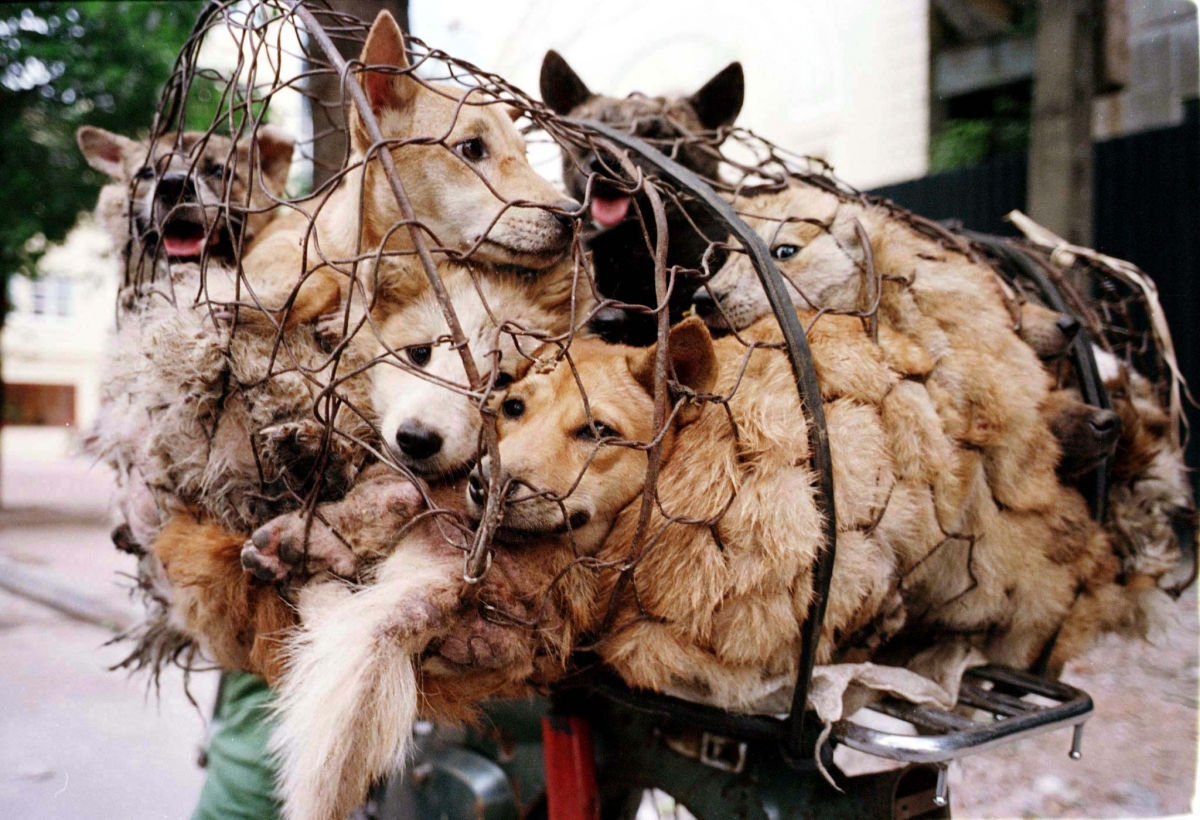
Yes, that's right DOG EATING FESTIVAL. Up to 10,000 dogs and 10,000 cats are estimated to be killed each year during the barbarous event. The festival, which takes place in Guangxi province is not actually traditional but was invented five years ago by dog meat traders to boost business.

In preparation for the festival, the Humane Society International has filmed thousands of animals, many of them pets still wearing collars, being seized from the streets.


The society is asking supporters to sign its petition to China’s Guangxi Party Secretary Peng Qinghua.

The society claims up to 10million dogs a year are slaughtered in China to fuel the appetite for their flesh, although it insists many Chinese oppose the barbaric practice.

The authorities in Yulin have officially banned the festival after bad publicity but it is still going on. They introduced tactics such as stopping dog meat trucks entering the area and removing the words 'dog meat' from restaurant menus.


But despite the tough clamp down, many in the city still have an appetite for canine food, which is a lucrative industry. Chinese myths claim eating evil dog meat can rid the body of evil spirits and can provide a boost to sexual performance.

There is also the Care2 petition you can also sign.

Wednesday, 3 June 2015

Monkey Translator Dies

Some of you may remember the 1970's BBC series "Monkey", the story of how the Monkey king and his friends Pigsy and Sandy accompany the monk Tripitaka on his pilgrimage to find the ancient Buddhist scrolls that will establish peace throughout the world.


The saga, a Japanese television series dubbed into English, was based on the 16th Century Chinese novel by Wu ch'eng-en, “The Journey to the West.”. An unabridged, four-volume, 1,873-page English version of the monk’s mythological narrative was produced by Professor Anthony C. Yu who spent over fifteen years translating the work which is considered to be one of the Four Great Classical Novels of Chinese literature. 


Sadly Professor Yu died last month aged 76.

Wednesday, 6 May 2015

More Interesting?

Last election I posted the following observation regarding a hung parliament..........

"May you live in interesting times", (an ancient Chinese curse)!


plus ça change, plus c'est la même chose


Thursday, 4 December 2014

Zen "In Our Time"

Some of you may have heard Melvyn Bragg's Radio 4 program, "In Our Time" this morning in which the subject discussed was Zen Buddhism. If you did you will have learnt precious little about Zen or indeed Buddhism!


The whole program was a bit of a mishmash not helped by the fact that Bragg was obviously suffering from a ferocious cold. The guests, Tim Barrett, Emeritus Professor in the Department of the Study of Religions at SOAS, University of London, Lucia Dolce, Numata Reader in Japanese Buddhism at SOAS, University of London and Eric Greene, Lecturer in East Asian Religions at the University of Bristol failed to get over some key points. The most central one being the nature of Zen meditation, Zazen. Constantly reiterating that it meant "just" sitting was singularly uninformative so I'm quoting from the "Rules for Meditation" from the Soto Zen tradition...........

"You should meditate in a quiet room, eat and drink moderately, cut all ties, give up everything, think of neither good nor evil, consider neither right nor wrong. Control mind function, will, consciousness, memory, perception and understanding; you must not strive thus to become Buddha. Cling to neither sitting nor lying down. When meditating, do not wear tight clothing. Rest the left hand in the palm of the right hand with the thumbs touching lightly; sit upright, leaning neither to left nor right, backwards nor forwards. The ears must be in line with the shoulders and the nose in line with the navel; the tongue must be held lightly against the back of the top teeth with the lips and teeth closed. Keep the eyes open, breathe in quickly, settle the body comfortably and breathe out sharply. Sway the body left and right then sit steadily, neither trying to think nor trying not to think; just sitting, with no deliberate thought, is the important aspect of serene reflection meditation."

As you can see there is a little more to it than "just sitting" but as always I'll let you listen and decide for yourselves.................


I have also placed this on the Miscellaneous page of our Audio section where you can download it.

Friday, 3 October 2014

China Throws its Weight Around, Again

The World Summit of Nobel Peace Laureates, which was supposed to happen in Cape Town, has been cancelled after the South African government refused a visa to the Dalai Lama.

South Africa denied Tibet's exiled spiritual leader permission to attend the summit to avoid angering China, which regards the Buddhist monk as a "splitist" who wants Tibet to secede from China.

When the Dalai Lama announced he could not attend the meeting, six fellow laureates said they would boycott the summit in protest.

 “The venue of the summit has been shifted out of South Africa,” Nobel Peace Prize laureate Jody Williams, one of the boycotters, said to American reporters today. Williams was speaking from Dharamsala, India, where she was visiting the Dalai Lama to celebrate his Nobel silver jubilee anniversary celebrations yesterday.

Nobel peace laureate Desmond Tutu has lashed out at his government for "kowtowing" to China by barring the Dalai Lama from attending the global summit in Cape Town.

 Mr Tutu said the move sullies the memory of Nelson Mandela, who would not bend to the will of powerful states in his time as president. "When the Americans told him he couldn't continue his friendship with presidents Gaddafi and Castro, he told them to go and jump in the lake," Mr Tutu said.


Mr Mandela's heirs in the ruling African National Congress party under president Jacob Zuma had now "spat in Mandela's face", Mr Tutu said in a statement.

Friday, 1 August 2014

Shamar Rinpoche's Cremation Goes Ahead

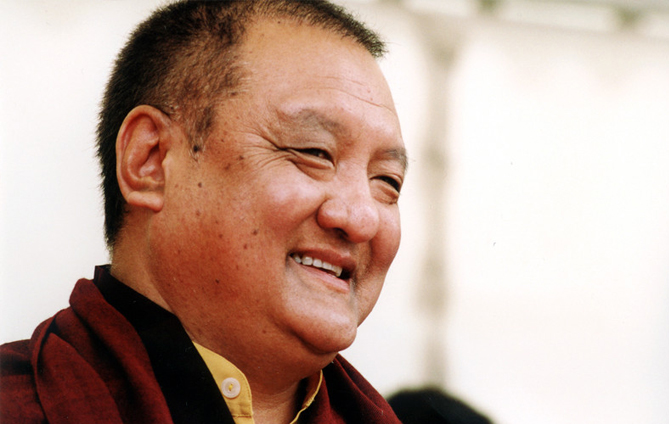
Yesterday thousands of Tibetan exiles attended the funeral in Nepal of Shamar Rinpoche, one of Tibetan Buddhism's most senior monks who died last month in Germany of a heart attack aged 62.


Nepal’s government announced on Tuesday that it would allow the funeral and cremation of Shamar Rinpoche to take place in the country, reversing an earlier refusal seen by some as resulting from pressure from China.

The decision came after Prime Minister Sushil Koirala returned from the United States following treatment for lung cancer and held an emergency cabinet session to overrule his deputy prime minister, Bam Dev Gautam. Shamar Rinpoche's body was brought from Bhutan on Tuesday to Shar Minub, the monastery he ran near the capital Kathmandu.

“The cabinet meeting endorsed a policy to cremate a foreigner’s body in Nepal if they have cultural and religious ties to Nepal and wish to be cremated here,” said Minendra Rijal, a government spokesman.

Wednesday, 4 June 2014

Tiananmen Square, Liao Yiwu's Poem "Massacre"

25 years ago today hundreds of students and residents were killed when the Chinese army pushed into Tiananmen Square in Peking to retake it from the student protesters who were calling for government accountability, freedom of the press, freedom of speech, and the restoration of workers' control over industry. This is Chinese author, reporter, musician, and poet Liao Yiwu's Poem about that day............................

“MASSACRE”

Leap! Howl! Fly! Run!
Freedom feels so good!
Snuffing out freedom feels so good!
Power will be triumphant forever.
Will be passed down from generation to generation forever.
Freedom will also come back from the dead.
It will come back to life in generation after generation.
Like that dim light just before the dawn.
No. There’s no light.
At Utopia’s core there can never be light.
Our hearts are pitch black.
Black and scalding.
Like a corpse incinerator.
A trace of the phantoms of the burned dead.
We will exist.
The government that dominates us will exist.
Daylight comes quickly.
It feels so good.
The butchers are still ranting!
Children. Children, your bodies all cold.
Children, your hands grasping stones.
Let’s go home.
Brothers and sisters, your shattered bodies littering the earth.
Let’s go home.
We walk noiselessly.
Walk three feet above the ground.
All the time forward, there must be a place to rest.
There must be a place where sounds of gunfire and explosions cannot
be heard.
We so wish to hide within a stalk of grass.
A leaf.
Uncle. Auntie. Grandpa. Granny. Daddy. Mummy.
How much farther till we’re home?
We have no home.
Everyone knows.
Chinese people have no home.
Home is a comforting desire.
Let us die in this desire.
OPEN FIRE, BLAST AWAY, FIRE!
Let us die in freedom.
Righteousness. Equality. Universal love.
Peace, in these vague desires.
Stand on the horizon.
Attract more of the living to death!
It rains.
Don’t know if it is rain or transparent ashes.
Run quickly, Mummy!
Run quickly, son!
Run quickly, elder brother!
Run quickly, little brother!
The butchers will not let up.
An even more terrifying day is approaching.
OPEN FIRE! BLAST AWAY! FIRE! IT FEELS GOOD! FEELS SO
GOOD! . . .
Cry cry cry crycrycrycrycrycrycry
We stand in the midst of brilliance but all people are blind.
We stand on a great road but no one is able to walk.
We stand in the midst of a cacophony but all are mute.
We stand in the midst of heat and thirst but all refuse to drink.
In this historically unprecedented massacre only the spawn of dogs
can survive.

Here Liao Yiwu performs his poem in the original chinese...........................