Showing posts with label BBC. Show all posts
Thursday, 15 November 2018
A Phrase That I Liked
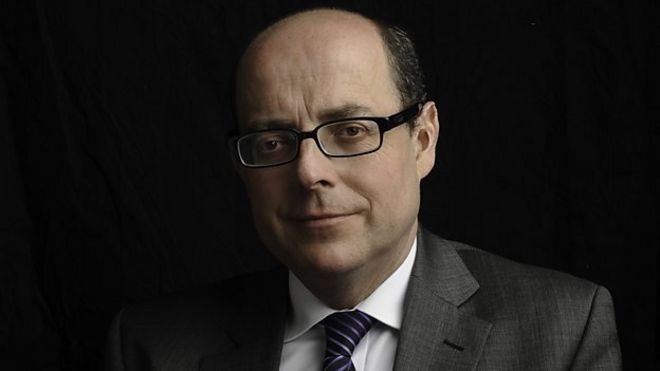
On this morning's Today program on Radio 4, Nick Robinson was interviewing Matt Hancock, the Secretary of State for Health, on the draft Brexit deal. When Mr Hancock tried to pull the conversation round to the future trade arrangements with the EU,
Robinson said: "We'll come to the future in a second."
Philosophical presentism is the view that neither the future nor the past exist. In some versions of presentism, this view is extended to timeless objects or ideas (such as numbers). According to presentism, events and entities that are wholly past or wholly future do not exist at all.
To live in the present moment is the basic foundation of Buddhism.
"Being in the moment is just another way of saying that we are aware of what is going on in our experience, that we are not just being angry (or whatever) but are aware that we are angry and are aware that we can choose to be otherwise............
Of course a lot of the time when we are not being in the moment, we are literally thinking about the past or present. We might be dwelling on the past – brooding about some past hurt. Or we may be fantasizing about a future in which we have won the lottery and are living out our lives in some imagined paradise, or daydreaming about being with the perfect partner.
Often these fantasized pasts and futures are not even real possibilities, but simply fantasies of how things might be or of how we would have liked them to have been. And as with all unmindful activity, we have no awareness that this fantasizing is pointless. All that it does is reinforce unhelpful emotional tendencies that can never truly enrich our lives."
Bodhipaksa
Wednesday, 3 October 2018
Something Understood
Last Sunday one of our Sangha members recommended this week's offering on the BBC Radio 4
program, "Something Understood". The piece is "Cultivating Kindness", by Suryagupta Dharmacharini, Chair of the London Buddhist Centre. In this episode, Suryagupta explores the Metta Bhavana meditation practice - the technique for the cultivation of kindness created by the Buddha.
Unfortunately, this program is not available as a podcast so here is the link to it on the iPlayer, but hurry, it is only available until the end of the month.
https://www.bbc.co.uk/radio/play/b0blgj7k
There are some great tracks featured; Hurt by Johnny Cash, No Love Dying by Gregory Porter, Stand By Me by Tracy Chapman, A Love Supreme, Pt. I – Acknowledgement by John Coltrane and also readings from works by Achaan Chah, Dostoyevsky, Ryokan, Rumi, The Buddha and others.
program, "Something Understood". The piece is "Cultivating Kindness", by Suryagupta Dharmacharini, Chair of the London Buddhist Centre. In this episode, Suryagupta explores the Metta Bhavana meditation practice - the technique for the cultivation of kindness created by the Buddha.
Unfortunately, this program is not available as a podcast so here is the link to it on the iPlayer, but hurry, it is only available until the end of the month.
https://www.bbc.co.uk/radio/play/b0blgj7k
There are some great tracks featured; Hurt by Johnny Cash, No Love Dying by Gregory Porter, Stand By Me by Tracy Chapman, A Love Supreme, Pt. I – Acknowledgement by John Coltrane and also readings from works by Achaan Chah, Dostoyevsky, Ryokan, Rumi, The Buddha and others.
Sunday, 12 August 2018
Boris, Labour and Wise Speech
You can download the talk from our Audio Section...........
Thursday, 2 August 2018
Vishvapani and Vesak
I've just posted Vishvapani's "Thought for the Day" from Friday onto our Audio Section.
This is the first talk from Vishvapani since the 14th of May which is a little curious. In the past Vishvapani has usually offered a "Thought" on the occasion of Vesak, the celebration of the Buddha's birth, awakening and death which are all considered to have occurred on the first full moon of May which this year fell on the 29th.
Now he's missed a couple of Vesaks over the years and there could be any number of reasons that he's missed this one, but that is not my point, why are there no other Buddhists who can provide a "thought" on such an important occasion?
On Thought for the Day the majority of contributors are Christian, although there are regular Muslim and Jewish contributors and occasional Hindus, Sikhs and Buddhists.
The BBC allocates the number of slots roughly in line with the proportion of each affiliation according to the latest census (2011). So, in terms of faith background, 78% of presenters were Christians, 8% Jews, 4% Muslims, 4% Sikhs, 3% Hindus and 2% Buddhists. Relative to the 2001 census of the population of the UK, and excluding those with no religious affiliation or none stated, Christians were under-represented as presenters (93% being their expected share, given Thought for the Day’s current brief).
By contrast, Jews, Sikhs, Hindus and Buddhists were over-represented in leading Thought for the Day, with the representation of Muslims nearly right in terms of the census (although their numbers have increased considerably since that time).
So, we are not going to get many slots, in fact from when I started posting "Thoughts for the Day" back in 2010 Vishvapani has averaged 8 talks a year but, coming back to my point, it is only ever Vishvapani who supplies a Buddhist Thought for the Day, surely the BBC can find another Buddhist or two to take up the slack and provide some variety of presentation.
This is the first talk from Vishvapani since the 14th of May which is a little curious. In the past Vishvapani has usually offered a "Thought" on the occasion of Vesak, the celebration of the Buddha's birth, awakening and death which are all considered to have occurred on the first full moon of May which this year fell on the 29th.
Now he's missed a couple of Vesaks over the years and there could be any number of reasons that he's missed this one, but that is not my point, why are there no other Buddhists who can provide a "thought" on such an important occasion?
On Thought for the Day the majority of contributors are Christian, although there are regular Muslim and Jewish contributors and occasional Hindus, Sikhs and Buddhists.
The BBC allocates the number of slots roughly in line with the proportion of each affiliation according to the latest census (2011). So, in terms of faith background, 78% of presenters were Christians, 8% Jews, 4% Muslims, 4% Sikhs, 3% Hindus and 2% Buddhists. Relative to the 2001 census of the population of the UK, and excluding those with no religious affiliation or none stated, Christians were under-represented as presenters (93% being their expected share, given Thought for the Day’s current brief).
By contrast, Jews, Sikhs, Hindus and Buddhists were over-represented in leading Thought for the Day, with the representation of Muslims nearly right in terms of the census (although their numbers have increased considerably since that time).
So, we are not going to get many slots, in fact from when I started posting "Thoughts for the Day" back in 2010 Vishvapani has averaged 8 talks a year but, coming back to my point, it is only ever Vishvapani who supplies a Buddhist Thought for the Day, surely the BBC can find another Buddhist or two to take up the slack and provide some variety of presentation.
Tuesday, 28 November 2017
A Bit of Controversy?
Some of you may have heard the story a few days ago of Engineers dowsing for water using L or Y-shaped divining rods. Their use came to light when a couple called out engineers from the Severn Trent water company to their home in the Midlands.
They were so astonished to see a technician use dowsing rods to locate the mains pipe that they contacted their daughter Sally Le Page, an Oxford University scientist. She contacted Severn Trent, who confirmed their technicians still use the method.
Now many of you who have attended some of our recent Meditation Retreat Days will have had a go at divining. I have been interested in the subject for a number of years and introduced a "sampling session" to the retreat days as a demonstration that we can be mindful and aware of very subtle influences in our environment. I give brief instructions as to how to correctly hold the rods (we use 30 inch braising rods with 6 inches bent at a right angle to form the handle) and how to walk slowly and attentively.
The would be diviner is then given a direction to walk and started on their way, no additional instructions, no clues and no prompts just advice on grip and walking speed. Everyone gets some sort of reaction and at the same points.
I first came across dowsing when a colleague brought a pair of rods into work. I hadn't a clue as to what they were so asked. He sheepishly replied that he had to put up some shelves and wanted to know if there was any wiring in the wall where he had to drill.
As I was looking very strangely at him he gave them to me, showed me how to hold them and told me to just walk across the office. I took about five steps and the rods swung violently across each other almost pointing directly back at me. In total bemusement I asked, "what the hell happened there". He told me to look at my feet, it was a modern office block and all the cabling was routed through underfloor trunking - I was standing directly on top of a section.
I asked my friend how he discovered dowsing and his story was almost identical to that of Ms Le Page's parents. Two chaps from the Gas Board turned up after he had reported a drop in the gas pressure to his property, they said that they had a problem with their gas detector so they were going to use divining rods as they always used to in the past but begged my friend not to mention it to "management". The rods were used, a single hole was dug and the leak fixed.
Now I'm not going to make any claims for dowsing other than to say, that in my experience, the vast majority of people that try dowsing succeed in detecting something. This may be because we detect subtle clues from our environment but that is my point, we can be mindful of those usually ignored parts of our field of awareness.
Just out of interest if you Google Ms Le Page, unlike most such searches the hits keep on going, I got to page 15 before Google started to go off piste and started referencing other le pages, you will also get acres of pictures on an image search.
Maybe it has something to do with the fact that General Electric has launched a “creator-in-residence” program, tapping 22-year-old British biologist and Oxford PhD candidate Sally Le Page as its first face. Le Page, who first gained a YouTube following with her self-produced videos, made a video a week for GE throughout June 2015, tackling subjects like the science behind movie magic and the relationship between humans and machines. One of Le Page’s most popular GE videos focused on Chappie, a science fiction film. The video, which kicks off with Le Page asking, “When am I going to have a robot best friend?” includes an interview with the project leader of GE’s robotics program and a visit to the company’s Global Research Centre.
Could Ms Le page's parents' much publicised outrage be anything to do with actually publicising their already much promoted daughter and was her response part of her continued quest for ever higher celebrity status re her considerable social media presence?
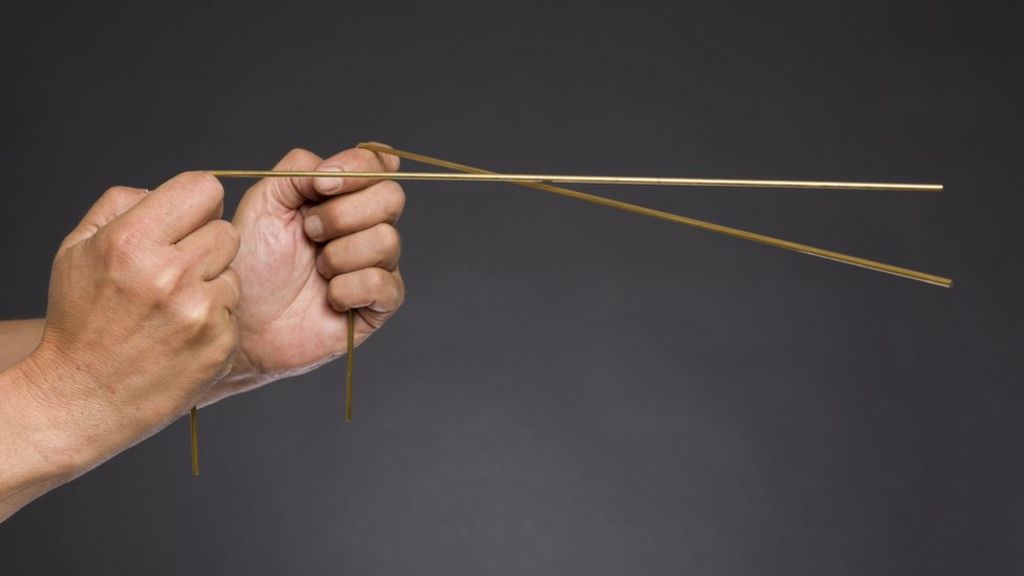
Now many of you who have attended some of our recent Meditation Retreat Days will have had a go at divining. I have been interested in the subject for a number of years and introduced a "sampling session" to the retreat days as a demonstration that we can be mindful and aware of very subtle influences in our environment. I give brief instructions as to how to correctly hold the rods (we use 30 inch braising rods with 6 inches bent at a right angle to form the handle) and how to walk slowly and attentively.
The would be diviner is then given a direction to walk and started on their way, no additional instructions, no clues and no prompts just advice on grip and walking speed. Everyone gets some sort of reaction and at the same points.
I first came across dowsing when a colleague brought a pair of rods into work. I hadn't a clue as to what they were so asked. He sheepishly replied that he had to put up some shelves and wanted to know if there was any wiring in the wall where he had to drill.
As I was looking very strangely at him he gave them to me, showed me how to hold them and told me to just walk across the office. I took about five steps and the rods swung violently across each other almost pointing directly back at me. In total bemusement I asked, "what the hell happened there". He told me to look at my feet, it was a modern office block and all the cabling was routed through underfloor trunking - I was standing directly on top of a section.
I asked my friend how he discovered dowsing and his story was almost identical to that of Ms Le Page's parents. Two chaps from the Gas Board turned up after he had reported a drop in the gas pressure to his property, they said that they had a problem with their gas detector so they were going to use divining rods as they always used to in the past but begged my friend not to mention it to "management". The rods were used, a single hole was dug and the leak fixed.
Now I'm not going to make any claims for dowsing other than to say, that in my experience, the vast majority of people that try dowsing succeed in detecting something. This may be because we detect subtle clues from our environment but that is my point, we can be mindful of those usually ignored parts of our field of awareness.
Just out of interest if you Google Ms Le Page, unlike most such searches the hits keep on going, I got to page 15 before Google started to go off piste and started referencing other le pages, you will also get acres of pictures on an image search.
Maybe it has something to do with the fact that General Electric has launched a “creator-in-residence” program, tapping 22-year-old British biologist and Oxford PhD candidate Sally Le Page as its first face. Le Page, who first gained a YouTube following with her self-produced videos, made a video a week for GE throughout June 2015, tackling subjects like the science behind movie magic and the relationship between humans and machines. One of Le Page’s most popular GE videos focused on Chappie, a science fiction film. The video, which kicks off with Le Page asking, “When am I going to have a robot best friend?” includes an interview with the project leader of GE’s robotics program and a visit to the company’s Global Research Centre.
Could Ms Le page's parents' much publicised outrage be anything to do with actually publicising their already much promoted daughter and was her response part of her continued quest for ever higher celebrity status re her considerable social media presence?Friday, 30 December 2016
A Buddhist Father Christmas
The Listening Project is a BBC Radio 4 initiative that offers a snapshot of contemporary Britain in which people across the UK volunteer to have a conversation with someone close to them about a subject they've never discussed intimately before.
Just before Christmas Fi Glover introduced a conversation between a Buddhist Father Christmas and a Baptist chaplain about how they spend Christmas morning in the hospice. Another in the series that proves it's surprising what you hear when you listen.
Wednesday, 27 April 2016
Note - Latest Vishvapani Talks Now Available
The latest "Thought for the Day" talks by Vishvapani are now available in our
Audio Section."Education"
The Buddhist ethical precepts telling people to avoid killing, lying and so on, are described as ‘training principles’ that invite us to adopt the underlying attitude the rule expresses...................................
"Shakespeare and the Buddha"
"For me, Shakespeare is more than a poet or a playwright. Of course, he isn’t a teacher as the Buddha is. But I see them both, in different ways, as heroes of consciousness who offer new ways of seeing and open up new ways of being".
Friday, 2 October 2015
Note - Latest Vishvapani Talk Now Available
The latest "Thought for the Day" talk by Vishvapani on "Our Assumptions and Biases" is now available in our Audio Section.
........ Looking at these seemingly intractable issues as a Buddhist, I reflect, firstly on the importance of self-scrutiny. Buddhism stresses that we tend to see the world in a way that confirms our assumptions and biases. What's more, belief systems and ideologies can objectify and justify those assumptions, presenting them as the objective truth and creating fixed, dogmatic views of ourselves and the world.
That's why Buddhism stresses holding our views lightly and listening, openly and with compassion, to those we might otherwise dismiss. But it also warns that the past can be a trap. We can't change history, and dwelling on grievances can in fact reinforce them.
Thursday, 20 August 2015
Note - Latest Vishvapani Talk Now Available
The latest "Thought for the Day" talk by Vishvapani on the "Good Children Report" is now available in our Audio Section.
Sunday, 5 July 2015
Emily Maitlis Interviews the Dalai Lama
Tonight on BBC4 TV Emily Maitlis will be interviewing the Dalai Lama about his spiritual "beliefs" and his views on politics and aging.
The program is entitled Dalai Lama at 80 and airs at 7:00 pm.
If you're reading this after the event you can catch it here on the BBC iPlayer
The program is entitled Dalai Lama at 80 and airs at 7:00 pm.
If you're reading this after the event you can catch it here on the BBC iPlayer
Monday, 12 January 2015
Finally, The Missing Thought
Here at last is Mona Siddiqui's thought for the day on the atrocities at "Charlie Hebdo".
`Je suis Charlie’ was all over social media yesterday in widespread condemnation of the tragic killing of the Charlie Hebdo journalists and policemen in Paris; a show of solidarity with the dead and the injured and an act of defiance against the Islamist perpetrators. This was a cold and carefully planned attack after years of threats against the satirical magazine for its cartoons of the Prophet.
The editor Stéphane Charbonnier, known simply as "Charb," was one of the victims paying the ultimate price for a magazine which refused to be silenced especially in its portrayal of religions. For some people the magazine was outrageously bold, overstepping the boundaries of decency and taste while others saw it as clever and inspirational, challenging anything and everything, central to the establishment, with its own history and ideals of the French republic. It’s been closed down before, it’s run out of money, warned for being too provocative but it stood resolute with the editor once saying, "When activists need a pretext to justify their violence, they always find it." And in 2012, he bravely told Le Monde, I would rather die standing than live on my knees.’ For Charb, there was never any intention of giving into fear, telling the New Yorker, that mocking Islam must continue "until Islam is just as banal as Catholicism." Ridicule against extremism was his weapon and it angered those who could only confront satire with guns. But in using the prophet as an excuse to kill, the gunmen chose to ignore the Qur’anic reprimand of Muhammad himself that he had no right to impose his belief on others.
The defence of free speech is again at the forefront and while freedom of expression may never be absolute, let it set its own limits rather than be frightened into submission. I've heard many say that just because you can say something doesn’t mean you should and at a purely pragmatic level that may sometimes be true. But it is free speech which gives minorities the right to practice their religion, groups to hold anti-war rallies and journalists to expose the tyrannies and hypocrisies of power. Freedom of expression with all its messy boundaries lies at the very core of liberal societies; if you lose this fundamental and hard fought privilege, you've lost the very soul of western freedoms.
These actions will only entrench social tensions about Islam in Europe. The irony of course is that more people will now see the very cartoons these gunmen wanted banned. And they will also see that their actions killed 12 but brought together thousands across the world, waving a pen in their hands holding vigils and showing that if gunshots try to divide us, the simple act of being with one another can still unite us.
The audio version of this can be found on the "Thought for the Day" page of our Audio Section where you can also download it.
`Je suis Charlie’ was all over social media yesterday in widespread condemnation of the tragic killing of the Charlie Hebdo journalists and policemen in Paris; a show of solidarity with the dead and the injured and an act of defiance against the Islamist perpetrators. This was a cold and carefully planned attack after years of threats against the satirical magazine for its cartoons of the Prophet.
The editor Stéphane Charbonnier, known simply as "Charb," was one of the victims paying the ultimate price for a magazine which refused to be silenced especially in its portrayal of religions. For some people the magazine was outrageously bold, overstepping the boundaries of decency and taste while others saw it as clever and inspirational, challenging anything and everything, central to the establishment, with its own history and ideals of the French republic. It’s been closed down before, it’s run out of money, warned for being too provocative but it stood resolute with the editor once saying, "When activists need a pretext to justify their violence, they always find it." And in 2012, he bravely told Le Monde, I would rather die standing than live on my knees.’ For Charb, there was never any intention of giving into fear, telling the New Yorker, that mocking Islam must continue "until Islam is just as banal as Catholicism." Ridicule against extremism was his weapon and it angered those who could only confront satire with guns. But in using the prophet as an excuse to kill, the gunmen chose to ignore the Qur’anic reprimand of Muhammad himself that he had no right to impose his belief on others.
The defence of free speech is again at the forefront and while freedom of expression may never be absolute, let it set its own limits rather than be frightened into submission. I've heard many say that just because you can say something doesn’t mean you should and at a purely pragmatic level that may sometimes be true. But it is free speech which gives minorities the right to practice their religion, groups to hold anti-war rallies and journalists to expose the tyrannies and hypocrisies of power. Freedom of expression with all its messy boundaries lies at the very core of liberal societies; if you lose this fundamental and hard fought privilege, you've lost the very soul of western freedoms.
These actions will only entrench social tensions about Islam in Europe. The irony of course is that more people will now see the very cartoons these gunmen wanted banned. And they will also see that their actions killed 12 but brought together thousands across the world, waving a pen in their hands holding vigils and showing that if gunshots try to divide us, the simple act of being with one another can still unite us.
The audio version of this can be found on the "Thought for the Day" page of our Audio Section where you can also download it.
Saturday, 10 January 2015
The Curious Case of the Disappearing Thought
As mentioned in the previous post there was an apparently (I only caught the tail end of it) sane and balanced talk by Prof. Mona Siddiqui on the events in Paris broadcast in the thought for the day slot of BBC radio 4's Today program.
Siddiqui, who is Professor of Islamic and Interreligious Studies at the University of Edinburgh gave her talk at 07:48 on Thursday the 8th, the day following the Charlie Hebdo atrocity.
Thoughts for the day are usually available to listen to again, read the text thereof, obtain the embed code or to download as a podcast the next day - this all stopped following Professor Siddiqui's item as you can see by following the link above.
We will bring you the talk as soon as the BBC deign to make it available, as to why they haven't done so already a number of possibilities spring to mind (but then that's what minds do).
UPDATE, This finally became available mid-morning on Monday the 12th!
Siddiqui, who is Professor of Islamic and Interreligious Studies at the University of Edinburgh gave her talk at 07:48 on Thursday the 8th, the day following the Charlie Hebdo atrocity.
Thoughts for the day are usually available to listen to again, read the text thereof, obtain the embed code or to download as a podcast the next day - this all stopped following Professor Siddiqui's item as you can see by following the link above.
We will bring you the talk as soon as the BBC deign to make it available, as to why they haven't done so already a number of possibilities spring to mind (but then that's what minds do).
UPDATE, This finally became available mid-morning on Monday the 12th!
Thursday, 18 December 2014
A Buddhist Response to the Peshawar Massacre
I wondered whether or not to respond to the mass slaughter of children in Peshawar and indeed how to without engendering even more reactivity but then I listened to Vishvapani's Thought for the day on the BBC this morning. He said it so much better than I could so here is what he had to say............Of all the horrors we’ve seen in the international conflict with radical Islam, Wednesday’s massacre at the army school in Peshawar must be among the most ghastly. When defenceless women and children are targeted on this scale, we’ve reached a new level of barbarism.
How did we get here? Without detracting from the attack’s distinctive horror, it stems from a spiral of violence and escalating conflict. When did it all start: the Pakistani army’s campaign against the Taliban? The wars in Afghanistan and Iraq? 9/11? The legacy of occupation and empire that stretches back over centuries? The causes are endless: perhaps that’s the nature of conflicts. And the solutions are doubtful. The Pakistani army may be victorious, but at what cost, and with what consequences? Perhaps this war will spread, or merge into the region’s other conflicts; or perhaps the barbarism will just continue to escalate.
Reflecting on the conflicts of his own time, the Buddha alighted on a singular term for what he observed: proliferation. Causes multiply into diverse effects, especially when ideology and beliefs magnify them. He made sense of this by noting the parallel with what happens in our minds: one irritable thought begets another, which becomes a compelling narrative about what’s happening; and, soon enough, we act.
This psychological approach led the Buddha to locate the ultimate causes of war and conflict in the minds of individual human beings. We’ll do anything to banish unpleasant feelings and put things right when we feel they’re wrong, even if that leads us to act in ways we’d otherwise condemn. That’s how otherwise decent people come to justify the use of torture.
In the Buddhist view, nothing good can result when we’re driven by hatred, anger and the desire for revenge. Blood will have blood. This doesn’t mean that force should never be used or that wars are never justified; but it’s a strong caution to check the impulse to act out of anger, to note the moral distortion that rigid ideology can bring, and to allow space for other wiser responses that come when we put anger aside.
Proliferation ends, the Buddha suggested, when we learn to tolerate pain, rather than reacting to it, and when patience and forgiveness give us the mental space to act with love. For me, that’s the ultimate challenge of the barbarity in Pakistan. The world is good at creating warmongers. Peacemakers have to make themselves.
(You can listen to Vishvapani's talk and download it HERE)
Thursday, 4 December 2014
Zen "In Our Time"
Some of you may have heard Melvyn Bragg's Radio 4 program, "In Our Time" this morning in which the subject discussed was Zen Buddhism. If you did you will have learnt precious little about Zen or indeed Buddhism!
The whole program was a bit of a mishmash not helped by the fact that Bragg was obviously suffering from a ferocious cold. The guests, Tim Barrett, Emeritus Professor in the Department of the Study of Religions at SOAS, University of London, Lucia Dolce, Numata Reader in Japanese Buddhism at SOAS, University of London and Eric Greene, Lecturer in East Asian Religions at the University of Bristol failed to get over some key points. The most central one being the nature of Zen meditation, Zazen. Constantly reiterating that it meant "just" sitting was singularly uninformative so I'm quoting from the "Rules for Meditation" from the Soto Zen tradition...........
"You should meditate in a quiet room, eat and drink moderately, cut all ties, give up everything, think of neither good nor evil, consider neither right nor wrong. Control mind function, will, consciousness, memory, perception and understanding; you must not strive thus to become Buddha. Cling to neither sitting nor lying down. When meditating, do not wear tight clothing. Rest the left hand in the palm of the right hand with the thumbs touching lightly; sit upright, leaning neither to left nor right, backwards nor forwards. The ears must be in line with the shoulders and the nose in line with the navel; the tongue must be held lightly against the back of the top teeth with the lips and teeth closed. Keep the eyes open, breathe in quickly, settle the body comfortably and breathe out sharply. Sway the body left and right then sit steadily, neither trying to think nor trying not to think; just sitting, with no deliberate thought, is the important aspect of serene reflection meditation."
As you can see there is a little more to it than "just sitting" but as always I'll let you listen and decide for yourselves.................
I have also placed this on the Miscellaneous page of our Audio section where you can download it.
The whole program was a bit of a mishmash not helped by the fact that Bragg was obviously suffering from a ferocious cold. The guests, Tim Barrett, Emeritus Professor in the Department of the Study of Religions at SOAS, University of London, Lucia Dolce, Numata Reader in Japanese Buddhism at SOAS, University of London and Eric Greene, Lecturer in East Asian Religions at the University of Bristol failed to get over some key points. The most central one being the nature of Zen meditation, Zazen. Constantly reiterating that it meant "just" sitting was singularly uninformative so I'm quoting from the "Rules for Meditation" from the Soto Zen tradition...........
"You should meditate in a quiet room, eat and drink moderately, cut all ties, give up everything, think of neither good nor evil, consider neither right nor wrong. Control mind function, will, consciousness, memory, perception and understanding; you must not strive thus to become Buddha. Cling to neither sitting nor lying down. When meditating, do not wear tight clothing. Rest the left hand in the palm of the right hand with the thumbs touching lightly; sit upright, leaning neither to left nor right, backwards nor forwards. The ears must be in line with the shoulders and the nose in line with the navel; the tongue must be held lightly against the back of the top teeth with the lips and teeth closed. Keep the eyes open, breathe in quickly, settle the body comfortably and breathe out sharply. Sway the body left and right then sit steadily, neither trying to think nor trying not to think; just sitting, with no deliberate thought, is the important aspect of serene reflection meditation."
As you can see there is a little more to it than "just sitting" but as always I'll let you listen and decide for yourselves.................
I have also placed this on the Miscellaneous page of our Audio section where you can download it.
Saturday, 5 July 2014
Another Thought for the Day talk by Vishvapani
Buddhist Thought for the Day talks by Vishvapani are like buses, you wait for ages and then TWO turn up! Here is the second of the latest batch, "Sangha and Health".
Saturday, 28 June 2014
Note - Latest Vishvapani Talk Now Available
The latest "Thought for the Day" talk by Vishvapani on Buddhist compassion is now available in our Audio Section.
Wednesday, 14 May 2014
Wesak with Vishvapani
This morning to, acknowledge Wesak, BBC Radio 4's Thought for the Day was by Vishvapani.This week Buddhists around the world celebrate the Buddha’s Enlightenment in the festival of Wesak or Buddha Day. Buddhists believe that on night of the May full moon he sat beneath a spreading fig tree and entered a state of deep concentration.........................
DOWNLOAD
Friday, 4 April 2014
Two New Talks
Rodney's talk emphasises the need to quieten the constant dialogue which creates and reinforces the form that we take to be "us". Vicky speaks of the need to escape the noise of our technology and find a space in silence.
Monday, 10 March 2014
Two New Buddhist Thoughts for the Day
Both the new talks by Vishvapani can be heard on the Thought for the Day page of our Audio Section. You can also download them directly from the page.
Tuesday, 11 February 2014
Talk by Vishvapani
You can access it here, "The Winter Olympics, Tennis, Sport and Meditation" or go to our Audio Section, Thought for the Day page for more by Vishvapani and other speakers.
Subscribe to:
Posts (Atom)