All chains of confinement fall away
from those who see clearly
and know well the states
of concentration and insight.
Dhammapada v. 384
A visitor to the monastery asked the meditation master, Venerable Ajahn Chah, how we can practice concentration meditation (samadhi) when in reality there is no self. The teacher explained that when we are developing concentration we work with a self. When we are developing insight (vipassana) we work with non-self. Then when we truly know what’s what, we are beyond both self and non-self.
With Metta, Bhikkhu Munindo
To study the Way is to study the self. To study the self is to forget the self. To forget the self is to be enlightened by all things of the universe. To be enlightened by all things of the universe is to cast off the body and mind of the self as well as those of others. Even the traces of enlightenment are wiped out, and life with traceless enlightenment goes on forever and ever.
Eihei Dōgen
Tuesday, 21 February 2012
Saturday, 18 February 2012
Olympic Truce Walk
The Olympic Truce is an ancient tradition of nations observing ceasefires for the duration of the Games so that competitors can travel safely to and from the event.
After lobbying government, one member of the House of Lords is trying to raise the profile of the truce which has been signed by all 193 member states of the U.N.
To show his support for this Olympic ideal, Lord Michael Bates of Langbaurgh, is walking from Olympia in Greece to London – a journey of over 3,000 miles. Through his Walk for Truce initiative, Lord Bates hopes to encourage others to do something to show their commitment to the London 2012 Olympic Truce resolution. Watch the following video to find out more...........
Wednesday, 15 February 2012
Animation Against Factory Farming
A stop-motion short slamming factory farming practices aired at the Grammys on Saturday.
The short film follows the story of one farmer as he industrialises his land to help support his growing family. As time goes on, he realizes the ugliness and unsustainability of factory farming, and converts his farm back to focusing on free-range livestock. It also features a cover version by Willie Nelson of Coldplay’s “The Scientist”.
Compassion in World Farming was founded over 40 years ago in 1967 by a British farmer who became horrified by the development of modern, intensive factory farming.
Tuesday, 14 February 2012
Secularism under attack
The High Court ruled on Friday the saying of prayers as a formal part of a council meeting was unlawful, following a case brought by the National Secular Society and an atheist town councillor from Bideford, Devon.
On Friday, Mr Justice Ouseley said: "The saying of prayers as part of the formal meeting of a council is not lawful under section 111 of the Local Government Act 1972 and there is no statutory power permitting the practice to continue."
The ruling went on to state prayers could be said in a council chamber before a formal meeting as long as councillors were not required to attend.
But church leaders said it amounted to a victory for an “aggressive secularist agenda” intent on banishing religion from public life.
Eric Pickles, the Communities Secretary, has lawyers preparing to issue emergency legal guidance to councils, effectively urging them to ignore the ruling.
MPs and peers will not be prevented from praying at the start of parliamentary proceedings, Downing Street has confirmed. A source at Number 10 said the prime minister "thinks that the prayer sessions are very important and that we should keep them".
Cllr Imran Khan a Tory member of Reigate and Banstead Borough Council in Surrey, said: “Religion has no place in politics. This High Court judgment is a victory for everyone who believes that democracy and religious freedom is the cornerstone of western free society.”
In a speech to be given during a visit to the Vatican, Baroness Warsi, chairman of the Conservative Party, will once again criticise 'militant secularisation' as 'intolerant' and 'illiberal' and call for Christianity and 'Christian values' to be reaffirmed in Europe (she's a Muslim although she has been pelted with eggs for not being Islamic enough).
Here on the Island prayers are traditionally said before every full council meeting. Prayers appear on Isle of Wight Council full meeting agendas but before the numbered items of business.
Council leader Cllr David Pugh said: "It remains our view that our prayers precede full council meetings and are not part of the formal agenda.
"We will, however, be reviewing our procedure with a view to ensuring prayers can continue to take place before the formal meeting commences."
See http://secularbuddhism.co.uk/
On Friday, Mr Justice Ouseley said: "The saying of prayers as part of the formal meeting of a council is not lawful under section 111 of the Local Government Act 1972 and there is no statutory power permitting the practice to continue."
The ruling went on to state prayers could be said in a council chamber before a formal meeting as long as councillors were not required to attend.
But church leaders said it amounted to a victory for an “aggressive secularist agenda” intent on banishing religion from public life.
Eric Pickles, the Communities Secretary, has lawyers preparing to issue emergency legal guidance to councils, effectively urging them to ignore the ruling.
MPs and peers will not be prevented from praying at the start of parliamentary proceedings, Downing Street has confirmed. A source at Number 10 said the prime minister "thinks that the prayer sessions are very important and that we should keep them".
Cllr Imran Khan a Tory member of Reigate and Banstead Borough Council in Surrey, said: “Religion has no place in politics. This High Court judgment is a victory for everyone who believes that democracy and religious freedom is the cornerstone of western free society.”
In a speech to be given during a visit to the Vatican, Baroness Warsi, chairman of the Conservative Party, will once again criticise 'militant secularisation' as 'intolerant' and 'illiberal' and call for Christianity and 'Christian values' to be reaffirmed in Europe (she's a Muslim although she has been pelted with eggs for not being Islamic enough).
Here on the Island prayers are traditionally said before every full council meeting. Prayers appear on Isle of Wight Council full meeting agendas but before the numbered items of business.
"We will, however, be reviewing our procedure with a view to ensuring prayers can continue to take place before the formal meeting commences."
See http://secularbuddhism.co.uk/
Saturday, 11 February 2012
Prominent Burmese Monk Arrested
This from the New York Times.......
A prominent Burmese monk who was freed last month as part of a mass release of political prisoners was briefly detained again on Friday in Yangon, Myanmar’s main city, according to the Assistance Association for Political Prisoners, a group that tracks the plight of dissidents and democracy advocates in the country.
The monk, Ashin Gambira, was one of the organizers of the 2007 uprising against the military government that ruled Myanmar at the time. His arrest on Friday, after four weeks of freedom, appeared to demonstrate the limits of tolerance under Myanmar’s new civilian government.
The government of President Thein Sein, which took office less than a year ago, has rescinded a number of the authoritarian practices that for decades had made Myanmar one of the most repressive countries in Asia. It has been rewarded with increasing international reconciliation. Last month, a few hours after the prisoner release, the United States moved to restore full diplomatic relations.
Before Mr. Gambira was released on Friday, the State Department called on the government “to provide clarification on the purpose of his detention.”
“Given the Burmese government’s stated commitment to reform and democratization, we call on Burmese authorities to protect the fundamental freedoms of all its citizens, including all of those recently released from detention,” said Victoria Nuland, a State Department spokeswoman, referring to Myanmar, per American policy, by its former name.
Many observers have been predicting some sort of backlash against the reforms by hard-liners in the government or factions of the military.
Mr. Gambira in recent weeks has remained critical of the government, telling an interviewer that Myanmar still had the “characteristics of a dictatorship.” He also sought to reopen a Yangon monastery that served as a center of opposition during the 2007 uprising.
Details of Mr. Gambira’s detention were slow to emerge Friday. The American Embassy in Myanmar said he was arrested early Friday at the monastery. The timing was reminiscent of the tactics used against dissidents by the former junta.
The Associated Press quoted a Home Ministry official in Myanmar as saying that Mr. Gambira had been taken in for “questioning in relation to an incident” and was released that evening.
Mr. Thein Sein, a former general, has quickly carried out reforms in recent months that have won the praise of, among others, the United States and the European Union, which were among Myanmar’s main critics during its long years of military rule. But amid the hurried efforts to write new laws, end some censorship of the media, release hundreds of political prisoners and woo foreign investors, there have been signs of fissures in the reform process.
Bo Kyi, one of the founders of the Assistance Association for Political Prisoners, which is based along the Thai-Myanmar border, counts at least 415 political prisoners still in detention.
Friday, 10 February 2012
Maldives - Latest Attack on Buddhist Culture
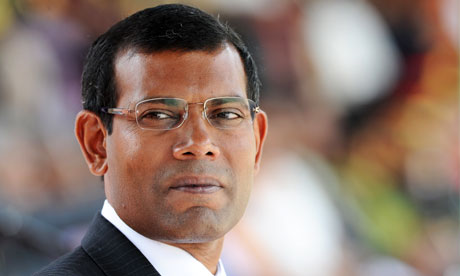
Maldives police say a mob stormed the Maldives national museum and smashed Buddhist statues, an act of vandalism which former president Mohamed Nasheed blamed on Islamic radicals.
“A mob entered the museum yesterday (Tuesday). They smashed many statues. This included some statues of Buddha,” police spokesman Ahmed Shiyam told AFP.
In an interview with AFP on Wednesday, Nasheed said a mob including Islamist hardliners had attacked the museum because they believed some of the statues inside were “idolatrous.”
Islam is the official religion of the Maldives and open practice of any other religion is forbidden and liable to prosecution.
Tuesday, 7 February 2012
Maldives President Resigns - Buddhist Image Vandalised
An angry protest last month followed a call by UN High Commissioner for Human Rights Navi Pillay for the Maldives to end floggings of women being punished for adultery.
Sunni Islam is the official religion in the Maldives and practising any other faith is forbidden.
Debates on religious issues have emerged since a group vandalised a monument with Buddhist imagery which had been gifted to mark a summit of The South Asian Association for Regional Cooperation (SAARC). Buddhism was part of the present Islamic republic's history.
Bhutan took a Buddhist story to the scenic island of Feydhoojetty, Adhoo, in the Maldives.
The story of four animal friends was an account Lord Buddha told his disciples. The four animals – an elephant, a monkey, a rabbit and a bird – once had a dispute over the ownership to a tree.
The biggest of them all, the elephant claimed it was his as he saw it first. The monkey claimed he had always been feeding on the fruits of the tree. The rabbit claimed he had been feeding on the leaves of the tree since it was a sapling. The bird then claimed that it had once eaten a fruit and spat out the seed which grew into the tree. The dispute was settled. The other three accepted the bird as their oldest brother and the four decided to share the tree in peaceful harmony.
This story of selfless friendship is depicted with the bird on top of the rabbit riding the monkey as it sits on the back of the elephant. This portrait is called the Thuenpa Puen Zhi or the “four harmonious brothers.”
FULL MOON - Tuesday 7th February 2012
Anyone who lives freed
from habits of clinging,
to past, present or future,
attaching to nothing,
is a great being.
‘Attaching to nothing’ isn’t about not having anything. It is about
the way we have things. If we drive a car with the steering wheel held
too tightly we become tired and don't drive so safely. If the wheel is
held too loosely we likewise run the risk of an accident. This verse
is telling us the past, the present and the future can be held in a
way that doesn’t lead to suffering. And it is with this clear
understanding that we practice letting go - not simply from an ideal
that we shouldn't cling.
Dhammapada v. 421
With Metta,
Bhikkhu Munindo
Subscribe to:
Posts (Atom)