Friday, 11 December 2015

NEW MOON - Positively Uncertain

Positively Uncertain

With an image of liberation as the goal
the wise abandon darkness and cherish light,
leave petty security behind
and seek freedom from attachment.
To pursue such release is difficult and rare, 
yet the wise will seek it, 
detaching themselves from obstructions, 
purifying heart and mind. 

Dhammapada v. 87-88

In this ever changing world it is understandable that we seek out security. But if we seek for this security in the wrong places, we'll end up disappointed. So long as we insist on clinging to fantasies, setting them up as facts, we create the causes for suffering. The fact, for instance of the uncertainty of all things, is something we really can't afford to ignore. Children do need some degree of protection until they have grown up, but as adults we need to let go of false security. Growing up spiritually means acknowledging when we are still holding to worn out stories, about ourselves and about the larger reality. It means that when we are tripped up by our naivety we don't rush to hide it, pretending we are more aware than we are. Rather we say thank you for the valuable teaching.

With Metta, Bhikkhu Munindo

Wednesday, 9 December 2015

A Poem That I Like

At our meetings members are encouraged to bring along any readings that have inspired them, yesterday John brought this poem by John Austin that he'd heard at a recent retreat he had attended.

Awareness-
her gaze is so constant,
our every move
watched
with such affection,
a ceaseless vigil
without condition
or agenda,
silent,
patient,
unrelenting in her embrace.

There is endless room in
the heart of this lover,
infinite space for whatever
foolishness we may
toss her way.

But she is also
crafty, this one-
a thieft who will steal away
everything we ever cherished,
all our beliefs,
all our ideas,
all our philosophies,
until nothing is left
but her shimmering
wakefulness,
this simple love
for what is.

Thursday, 3 December 2015

Syria, What is "Skilful"

Last night the British Parliament voted by 397 votes to 223 to bomb Daesh in Syria, one hour later RAF Tornados took off to bomb an oil refinery in Syria's Omar oil fields.

Those opposing the resolution argued passionately that civilians would inevitably be killed or injured in these raids and that we were entering a confused and multi-factional conflict with no clear long term aims or exit strategy.


Those arguing for airstrikes likewise argued fervently that the "evil" of Daesh must be confronted to protect both the peoples of Syria, Iraq and the citizens of this country.

Hilary Benn, the Labour Shadow Foreign Secretary, delivered a powerful speech in favour of taking action, “The question which confronts us in a very, very complex conflict is at its heart very simple. What should we do with others to confront this threat to our citizens, our nation, other nations and the people who suffer under the yoke, the cruel yoke, of Daesh? The carnage in Paris brought home to us the clear and present danger we face from them. It could have just as easily been London, or Glasgow, or Leeds or Birmingham and it could still be. And I believe that we have a moral and a practical duty to extend the action we are already taking in Iraq to Syria..................................

And we are here faced by fascists. Not just their calculated brutality, but their belief that they are superior to every single one of us in this chamber tonight, and all of the people that we represent. They hold us in contempt. They hold our values in contempt. They hold our belief in tolerance and decency in contempt. They hold our democracy, the means by which we will make our decision tonight, in contempt. And what we know about fascists is that they need to be defeated. And it is why, as we have heard tonight, socialists and trade unionists and others joined the International Brigade in the 1930s to fight against Franco. It’s why this entire House stood up against Hitler and Mussolini. It is why our party has always stood up against the denial of human rights and for justice. And my view, Mr Speaker, is that we must now confront this evil. It is now time for us to do our bit in Syria. And that is why I ask my colleagues to vote for the motion tonight.”

So, how do I as a Buddhist respond to this? I would like offer the story of Captain Jātaka from the Upāyakauśalya-sūtra..............

The Buddha, in a past life as a ship's captain named Jātaka, discovered a criminal on board who intended to kill the 500 passengers. If he told the passengers, they would panic and become killers themselves. With no other way out, he compassionately stabbed the criminal to death. Captain Jātaka saved the passengers not only from murder, but from becoming murderers themselves. Unlike him, they would have killed in rage and suffered hell. He saved the criminal from becoming a mass murderer and even worse suffering. He himself generated vast karmic merit by acting with compassion.

I am also grateful to Jack for his comment on our previous post on the Paris atrocities where he points out some of the complexity of the wider situation.

Saturday, 28 November 2015

Buddhist Animal Releasing Ritual Embraces the Environment


"Release life," (fang sheng) the practice of freeing caged animals into the wild to generate good karma, is now an environmentally friendly act of kindness.

“It works better with turtles — turtles just stand there and stare at you,” Shi Benkong said as he stood near the Great Lawn in Central Park on Tuesday near several cardboard boxes containing not turtles but restless, rustling birds.

Mr. Shi and other Buddhists chanted as Chinese-speaking monks sprinkled purifying water on the boxes holding the impatient birds, which were about to be freed as part of a religious ritual known as a life-release ceremony. In such rituals, a caged animal is freed into a public place as a way of generating positive karma for the animal as well as for the person releasing it.

The act enhances one’s karma and brings hope for the next life, said Mr. Shi, a resident monk at Grace Gratitude Buddhist Temple on East Broadway in Chinatown in Manhattan.

“It’s a win-win,” he said. “The animal is freed from being murdered, and we get good karma. The animal’s gratitude comes back to us.” While obscure to many New Yorkers, the practice has attracted the attention of environmental and animal-rights advocates, who are concerned that many of the released animals — often nonnative species purchased in Asian neighbourhoods throughout New York City — pose risks to local ecosystems and to the animals themselves.

“Mercy releases are a growing problem,” says Chris Harley, an ecologist at the University of British Columbia. Alien species, including snakehead fish and sea snails (which carry a potentially dangerous parasite), have turned up in waters around Vancouver, though the good Samaritans—Buddhist or otherwise—behind those invasions remain unidentified. “It is entirely possible that Buddhist releases were responsible,” he says, but these practices “are not well documented and are completely unregulated.”

Bent on finding a solution that is regulated, Benkong realised that certified wildlife rehabilitators often let animals go—unblessed. If Buddhists could join in, they could receive fang sheng credit without throwing a wrench into local ecosystems. He placed an ad in the New York Turtle and Tortoise Society’s newsletter and found two local turtle rehabbers, Patricia Johnson and Lorri Cramer, who were willing to work with him on the idea, which he called “compassionate release.”

“When you’re dealing with cultural traditions, sometimes you can’t say, ‘You can’t do that,’ or ‘This is wrong,’ ” Johnson says. “That’s what I love about the compassionate release: It’s taking something that serves a real spiritual service for a lot of people, and redirecting it just a little.”

Monday, 16 November 2015

Paris, a Buddhist Perspective


How should we respond to the events in Paris? As a Buddhist I feel that the only wise, the only skillful response is compassion.

Compassion for the victims, all the victims, the victims of the past, those whose suffering has produced the hatred of the present, the victims of Friday's terrorist attack, the victims to come and the potential victims who will not be killed, maimed or imprisoned but who will have their compassion killed their humanity maimed and their thoughts and opinions imprisoned in hatred.

The Syrian passport found alongside the dead body of one of the terrorists is significant. ISIS hates the compassion that Europe has shown to the victims of their bloody war; they loath the welcome shown to the refugees in many European countries, how better to sour the succour given than to sow suspicion and distrust precisely when the sheer numbers involved are causing disquiet.

The Buddha said that, "He abused me, he beat me, he defeated me, he robbed me,"— in those who harbour such thoughts hatred will never cease. "He abused me, he beat me, he defeated me, he robbed me," — in those who do not harbour such thoughts hatred will cease. For hatred does not cease by hatred at any time: hatred ceases by love, this is an unending truth." The Dhammapada verses 3 - 5.

The Dalai Lama was once asked why didn't you fight back against the Chinese. He replied that "war is obsolete, you know. Of course the mind can rationalise fighting back ... but the heart, the heart would never understand. Then you would be divided in yourself, the heart and the mind, and the war would be inside you."

Wednesday, 11 November 2015

NEW MOON - Nourishment

A deed is well-done
when upon reflection no remorse arises:
with joy one harvests its fruits.

Dhammapada 68

Our hearts are nourished by joy. As our physical being benefits from healthy food, so our spiritual being benefits from joy. We are all aware of how the body suffers when we consume junk food. Junk food for the heart is resentment, bitterness, envy and fear. We are wise to protect ourselves from them. When we can see clearly the benefits of consuming that which is truly nourishing, and the disadvantage of indulging in that which is harmful, we will naturally incline towards the wholesome.

Thursday, 5 November 2015

Delanceyplace and Meditation


I receive a daily email from Delanceyplace.com which is a brief excerpt or quote that they view as interesting or noteworthy, offered with commentary to provide context. There is no theme, except that most excerpts will come from a non-fiction work, mainly works of history, are occasionally controversial, and  hopefully  have a more universal relevance than simply the subject of the book from which they came.

Today's is about Meditation.........................

Today's selection -- from "Mind of the Meditator" by Matthieu Ricard, Antoine Lutz and Richard J. Davidson. Brain imaging shows that when we master a task such as playing an instrument or the advanced performance in a sport, specific parts of the brain are transformed -- certain neural pathways grow and strengthen. Neuroscientists have now shown that the same is true for mastery of meditation with direct benefits for improving focus, overcoming depression, dealing with pain and cultivating emotional well-being:

"A comparison of the brain scans of meditators with tens of thousands of hours of practice with those of neophytes and nonmeditators has started to explain why this set of techniques for training the mind holds great potential for supplying cognitive and emotional benefits. ...

"The discovery of meditation's benefits coincides with recent neuroscientific findings showing that the adult brain can still be deeply transformed through experience. These studies show that when we learn how to juggle or play a musical instrument, the brain undergoes changes through a process called neuroplasticity. A brain region that controls the movement of a violinist's fingers becomes progressively larger with mastery of the instrument. A similar process appears to happen when we meditate. Nothing changes in the surrounding environment, but the meditator regulates mental states to achieve a form of inner enrichment, an experience that affects brain functioning and its physical structure. The evidence amassed from this research has begun to show that meditation can rewire brain circuits to produce salutary effects not just on the mind and the brain but on the entire body. ...

 
A) 12 expert meditators had greater overlap of increased activation of attention-related brain regions. B)12 non-meditators had less overlap and activation. Orange hues equal higher correlation between individuals & activation. Blue hues equal little to no correlation between regions of activation.

"Neuroscientists have now begun to probe what happens inside the brain during the various types of meditation. Wendy Hasenkamp, then at Emory University, and her colleagues used brain imaging to identify the neural networks activated by focused- attention meditation. ... Advanced meditators appear to acquire a level of skill that enables them to achieve a focused state of mind with less effort. These effects resemble the skill of expert musicians and athletes capable of immersing themselves in the 'flow' of their performances with a minimal sense of effortful control. ...

Saturday, 31 October 2015

A Buddhist "Halloween"?

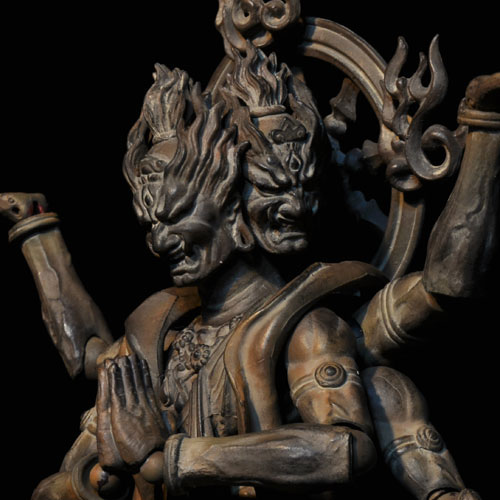
What with this being Halloween I thought a display of Buddhist demons and wrathful deities was in order.


 Mara, the Buddhist Devil, who represents temptation, sin, and death.


Hell demons. Buddhist "hell" (it's all in your own mind anyway) is not forever - everything is impermanent, even devils and gods.

Yama the Lord of Death. Although Yama is frightening, he is not evil. As with many wrathful iconic figures, his role is to frighten us to pay attention to our lives -- and the divine messengers -- so that we practice diligently.

In Buddhist lore, Hariti was originally a demon who slew human children in her desperation to feed her hundreds of children. In order to put a stop to this way of feeding, Gautama Buddha hid away one of her sons under a rice bowl, then pointed out to her that the suffering she was experiencing from losing one out of her hundreds of children could not be compared to that of the human mothers whose few children became her victims. Remorseful for her deeds, Hariti pledged to become the protector of childbirth and children. From then on, she and her brood fed on pomegranates as a substitute for human flesh.