On yesterday's edition of BBC radio 4's program Today Vishvapani (a member of the Triratna Buddhist group) offered his thoughts on the situation in Myanmar and the plight of the Rohingyas..........
"When I hear about the horrific repression that's being inflicted on the Muslim Rohingyas, I share many of the outraged feelings that others are expressing. But I feel something extra as well: shame that these things are being done by my fellow Buddhists for the sake of a Buddhist state and with the support of many Buddhist monks.
How did we get here? I don't want to over-simplify the situation in Rohingya, or generalise the responses of all Burmese Buddhists; but the question remains. The Buddha said that 'hatred is never overcome by hatred, but only by love'; so how has the faith he founded become associated with such brutality?"
Listen to the full talk here................
DOWNLOAD (Right click and "Save link as....")
Wednesday, 13 September 2017
Friday, 8 September 2017
Anniversaries and Milestones
I had a note in my diary for tomorrow that it's the 10th anniversary of the founding of the Alliance for Bhikkhunis which is a nice coincidence as the West Wight Sangha is also ten years old this year.
While looking at their website I noticed that it was the 7th International Bhikkhuni Day on Wednesday, so a slightly belated congratulations on this auspicious event which marks the end of a significant year — the 2600th year of the Bhikkhuni Sangha.
Between the full moon of September 2016 and the full moon of September 2017 there were worldwide commemorations of the 2600th anniversary of the bhikkhuni sangha.
In the fifth year of his ministry, the Buddha was staying at Vesali when he heard that his father, King Suddhodana, was ill. He decided to visit him again at Kapilavatthu to teach him the Dharma, and made the long journey. After hearing the Dharma, the king immediately attained arahantship and passed away peacefully seven days later. It was in this year that the order of nuns was founded at the request of Maha Pajapati Gotami, the aunt and foster mother of the Buddha.
Three times she approached the Buddha and asked him to ordain her into the Sangha, but each time the Buddha refused, giving no reason at all. After the Buddha had stayed at Kapilavatthu a while, he journeyed back to Vesali.
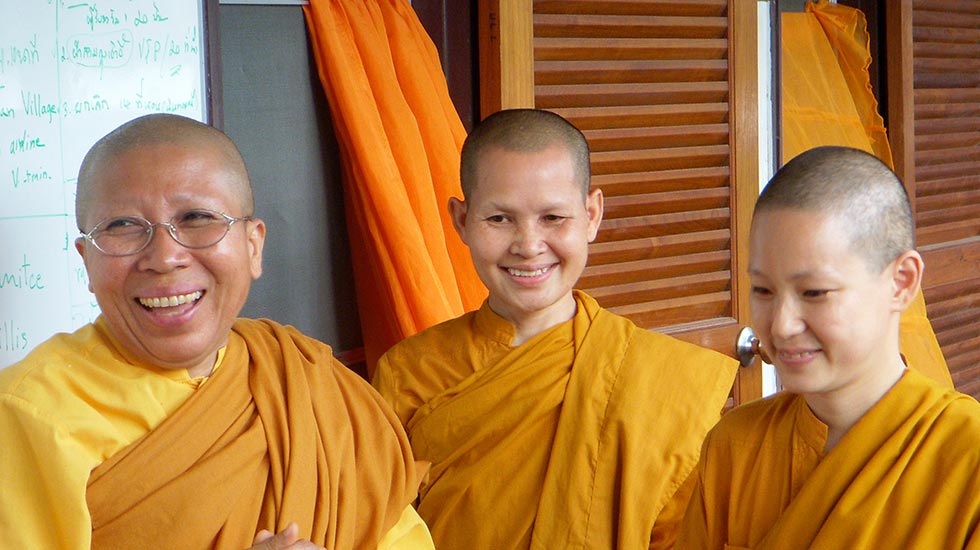
Pajapati Gotami was a determined lady, and would not be so easily discouraged. She had a plan to get her way. She cut her hair, put on yellow garments and, surrounded by a large number of Sakyan ladies, walked 150 miles from Kapilavatthu to Vesali. When she arrived at Vesali, her feet were swollen and her body was covered with dust. She stood outside the hall where the Buddha was staying with tears on her face, still hoping that the Buddha would ordain her as a nun.
Ananda was surprised to see her in this condition. "Gotami, why are you standing here like this?" he asked.
"Venerable Ananda, it is because the Blessed One does not give permission for women to become nuns," she replied.
"Wait here, Gotami, I'll ask the Blessed One about this," Ananda told her. When Ananda asked the Buddha to admit Maha Pajapati Gotami as a nun, the Buddha refused. Ananda asked three times and three times the Buddha refused.
So Ananda put the request in a different way. Respectfully he questioned the Buddha, "Lord, are women capable of realising the various stages of sainthood as nuns?"
"They are, Ananda," said the Buddha.
"If that is so, Lord, then it would be good if women could be ordained as nuns," said Ananda, encouraged by the Buddha's reply.
"If, Ananda, Maha Pajapati Gotami would accept the Eight Conditions* it would be regarded that she has been ordained already as a nun."
When Ananda mentioned the conditions to Maha Pajapati Gotami, she gladly agreed to abide by those conditions and automatically became a nun. Before long she attained arahantship. The other Sakyan ladies who were ordained with her also attained Arahantship.
based on Anguttara Nikaya 8.51
The establishment of an order of nuns with rules and regulations was an opportunity for women that the Buddha offered for the first time in the history of the world. No other spiritual leader had given such high religious status to women.
Tuesday, 5 September 2017
FULL MOON - Do Not Abandon Yourselves
To lose the company of those
with whom one feels at home is painful,
to be associated with those
whom you dislike is even worse;
so do not abandon yourselves
either to the company of those
with whom you feel at home
or those whom you dislike.
Dhammapada v. 210
Abandoning ourselves here means losing ourselves or losing perspective. It is thoroughly natural to experience warm-hearted caring for another, as the Buddha pointed out in his teachings on cultivating loving-kindness. What we add to that with our clinging, is unnatural, or at least unnecessary. And if we could stop clinging we might be more whole-heartedly caring. If we are not really attentive we could be harbouring some hesitation to truly care for others out of fear of becoming attached. With wise contemplation however, it is possible to care and at the same time be mindful of tendencies to attach. The only thing to be afraid of is the time it takes to remember to be mindful.
Monday, 4 September 2017
It Never Rains But it Pours!
A stalwart group of us gathered on the Duver at St Helens yesterday to participate in the annual Buddhist picnic when the various Buddhist groups from across the island meet for a relaxed late summer get together and alfresco meal. This year was a milestone as it was the 20th year that we had held the picnic.
It poured down................. all day.
So we went back to Matt's and had the "picnic" in his conservatory where we could fantasise we were communing with nature by looking out at the garden.
especially welcome at the Buddhist picnic.
It poured down................. all day.
So we went back to Matt's and had the "picnic" in his conservatory where we could fantasise we were communing with nature by looking out at the garden.
Saturday, 26 August 2017
The Isle of Wight, The Buddha, NCIS and The Ham
Everything is interconnected.
Our last post concerned the changes to Japan's traditional Buddhist inspired vegetarian cuisine brought about by Japan's contact with the West.
I've just come across this story about the "World’s Oldest Edible Ham" which is stored in the Isle of Wight County Museum!
Before you all book a ferry to come over to the island to see it pause a moment for the penny to drop that this museum is in Isle of Wight County, Virginia USA which featured in a previous post about the Isle of Wight appearing in an episode of NCIS.
To further add to the confusion and connections the museum is in the town of Smithfield a name any Brit immediately associates with Smithfield market, the largest wholesale meat market in the UK.
You can keep track of what the ham is doing here, yes they've got a webcam on it.......
Thursday, 24 August 2017
How the West Eroded Vegetarianism in Japan
I receive a daily email from Delanceyplace.com which is a brief excerpt or quote that they view as interesting or noteworthy, offered with commentary to provide context. There is no theme, except that most excerpts will come from a non-fiction work, mainly works of history, are occasionally controversial, and hopefully have a more universal relevance than simply the subject of the book from which they came.
Today's selection is from A Daughter of the Samurai by Etsu Inagaki Sugimoto. For centuries under Buddhism, vegetarianism was widely practised in Japan. That continued until the 1850s, when the expedition of Commodore Matthew Perry forced the opening of Japanese society and the Japanese began to tentatively adopt Western eating habits and other practises, (I particularly like the grandmother's final comment):
"I was about eight years old when I had my first taste of meat. For twelve centuries, following the introduction of the Buddhist religion, which forbids the killing of animals, the Japanese people were vegetarians. In late years, however, both belief and custom have changed considerably, and now, though meat is not universally eaten, it can be found in all restaurants and hotels. But when I was a child it was looked upon with horror and loathing.
"How well I remember one day when I came home from school and found the entire household wrapped in gloom. I felt a sense of depression as soon as I stepped into the 'shoe-off' entrance, and heard my mother, in low, solemn tones, giving directions to a maid. A group of servants at the end of the hall seemed excited, but they also were talking in hushed voices. Of course, since I had not yet greeted the family, I did not ask any questions, but I had an uneasy feeling that something was wrong, and it was very hard for me to walk calmly and unhurriedly down the long hall to my grandmother's room.
" 'Honourable Grandmother, I have returned,' I murmured, as I sank to the floor with my usual salutation. She returned my bow with a gentle smile, but she was graver than usual. She and a maid were sitting before the black-and-gold cabinet of the family shrine. They had a large lacquer tray with rolls of white paper on it and the maid was pasting paper over the gilded doors of the shrine.
"Like almost every Japanese home, ours had two shrines. In time of sickness or death, the plain wooden Shinto shrine, which honours the Sun goddess, the Emperor, and the nation, was sealed with white paper to guard it from pollution. But the gilded Buddhist shrine was kept wide open at such a time; for Buddhist gods give comfort to the sorrowing and guide the dead on their heavenward journey. I had never known the gold shrine to be sealed; and besides, this was the very hour for it to be lighted in readiness for the evening meal. That was always the pleasantest part of the day; for after the first helping of our food had been placed on a tiny lacquer table before the shrine, we all seated ourselves at our separate tables, and ate, talked and laughed, feeling that the loving hearts of the ancestors were also with us. But the shrine was closed. What could it mean?
"I remember that my voice trembled a little as I asked, 'Honourable Grandmother, is --is anybody going to die?'
"I can see now how she looked -- half amused and half shocked.
" 'Little Etsu-ko,' she said, 'you talk too freely, like a boy. A girl should never speak with abrupt unceremony.'
" 'Pardon me, Honourable Grandmother,' I persisted anxiously; 'but is not the shrine being sealed with the pure paper of protection?'
" 'Yes,' she answered with a little sigh, and said nothing more.
"I did not speak again but sat watching her bent shoulders as she leaned over, unrolling the paper for the maid. My heart was greatly troubled.
"Presently she straightened up and turned toward me. 'Your honourable father has ordered his household to eat flesh,' she said very slowly. 'The wise physician who follows the path of the Western barbarians has told him that the flesh of animals will bring strength to his weak body, and also will make the children robust and clever like the people of the Western sea. The ox flesh is to be brought into the house in another hour and our duty is to protect the holy shrine from pollution.
"That evening we ate a solemn dinner with meat in our soup; but no friendly spirits were with us, for both shrines were sealed. Grandmother did not join us. She always occupied the seat of honour, and the vacant place looked strange and lonely. That night I asked her why she had not come.
" 'I would rather not grow as strong as a Westerner -- nor as clever,' she answered sadly. 'It is more becoming for me to follow the path of our ancestors.'
"My sister and I confided to each other that we liked the taste of meat. But neither of us mentioned this to anyone else; for we both loved Grandmother, and we knew our disloyalty would sadden her heart."
Monday, 21 August 2017
NEW MOON - Foolishness
but not those who seek the beyond.
Just as they dismiss the well-being of others and cause harm,
fools also ruin themselves.
Dhammapada v. 355
Wealth can generate great benefit; it can also cause considerable harm. The Buddha referred to wealth as an intoxicant. As with power, wealth can be an opportunity for bringing increased goodness in the world, or it can inflate a sense of self-importance, making us deaf to those who might otherwise be genuinely helpful to us. The intoxicating effect of wealth tends to cause us to believe we can afford to listen only to those who give us praise. Such arrogance leads to further greed and the only thing that increases is foolishness.
Sunday, 6 August 2017
Only 4 Weeks Until the 20th Annual Buddhist Picnic!
It's hard to believe but this year's Annual Buddhist Picnic will be our 20th! As is traditional we will be holding the picnic on the first Sunday of September (that's the 3rd) on the Duver at St. Helens.
For those of you who have not been before , our picnic site is the other side of the road from the National Trust car park. Take the right hand turning by the signs showing the Duver and long stay beach front car parks, carry on a few hundred metres and the National Trust car park is on the left.
In the centre of the photo below you can see our original meeting place, the small oak tree. As previously reported, the tree has unfortunately died and as such now offers no shade.
However, Angie and Mark have found another oak tree about a hundred meters further on along the track you can see to the right of the photo. So just carry on along the path and look for some Buddhists sitting under another small oak tree! If you're on foot and coming from the St. Helen's side you can go to the end of Mill Road and come across on the causeway, the "new" oak tree will be facing you to your right.
Family, friends, children and dogs welcome. Bring vegetarian
food to share (don’t forget the fruit juices).
Subscribe to:
Posts (Atom)